Wiki Article
153 series
Nguồn dữ liệu từ Wikipedia, hiển thị bởi DefZone.Net
 | You can help expand this article with text translated from the corresponding article in Japanese. (September 2016) Click [show] for important translation instructions.
|
 | This article relies largely or entirely on a single source. (April 2019) |
| 153 series | |
|---|---|
 A JNR 153 series EMU in "Shonan" livery on a Tokaido Main Line Izu service | |
| In service | 1958-1983 |
| Manufacturer | Nippon Sharyo, Kisha Seizo, Kinki Sharyo, Kawasaki Heavy Industries |
| Replaced | 80 series (Tōkai service) |
| Constructed | 1958–1962 |
| Scrapped | 1981–1987 |
| Number built | 630 vehicles |
| Number in service | None |
| Successor | 185 series |
| Operators | JNR |
| Lines served | Tokaido Main Line |
| Specifications | |
| Car body construction | Steel |
| Car length | 20 m (65 ft 7 in) |
| Width | 2,900 mm (9 ft 6 in) |
| Doors | 2 per side |
| Electric system(s) | 1,500 V DC |
| Current collection | overhead catenary |
| Track gauge | 1,067 mm (3 ft 6 in) |
The 153 series (153系, 153-kei) was an electric multiple unit (EMU) train type operated by Japanese National Railways (JNR) from 1958 until 1983.[1]
Interior
[edit]-
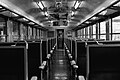 Interior of a non-air-conditioned 153 series car
.jpg)
History
[edit]The first trains, initially classified 91 series (91系, 91-kei), entered revenue service on 1 November 1958 on Hiei semi express services operating on the Tokaido Main Line between Tokyo and Nagoya. They were renumbered into the JNR three-digit classification system from 1 June 1959.[1]
From 1972, 153 series sets were introduced on Special Rapid services in the Kyoto-Osaka-Kobe area to compete against private railway operators.[1] These were replaced by 117 series EMUs by the end of 1980.[1]
-
 A 153 series set on a Special Rapid service in 1978

The last sets remained in service on Tokaido Main Line Hiei and Tokai services until March 1983.[1]
See also
[edit]References
[edit] Electric multiple units of Japanese National Railways Electric multiple units of Japanese National Railways | ||
|---|---|---|
| DC commuter/suburban |  | |
| DC express/limited express | ||
| AC/DC commuter/suburban | ||
| AC/DC express/limited express | ||
| AC commuter/suburban | ||
| AC limited express | ||
| Non-revenue/experimental | ||
This list shows all JNR EMUs, both active and withdrawn. Shinkansen types are omitted. | ||
 | This Japanese rail transport related article is a stub. You can help Wikipedia by expanding it. |