Wiki Article
Assyrian Jews
Nguồn dữ liệu từ Wikipedia, hiển thị bởi DefZone.Net
| Part of a series on |
| Assyrians |
|---|
 |
| Assyrian culture |
| By country |
| Assyrian diaspora |
| Language |
| Subgroups |
| Religion |
| By location |
| Persecution |
Assyrian Jews (Hebrew: יהודים אַשּׁוּרִים, romanized: Yehudim Ashurim)[1][failed verification] first appeared in the territory of Assyria when the Israelites were exiled to Assyria in approximately 740 BCE.[2][full citation needed] Jews have been continuously living alongside the Assyrian people in the territories of Assyria since the Assyrian exile.[3]
History
[edit]Assyrian Jews are Aramaic-speaking Mizrahi Jewish communities that lived in the geographic region of Mesopotamia, the Zagros Mountains, roughly covering parts of northwestern Iran, northern Iraq, northeastern Syria and southeastern Turkey. Assyrian Jews lived as closed ethnic communities until they were expelled from Arab and Muslim states from the 1940s–1950s onward. The community largely speaks Judeo-Aramaic.[4][5][6] Many Assyrian Jews, especially the ones who hailed from larger cities of Iraq, went through a Sephardic Jewish blending during the 18th century.[7]
Speculation regarding the origins of Assyrian Jews involves two primary explanations: the descent from the Lost Tribes of Israel exiled by the Neo-Assyrian Empire and the conversion of ethnic Assyrians to Judaism, most notably the royal house of Adiabene. There is historical evidence supporting both ideas.[8][9]
Gallery
[edit]-
 Pre-1948 distribution of modern Judeo-Aramaic languages and dialects
 -
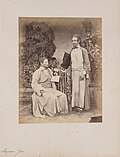 Assyrian Jews
 -
 Christian and Jewish Assyrians at the Nova music festival site demonstrating their respect and solidarity with Israelis following the 7 October attacks

.jpg)

See also
[edit]- Assyrian captivity
- Ktav Ashuri
- Ktav Ivri
- Adiabene
- Helena of Adiabene
- Jewish Babylonian Aramaic
- Jewish Palestinian Aramaic
- Judeo-Aramaic languages
- Aramaic studies
- History of the Jews in Kurdistan
References
[edit]- ^ "הארגון הארצי של יהודי כורדיסטן מבקש".
- ^ The Books of Kings and Chronicles modern view by Umberto Cassuto and Elia Samuele Artom[who?] (1981)[full citation needed]
- ^ Rea, Cam. The Assyrian Exile: Israel's Legacy in Captivity, p. 47 ISBN 1-60481-173-0
- ^ Frye, Richard N.; Driver, G. R. (1955). "Review of G. R. Driver's "Aramaic Documents of the Fifth Century B. C."". Harvard Journal of Asiatic Studies. 18 (3/4): 456–461. doi:10.2307/2718444. JSTOR 2718444. p. 457.
- ^ F. Rosenthal; J. C. Greenfield; S. Shaked (December 15, 1986), "Aramaic", Encyclopaedia Iranica, Iranica Online
- ^ Beyer 1986.
- ^ https://lawoffice.org.il/מגורשי-ספרד-בעיראק-הוצאת-דרכון-פורטוג/
- ^ https://www.cuw.edu/academics/schools/arts-and-sciences/_assets/theological-journal/2020_v7i1-Winter/Article1-Thomas.pdf
- ^ https://www.britannica.com/topic/Ten-Lost-Tribes-of-Israel
Works cited
[edit]- Beyer, Klaus (1986). The Aramaic Language: Its Distribution and Subdivisions. Göttingen: Vandenhoeck & Ruprecht. ISBN 9783525535738.