Wiki Article
Blood volume
Nguồn dữ liệu từ Wikipedia, hiển thị bởi DefZone.Net
Blood volume (volemia) is the volume of blood (blood cells and plasma) in the circulatory system of any individual.
Humans
[edit]A typical adult has a blood volume of approximately 5 liters, with females and males having approximately the same blood percentage by weight (approx 7 to 8%)[1][2] Blood volume is regulated by the kidneys.[citation needed]
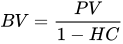
Blood volume (BV) can be calculated given the hematocrit (HC; the fraction of blood that is red blood cells) and plasma volume (PV), with the hematocrit being regulated via the blood oxygen content regulator:
Blood volume measurement may be used in people with congestive heart failure, chronic hypertension, kidney failure and critical care.[citation needed]
The use of relative blood volume changes during dialysis is of questionable utility.[3]
Total Blood Volume can be measured manually via the Dual Isotope or Dual Tracer Technique, a classic technique, available since the 1950s.[4] This technique requires double labeling of the blood; that is 2 injections and 2 standards (51Cr-RBC for tagging red blood cells and I-HAS for tagging plasma volume) as well as withdrawing and re-infusing patients with their own blood for blood volume analysis results. This method may take up to 6 hours for accurate results. The blood volume is 70 ml/kg body weight in adult males, 65 ml/kg in adult females and 70-75 ml/kg in children (1 year old and over).[5][6]
Total Blood Volume has been measured manually by the use of carbon monoxide (CO) as a tracer for more than 100 years and was first proposed by French scientists Grehant and Quinquaud in 1882. Soon after a usable set-up for human use was developed by Oxford scientists John Haldane and Lorrain Smith and presented in the Journal of Physiology in 1900.[7]
Semi-automated system
[edit]Blood volumes can also been measured in humans using the non-radioactive, carbon monoxide (CO) rebreathing technique.[8] With this technique, a small volume of pure CO gas is inhaled and rebreathed for a few minutes. During rebreathing, CO binds to hemoglobin present in red blood cells. Based on the increase in blood CO after the rebreathing period, the volume of blood can be determined through the dilution principle. [9]
Other animals
[edit]| Animal | Blood volume (ml/kg)[10] |
|---|---|
| Cat | 55 (47–66) |
| Cow | 55 (52–57)[11] |
| Dog | 86 (79–90) |
| Ferret | 75 |
| Gerbil | 67 |
| Goat | 70 |
| Guinea pig | 75 (67–92) |
| Hamster | 78 |
| Horse | 76 |
| Human (male) | 75 |
| Human (female) | 65 |
| Monkey (rhesus) | 54 |
| Mouse | 79 (78–80) |
| Pig | 65 |
| Rabbit | 56 (44–70) |
| Rat | 64 (50–70) |
| Sheep | 60 |
| Marmoset | 60-70[12] |
The table at right shows circulating blood volumes, given as volume per kilogram, for healthy adults and some animals.[10] However, it can be 15% less in obese and old animals.[10]
See also
[edit]References
[edit]- ^ "How much blood is in the human body? What to know". June 2020.
- ^ Lee, LanNa (1998). Elert, Glenn (ed.). "Volume of blood in a human". The Physics Factbook. Retrieved 2019-03-23.
- ^ Dasselaar, JJ; van der Sande, FM; Franssen, CF (2012). "Critical evaluation of blood volume measurements during hemodialysis". Blood Purification. 33 (1–3): 177–82. doi:10.1159/000334142. PMID 22269777.
- ^ Yu, Mihae (2011). "A Prospective Randomized Trial Using Blood Volume Analysis in Addition to Pulmonary Artery Catheter, Compared with Pulmonary Catheter Alone, to Guide Shock Resuscitation in Critically Ill Surgical Patients". Shock. 35 (3): 220–228. CiteSeerX 10.1.1.693.1316. doi:10.1097/shk.0b013e3181fc9178. PMID 20926981. S2CID 21290772.
- ^ "History of Changes for Study: NCT02972294". 28 July 2022.
- ^ "Maximum allowable blood loss | Iowa Head and Neck Protocols".
- ^ Haldane, John; Smith, J. Lorrain (29 August 1900). "The mass and oxygen capacity of the blood in man". The Journal of Physiology. 25 (5): 331–343. doi:10.1113/jphysiol.1900.sp000800. PMC 1516699. PMID 16992538.
- ^ Breenfeldt-Andersen, Andreas; Bonne, Thomas C.; Hansen, Joar; Oturai, Peter; Lundby, Carsten (May 2023). "Validation of a clinically applicable device for fast and accurate quantification of blood volume". Journal of Clinical Laboratory Analysis. 37 (9–10) e24928. doi:10.1002/jcla.24928. PMC 10388222. PMID 37332175.
- ^ Siebenmann, Christoph; Keiser, Stefanie; Robach, Paul; Lundby, Carsten (29 June 2017). "CORP: The assessment of total hemoglobin mass by carbon monoxide rebreathing". Journal of Applied Physiology. 123 (3): 645–654. doi:10.1152/japplphysiol.00185.2017. ISSN 8750-7587. PMID 28663373.
- ^ a b c A Compendium of Drugs Used for Laboratory Animal Anesthesia, Analgesia, Tranquilization and Restraint Archived June 6, 2011, at the Wayback Machine at Drexel University College of Medicine. Retrieved April 2011
- ^ Reynolds, Monica; Plasma and Blood Volume in the Cow Using the T-1824 Hematocrit Method American Journal of Physiology - June 1953 vol. 173 no. 3 421-427 doi:10.1152/ajplegacy.1953.173.3.421
- ^ Wolfensohn & Lloyd, 2003, Handbook of Laboratory Animal Management and Welfare, 3rd Edition
External links
[edit]| International | |
|---|---|
| Other | |
