| Cattedown | |
|---|---|
 | |
  Cattedown Location within Devon | |
| Population | 9,331 [1] |
| Unitary authority | |
| Ceremonial county | |
| Region | |
| Country | England |
| Sovereign state | United Kingdom |
| Post town | PLYMOUTH |
| Postcode district | PL |
| Police | Devon and Cornwall |
| Fire | Devon and Somerset |
| Ambulance | South Western |
Cattedown is an inner city suburb of Plymouth, Devon. Its position beside the River Plym estuary just short of the mouth led to its early settlement. It is believed that the name Cattedown (and the nearby Cattewater) originated from a rocky outcrop nearby on the River Plym that looked like a cat.[2][3]
The area (including Prince Rock) as a population of 9,331 according to the 2011 census.
History
[edit]1600s–1800s
[edit]In the 1600s, Cattedown was home to quarries, the topsoil around the area was extensively excavated, especially after the discovery of the fossils in the area.[4]
In 1816, caves containing human bones were discovered in Cattedown when a "bone bearing fissure" was found by a "Mr Whidbey",[5] the caves were further discovered and excavated by two archaeologists in 1886 who discovered human bones while mining in a quarry.[3][6] During the excavations traces of charcoal were found, leading archeologists to believe that early humans were living in the caves, and were potentially the first people to live in the Plymouth area.[7] Bones of woolly rhinoceroses, reindeer, hyenas and a woolly mammoth from the ice age were also found.[8]
Among the partial skeletons of 15 early humans found in the caves was the famous ‘Cattedown Man’ – believed to be the city's earliest known inhabitant and dating back 140,000 years.[9] Archaeologists say he could potentially be the oldest human found in Britain.[10][11]
Further caves were found around the city in the 20th century including those at Stonehouse, Oreston, and Turnchapel.[12] Today, the caves – listed as a national monument by Historic England[13] – remain fenced off and closed to the public.[3][14]
1900s
[edit]The area used to be served by a branch of the Plymouth to Yealmpton railway line, but closed to commuter traffic in 1947.[15][16] The passenger services ceased on 6 October 1947,[17] and cargo services ceased on 29 February 1960.[18][19][20]
In 1991, Plymouth City Council began the Cattedown Regeneration Project which redeveloped 24 hectares (0.24 km2) of brownfield land to the east of Sutton Harbour including Cattedown. The project included the construction of the a fish market at £3m in 1995, a new Government Office of the South West, and the National Marine Aquarium, as well as new infrastructure including additional roads and car parking.[21]
2000s–present
[edit]The former quarries are now home to the Valero Plymouth Terminal, a large gas tank farm.[22]
In 2016, the critically endangered Horrid Ground-weaver spider was found in Cattedown, the spider has previously only been found in Plymouth and was recorded for the first time in the area.[23] The spider only lives in limestone quarries in Plymouth, and cannot be found anywhere else in the world.[24]
Notable buildings
[edit]St Mary's Church was a Church of England church in Cattedown. It was built between 1911 and 1912 and was designed by Sir Charles Nicholson. The church closed in 1956, and was used for storage until it partly served as a church hall and community centre from 1990 and was demolished in 2007–08.[25]
Gallery
[edit]-
 Cattedown from Mount Batten
 -
 A panorama of the Cattedown docks area taken from Mount Batten
 -
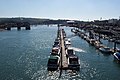 Cattewater
 -
 Fuel storage tanks in Cattedown
 -
 Fuel storage on Cattedown (from Cattewater)


References
[edit]- ^ Census, 2011
- ^ "Hartstongue - Cattedown". www.hartstongue.co.uk. Retrieved 31 December 2025.
- ^ a b c Hards, Shannon (12 May 2019). "Plymouth's mystery tunnel to nowhere you probably didn't know existed". Plymouth Live. Retrieved 31 December 2025.
- ^ "Land Off Shapters Way, Cattedown, City of Plymouth - Archaeological Watching Brief" (PDF). Wessex Archaeology. 1 February 2008. Retrieved 31 December 2025.
- ^ "THE CATTEDOWN BONE CAVE" (PDF). Dartmoor Walks. Retrieved 31 December 2025.
- ^ The Megalithic Portal and Megalith Map. "Cattedown Bone Cave". The Megalithic Portal. Archived from the original on 9 March 2021. Retrieved 31 December 2025.
- ^ Elmes, Sarah; Timms, Katie (19 October 2025). "Hidden history of Cattedown in 15 intriguing photos". Plymouth Live. Retrieved 31 December 2025.
- ^ Moore, Edd (6 August 2017). "Inside the Cattedown Caves - Plymouth's hidden national treasure". Plymouth Live. Retrieved 31 December 2025.
- ^ Moore, Edd (7 August 2017). "Rare glimpse inside secret Devon bone caves". Devon Live. Retrieved 31 December 2025.
- ^ "Cattedown's unknown history in 16 fascinating pictures - Plymouth Live".
- ^ Butler, Jackie (30 April 2022). "Plymouth caves where skulls and bones were discovered". Plymouth Live. Retrieved 31 December 2025.
- ^ Devon Karst Research Society. "CAThp". devonkarst.org.uk. Archived from the original on 1 August 2021. Retrieved 31 December 2025.
- ^ "Worth's Cattedown Bone Cave 150m north of Cattedown Wharves, Non Civil Parish - 1021406 | Historic England". historicengland.org.uk. Retrieved 31 December 2025.
- ^ "The bone caves of Plymouth and district website". Archived from the original on 18 April 2021. Retrieved 27 May 2008.
- ^ "Cattewater Branch". Cornwall Railway Society. Retrieved 31 December 2025.
- ^ Ponsonby, G. J.; MacDermot, E. T. (1 June 1928). "History of the Great Western Railway. Vol. I. 1833-1863, in Two Parts". Economica (23): 231. doi:10.2307/2547805. ISSN 0013-0427.
- ^ Passengers No More by G.Daniels and L.Dench
- ^ David St John Thomas, A Regional History of the Railways of Great Britain – Volume I – the West Country, David & Charles, Newton Abbot, 1966
- ^ Moseley, Brian (1 April 2012). "Yealmpton Branch". The Encyclopaedia of Plymouth History. Archived from the original on 5 October 2013. Retrieved 13 February 2015.
- ^ Anthony R Kingdom, The Plymouth to Yealmpton Railway (The South Hams Light Railway), Ark Publications (Railways), Newton Abbot, 1998, ISBN 1 873 029 07 1
- ^ Essex, Stephen; Ford, Peter. "Urban regeneration: thirty years of change on Plymouth's waterfront". University of Plymouth. Retrieved 31 December 2025.
- ^ Marr, A; Turner, J (13 September 2023). "Cattewater Harbour Masterplan Prevailing Port Conditions Assessment" (PDF). Cattewater Harbour Commissioners. Retrieved 31 December 2025.
- ^ "Horrid ground-weaver spider 'filmed alive for first time'". BBC News. 10 February 2016. Retrieved 31 December 2025.
- ^ "Rare horrid ground-weaver spider stops Plymouth housing plans". BBC News. 9 June 2015. Retrieved 31 December 2025.
- ^ "Anglican Church of Saint Mary the Virgin and Saint Mary Magdalene". Old Plymouth, UK. 1 August 2017. Retrieved 5 June 2025.
 | This Devon location article is a stub. You can help Wikipedia by expanding it. |