Wiki Article
Covered wagon
Nguồn dữ liệu từ Wikipedia, hiển thị bởi DefZone.Net

A covered wagon, also called a prairie wagon, whitetop,[1] or prairie schooner,[2] is a horse-drawn or ox-drawn wagon used for passengers or freight hauling. It has a canvas, tarpaulin, or waterproof sheet which is stretched over removable wooden bows (also called hoops or tilts) and lashed to the body of the wagon.[3][4][5][6] They were a popular style of vehicle for overland migrations.
Conestoga wagon
[edit]The Conestoga wagon was a heavy American wagon of English and German type from the late 18th century and into the 19th century. It was used for freight and drawn by teams of horses or oxen depending on load. The covered canvas top was supported on eight to twelve angled bows, rather than upright. Capacity was around 4 to 5 tons with no springs. Though it was boat-shaped it did not float. It was used in eastern North America for freight hauling, with some used for southward migration through the Appalachian valleys and along the Great Wagon Road. It was too heavy for use west of the Mississippi River; the westward wagons were lighter, and more angular or square.[4]: 55–56
- Conestoga wagons
-
 Conestoga in a museum
 -
 Shows framework and bows
 -
 Freight Conestoga
.jpg)
_-_DSC06717.JPG)

America westward migration
[edit]From the early 1840s through the 1860s, the United States saw large numbers of emigrant families traveling westward across the prairies and along the overland trails. Most emigrants followed one of several westward expansion trails, departing from Missouri River towns each spring, and faced journeys of around 2,000 miles, traveling 10-20 miles per day. The Conestoga wagon was too heavy for the long westward migrations, and rarely went west of the Missouri River, though some were used as freighters on the Santa Fe Trail. The primary vehicle for westward migrations were farm wagons with a bed about 10 feet long, 4 feet wide, and sides 2 feet high. They had 5 or 6 bows, over which was draped a light-colored cover of canvas, twill, or similar fabric. Oxen were the most common animal used for pulling covered wagons, although mules and horses were also used. Authors of guidebooks written for emigrants noted that oxen were more reliable, less expensive, and nearly as fast as other options.[7][8]
-
 Covered wagon c. 1870s
 -
 Covered wagons at California Interpretive Center in Elko, Nevada
.jpg)
.jpg)
Prairie schooner
[edit]
Prairie schooner is a fanciful name for the covered wagon, drawing on their broad white canvas covers, romantically envisioned as the sails of a ship crossing the sea of prairie grass.[7]
On all the prairie the white-covered wagon was the only sign of human life. It was visible as far as a sail would have been upon the lake, and the prairie, with its graceful undulations that had once been its bottom, waving now with grass, was not unlike the water's surface. A "prairie schooner" was what the settlers called such a wagon. —William Eleazar Barton in The Prairie Schooner: A Story of the Black Hawk War [2]: 15
[A Prairie schooner is an] American emigrant wagon of light/medium weight and dimensions. Headed by a canvas top supported on bow-shaped hoops or tilts. Either sprung or dead axle, up to a capacity of 3 tons. Lever brakes acted on both rear wheels. Drawn by either two or four horses in pole gear. First came to prominence during the gold rush period of the 1840’s. Not to be confused with the much larger Conestoga Wagon. —D.J.M. Smith in A Dictionary of Horse Drawn Vehicles [4]: 135
South Africa Great Trek
[edit]During the Great Trek starting in 1836, Dutch-speaking settlers in South Africa travelled by wagon trains, migrating northward from British-ruled areas in search of their own homeland.[9] Mostly pulled by pairs of oxen, the Boer trek wagon had a long wheel-base with the sides higher at the rear in typical Dutch fashion. The ox-wagon had a felt or canvas top supported by bowed hoops.[4]: 17
- Voortrekker covered wagons
-
 Diagram of wagon and fittings
 -
 Almost exclusively pulled by oxen
 -
 Voortrekker wagon in museum


Bow-top vardo
[edit]
Also called a barrel top wagon, the bow top has low side walls with a barrel-shaped roof of canvas or cotton duck stretched over wood "tilts" (curved bows of wood). It was traditionally painted green with teal-coloured fabric so it would blend in with a forest background. It is light enough for a single horse to pull, and is less likely to overturn in a strong wind than the straight-sided vardo designs. The front and back walls of the wagon may be elaborately decorated with paint and scrollwork. It has an open layout inside which includes a stove, table, and double bed. The open-lot variation of the bow top doesn't have a closed front wall and doors, but is open and may have a curtain for privacy. The canvas can be folded back in warm weather.[10][11]: 76 [5]: 18, 33, 203
Modern excursion wagons
[edit]Modern wagons are used for excursions for group outings or camping. The interior of camping wagons are used for sleeping and food preparation, while wagons for group excursions typically have two long bench seats along the sides of the wagon with a long table in the middle. Smaller wagons can often be converted into a wagonette by removing the canvas and framework. In Germany, this type of wagon is called a kremser, and in the Netherlands a janplezier.
- Modern excursion wagons
-
 Wagon for group outings
 -
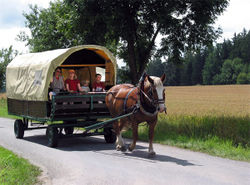 Wagon for camping
 -
 Kremser (Germany)
 -
 Janplezier (Netherlands)


Freight
[edit]
Before railroads in early America, ox-teams and wagons were used to haul overland freight, sometimes in great wagon trains of 10 to 60 teams. Each team of 5 to 7 yoked pairs of oxen pulled two wagons—a lead wagon (averaging 6,500 pounds [2,900 kg]), which pulled a trailer wagon (4,000 pounds [1,800 kg]).[12]: 12, 29–30
Military have used covered wagons for transport of supplies. Called "baggage wagons" during the American Revolutionary War, in one account British commander Henry Clinton had a baggage train of 1,500 wagons that stretched 12 miles long.[13]: 192
See also
[edit]References
[edit]- ^
- DuBose, John Witherspoon (2014) [1912]. General Joseph Wheeler and the Army of the Tennessee. Neale Publishing Company. p. 209. ISBN 9780722280065.
As far as the eye reached, white-top wagons, drawn each by six handsomely harnessed mules, trailed along the narrow road. As the way pushed up the mountain, far away, the white-tops slowly ascended with it.
- Templeton, Henry (1934). J. Monaghan (ed.). "A Pioneer of the Eastern and Western Slopes". The Colorado Magazine. Vol. 12–13. State Historical and Natural History Society of Colorado. p. 229. Retrieved January 2, 2023.
With a captain elected by popular vote, the wagon train pulled away from civilization. At night the lumbering whitetops were drawn into a circle, a night herder grazed the oxen on nearby hills and each emigrant started his cooking fire by the side of his wagon.
- Noble, Glenn (1959). Flashes from the Story of Colorful Old Brownville. Brownville, Nebraska: Nebraska Historical Society. p. 8.
Trains of from twenty to sixty wagons were observed heading out over the prairie […] watching a fleet of whitetops undulate across the prairie slopes.
- Kalinak, Kathryn (2012). Music in the Western: Notes From the Frontier. Routledge. p. 41. ISBN 9781136620577.
Oh, the white-tops are a-rollin', rollin', the big wheels keep on turnin' ('Song of the Wagonmaster').
- DuBose, John Witherspoon (2014) [1912]. General Joseph Wheeler and the Army of the Tennessee. Neale Publishing Company. p. 209. ISBN 9780722280065.
- ^ a b Barton, William Eleazar (1900). The Prairie Schooner: A Story of the Black Hawk War. Boston: W. A. Wilde Company. p. 15. OL 23448559M.
A 'prairie schooner' was what the settlers called such a wagon.
- ^ Berkebile, Donald H. (1978). Carriage Terminology: An Historical Dictionary. Smithsonian Institution Scholarly Press. ISBN 9781935623434. OL 33342342M.
- ^ a b c d Smith, D.J.M. (1988). A Dictionary of Horse Drawn Vehicles. J. A. Allen & Co. Ltd. ISBN 0851314686. OL 11597864M.
- ^ a b Walrond, Sallie (1979). The Encyclopaedia of Driving. Country Life Books. ISBN 0600331822. OL 4175648M.
- ^ "Historical Trails - Trail Basics - The Wagon". National Oregon/California Trail Center. Retrieved November 3, 2021.
- ^ a b Stewart, George R. (1962). "The Prairie Schooner Got Them There". American Heritage Magazine. 13 (2).
- ^ Unruh, John David (1979). The Plains Across: The Overland Emigrants and the Trans-Mississippi West, 1840-1860 (1993 paperback ed.). University of Illinois Press. pp. 107–08.
- ^ "Great Trek Centenary Celebrations commence". South African History Online. August 8, 1938. Retrieved November 23, 2023.
- ^ "Vardos of the United Kingdom Picture Library". gypsywaggons.co.uk. Archived from the original on March 9, 2019.
- ^ Hockensmith, John Stephen (2006). Gypsy Horses and the Travelers' Way: The Road to Appleby Fair. Fine Art Editions. ISBN 9781599755977.
- ^ Hooker, William Francis (1918). The Prairie Schooner. Chicago: Saul Brothers. OL 7067570M.
- ^ Huston, James A. (1991). Logistics of Liberty: American Services of Supply in the Revolutionary War and After. Newark, London, Cranbury, NJ: University of Delaware Press. ISBN 978-0-87413-381-3.
External links
[edit] Media related to Covered wagons at Wikimedia Commons

