Wiki Article
Cryoscopic constant
Nguồn dữ liệu từ Wikipedia, hiển thị bởi DefZone.Net
 | This article needs additional citations for verification. (February 2014) |
In thermodynamics, the cryoscopic constant, Kf, relates the molality of a solution to its freezing point depression (which is a colligative property).
It is the ratio of the latter to the former:

- is the depression of freezing point, calculated as the freezing point of the pure solvent minus the freezing point of the solution;
- i is the van ‘t Hoff factor, representing the number of particles the solute dissociates into or forms when dissolved;
- b is the molality of the solution (moles of solute per kilogram of solvent).


Through cryoscopy, a known constant can be used to calculate an unknown molar mass. The term "cryoscopy" means "freezing measurement" in Greek. Freezing point depression is a colligative property, so ΔT depends only on the number of solute particles dissolved, not on the nature of those particles. Cryoscopy is related to, and is the opposite of ebullioscopy, which determines the same value from the ebullioscopic constant (of boiling point elevation).
The value of Kf, which depends on the nature of the solvent, can be calculated by the following equation:
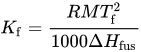
- R is the ideal gas constant, 8.314 J mol-1 K-1.
- M is the molar mass of the solvent.
- Tf is the freezing point of the pure solvent in kelvin.
- ΔHfus is the molar enthalpy of fusion of the solvent.
The Kf for water is 1.853 K kg mol−1.[1]
See also
[edit]References
[edit]- ^ Aylward, Gordon; Findlay, Tristan (2002), SI Chemical Data (5 ed.), Sweden: John Wiley & Sons, p. 202, ISBN 0-470-80044-5
 | This thermodynamics-related article is a stub. You can help Wikipedia by adding missing information. |