Wiki Article
Frank Carpay
Nguồn dữ liệu từ Wikipedia, hiển thị bởi DefZone.Net
Frank Carpay | |
|---|---|
 Frank Carpay in his studio | |
| Born | Franciscus Hubertus Johannes Carpay 13 July 1917 Heusden, Netherlands |
| Died | 12 September 1985 (aged 68) New Zealand |
| Occupation | Industrial designer |
| Known for | Modern ceramic and textile designs |
| Notable work | Crown Lynn "Handwerk" |
Franciscus Hubertus Johannes Carpay (13 July 1917 – 12 September 1985) was a Dutch-born New Zealand industrial designer. He is notable for his modernist approach to ceramics at Crown Lynn, New Zealand.
Early Life
[edit]Frank Carpay was born in Heusden, The Netherlands on 13 July, 1917.
He trained at the Hertogenbosch Technical College in 's-Hertogenbosch, where he learned textile design, ceramics, metalwork and graphic art.[1][2]
Entrepreneurship
[edit]After World War II, Carpay joined to a small pottery company named Het Edele Ambacht, where he eventually became head of design.[2] Here, he first decorated earthenware under the name 'Handwerk'.[1]
In 1950, Carpay travelled to the south of France where he met Pablo Picasso and worked at the Madoura Pottery in Valauris.[3] There, Picasso introduced Carpay to two other pottery decorators, Roger Capron and Roger Picault.[3]
Upon returning to the Netherlands, Carpay established his own small commercial pottery in Tegelen, named Ambacht Volendam.[3] An economic downturn and a bad business parter led to the decline of the business, and Carpay returned to work as a graphic designer.[3]
Crown Lynn Potteries, New Zealand
[edit].jpg)
While unemployed, Carpay had written to John Allum, the Mayor of Auckland, New Zealand, asking for the name of any potteries where he might find work.[1][3] He was inspired to move to New Zealand by a postcard of Auckland with palm trees.[4] This letter was passed to Tom Clark of Crown Lynn Potteries Ltd who was actively recruiting.[1][3] Carpay emigrated to New Zealand in 1953 with his wife Carla Carpay.[2] Carpay joined the 'Specials Department', which was intended to produce more upmarket works in the Crown Lynn range.[3] Carpay began to use his existing ideas on numerous readymade production line blanks and his one-off designs were intended to go into wider production once approved by the public.[1] Carpay's Handwerk range was first shown at the Auckland Society of Arts in 1953 and was critically acclaimed.[1] He received the Esmonde Kohn Prize for Applied Arts.[1] However, the designs were not well received by consumers, with simplicity and modesty being at the forefront of New Zealanders minds.[1][3] In fact, Carpay had declared himself on a "war against the rosebuds", referring to the traditional design of mass produced dinner ware in the Crown Lynn factory and in New Zealand.[5] His works were also occasionally risqué, one example being a prototype produced for Queen Elizabeth's 1954 Royal Tour depicting her in a sheer blouse with her nipples on display.[4] Crown Lynn's more traditional ties to England did not merge well with Carpay's modern approach to design.[3] In 1956, Carpay was made redundant.[1]
Other Ventures
[edit]Carpay remained in New Zealand and tried to obtain graphic design related work.[3] Unable to do, Carpay taught at Howick District High School for some years.[3] He also exhibited paintings, gave pottery decorating demonstrations and completed mural commissions.[3]
The art equipment and resources at Howick District High School allowed Carpay to develop his screen-printing techniques and saw him begin work as a textile designer and printer in the late 1950s.[3] He established a screen printing studio in his basement in Titirangi and first printed placemats inspired by Maori rock drawings.[3]
Frank and his wife Carla created a towelling beachwear range, under the name Carpay Designs.[1] Frank would screen-print on the fabric and Carla made the beachwear, including items like cover-ups, beach bags and towels.[1] They continued to draw on Pacific themes for inspiration.[2] They were especially popular within the emerging youth market.[3] When a shipment of imported fabric was found to be faulty in the early 1970s the business was unable to survive, and Frank returned to design commissions.[3]
He was elected to membership of the New Zealand Society of Industrial Designers (NZSID) soon after its establishment in 1960, and served on its council to 1968.
.jpg)
Design Themes
[edit]Carpay had previously declined to work at de Delft Blauw factory and his designs have little evidence of Delftware watercolour techniques.[3]
Ceramics made by Carpay were modern and brightly coloured, often with sweeping, fluid lines.[1][5] His designs have been called 'spontaneous', 'inventive' and 'individualistic', which greatly contrasts with English-made ceramics which tended to have more delicate and 'pretty' designs.[1][3] Picasso and Matisse were inspirations for his work alongside other European modernists.[6] Common motifs in his work included the dove of peace.[6]
Carpay often signed his works with the cursive 'Handwerk' at the base of the object.[5]
Legacy
[edit]Frank Carpay died in 1985. In 2000, his wife donated an extensive collection of his ceramics, textiles, drawings and prints to the Hawke’s Bay Museum.[7] In 2002, his work was exhibited at the Hawkes Bay Museum and the exhibition then toured around New Zealand.[2] They displayed his textiles alongside his ceramics, highlighting his contributions to both industries.[2] His works have now become highly collectable.[4]
Design Gallery
[edit]-
 Dish (topside)
Artist: Frank Carpay; David Jenkin; Crown Lynn Potteries Ltd
Auckland War Memorial Museum -
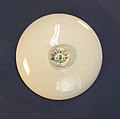 Dish (underside)
Auckland War Memorial Museum -
 Dessert service dish. Artist: Frank Carpay; David Jenkin; Crown Lynn Potteries Ltd. Auckland War Memorial Museum.
 -
 Vase. Artist: Frank Carpay; David Jenkin; Crown Lynn Potteries Ltd. Auckland War Memorial Museum.
 -
 Dish. Artist: Frank Carpay; David Jenkin; Crown Lynn Potteries Ltd. Auckland War Memorial Museum.
 -
 Jug. Artist: Frank Carpay; David Jenkin; Crown Lynn Potteries Ltd. Auckland War Memorial Museum.
 -
 Bottle (front). Artist: Frank Carpay; David Jenkin; Crown Lynn Potteries Ltd. Auckland War Memorial Museum.
 -
 Bottle (back). Auckland War Memorial Museum.
 -
 Platter. Artist: Frank Carpay; David Jenkin; Crown Lynn Potteries Ltd. Auckland War Memorial Museum.
 -
 Fruit bowl (top view). Artist: Frank Carpay; David Jenkin; Crown Lynn Potteries Ltd. Auckland War Memorial Museum.
 -
 Fruit bowl (side view). Auckland War Memorial Museum.
 -
 Fruit bowl (underside). Auckland War Memorial Museum.
 -
 Vase. Artist: Frank Carpay; David Jenkin; Crown Lynn Potteries Ltd. Auckland War Memorial Museum.
.jpg)
.jpg)
.jpg)
.jpg)
.jpg)
.jpg)
.jpg)
.jpg)
.jpg)
.jpg)
.jpg)
External links
[edit]
- Works in the collection of Museum of New Zealand Te Papa Tongarewa.
- Works in the collection of Tāmaki Paenga Hira Auckland War Memorial Museum.
Further reading
[edit]- "Frank Carpay: Obituary". Designz: Magazine of the New Zealand Society of Industrial Designers Inc. No. 39. Auckland: New Zealand Society of Industrial Designers. 1985. p. 2 – via University of Auckland; Auckland Libraries; National Library of New Zealand.
References
[edit]- ^ a b c d e f g h i j k l m "Biography of Frank Carpay". Museum of New Zealand Te Papa Tongawera. Retrieved 2026-01-08.
- ^ a b c d e f de Pont, Doris (Jan 2018). "Stories: Frank Carpay, 1917-1985". New Zealand Fashion Museum. Retrieved 2026-01-08.
- ^ a b c d e f g h i j k l m n o p q r Le Vailant, Louis (2003). "Considering Frank Carpay". Art New Zealand. Retrieved 2026-01-08.
- ^ a b c Papa, Te (2011-01-26). "Crown Lynn: Crockery of Distinction (with a touch of sauciness)". Te Papa's Blog. Retrieved 2026-01-08.
- ^ a b c "Crown Lynn: Crockery of Distinction". City Gallery Wellington. 2011. ISBN 0-9582704-8-1. Retrieved 2026-01-08.
- ^ a b Jenkins, Douglas Lloyd (2004). "A War Against Rosebuds: Frank Carpay at Crown Lynn and beyond" (PDF). b. 139. Christchurch: Christchurch Art Gallery: 18–21.
- ^ "Frank Carpay at Crown Lynn and beyond". christchurchartgallery.org.nz. Retrieved 2026-01-08.
| International | |
|---|---|
| National | |
| Artists | |
| Other | |
