Wiki Article
Grothendieck trace theorem
Nguồn dữ liệu từ Wikipedia, hiển thị bởi DefZone.Net
In functional analysis, the Grothendieck trace theorem is an extension of Lidskii's theorem about the trace and the determinant of a certain class of nuclear operators on Banach spaces, the so-called -nuclear operators.[1] The theorem was proven in 1955 by Alexander Grothendieck.[2] Lidskii's theorem does not hold in general for Banach spaces.

The theorem should not be confused with the Grothendieck trace formula from algebraic geometry.
Grothendieck trace theorem
[edit]Given a Banach space with the approximation property and denote its dual as .


2/3-nuclear operators
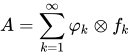
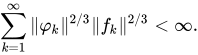
[edit]Let be a nuclear operator on , then is a -nuclear operator if it has a decomposition of the form where and and




Grothendieck's trace theorem
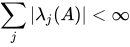
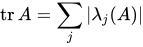
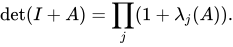
[edit]Let denote the eigenvalues of a -nuclear operator counted with their algebraic multiplicities. If then the following equalities hold: and for the Fredholm determinant

See also
[edit]Literature
[edit]- Gohberg, Israel; Goldberg, Seymour; Krupnik, Nahum (1991). Traces and Determinants of Linear Operators. Operator Theory Advances and Applications. Basel: Birkhäuser. p. 102. ISBN 978-3-7643-6177-8.
References
[edit]- ^ Gohberg, Israel; Goldberg, Seymour; Krupnik, Nahum (1991). Traces and Determinants of Linear Operators. Operator Theory Advances and Applications. Basel: Birkhäuser. p. 102. ISBN 978-3-7643-6177-8.
- ^ * Grothendieck, Alexander (1955). Produits tensoriels topologiques et espaces nucléaires (in French). Providence: American Mathematical Society. p. 19. ISBN 0-8218-1216-5. OCLC 1315788.
{{cite book}}: ISBN / Date incompatibility (help)
Banach space topics | |
|---|---|
| Types of Banach spaces | |
| Banach spaces are: | |
| Function space Topologies | |
| Linear operators | |
| Operator theory | |
| Theorems |
|
| Analysis | |
| Types of sets |
|
| Subsets / set operations | |
| Examples | |
| Applications | |


| Spaces |
| ||||
|---|---|---|---|---|---|
| Theorems | |||||
| Operators | |||||
| Algebras | |||||
| Open problems | |||||
| Applications | |||||
| Advanced topics | |||||
