Wiki Article
Grotto
Nguồn dữ liệu từ Wikipedia, hiển thị bởi DefZone.Net


A grotto or grot is a natural or artificial cave or covered recess.[1] Naturally occurring grottoes are typically small coastal caves associated with bodies of water and may be partially or fully submerged at high tide.[2] Artificial grottoes have also been constructed as garden features, particularly in landscape design from the Renaissance onward. Well‑known natural examples include the Grotta Azzurra on Capri and the grotto at Tiberius’ Villa Jovis in the Bay of Naples.

Etymology
[edit]The word grotto derives from Italian grotta, from Vulgar Latin grupta, and ultimately from Latin crypta (“crypt”).[3] The term is also historically connected to grotesque. In the late 15th century, the buried rooms of Nero’s Domus Aurea on the Palatine Hill were rediscovered. Their sunken, cave‑like condition led Renaissance viewers to describe the decorative motifs—garlands, slender architectural frameworks, foliage, and animals—as grottesche, a term that subsequently gave rise to the French grotesque.
Antiquity
[edit]
Grottoes were prominent features in Greek and Roman culture. Spring‑fed grottoes formed part of the oracular sanctuaries of Apollo at Delphi, Corinth, and Clarus.[4] In the Hellenistic period, the city of Rhodes incorporated rock‑cut artificial grottoes into its urban design, conceived to resemble natural formations.[5] At the Roman sanctuary of Praeneste, the earliest part of the complex was located on the second lowest terrace, in a natural grotto where a spring developed into a well. According to tradition, the sacred spring was associated with a local nymph, who was venerated in a grotto‑like watery nymphaeum.[6]
Garden grottoes
[edit]
Renaissance and Mannerist grottoes
[edit]The popularity of artificial grottoes helped introduce the Mannerist aesthetic into Italian and French gardens of the mid‑16th century. Two celebrated examples in the Boboli Gardens at the Palazzo Pitti were begun by Giorgio Vasari and completed by Bartolomeo Ammanati and Bernardo Buontalenti between 1583 and 1593; one originally housed Michelangelo’s Prisoners. Earlier, at the Medici Villa Castello near Florence, Niccolò Tribolo had incorporated a grotto into the garden layout. At the nearby Pratolino, despite the dryness of the site, a surviving Grotto of Cupid featured water tricks designed to surprise visitors.[7] The Fonte di Fata Morgana at Grassina (1573–74), built within the grounds of Bernardo Vecchietti’s Villa “Riposo”, is a small garden pavilion decorated with sculptures in the Giambologna manner.
Forms and decorative programs
[edit]The outsides of garden grottoes were often designed to resemble an enormous rock, a rustic porch, or a rocky overhang. Interiors could evoke temples or watery caverns, decorated with fountains, stalactites, imitation gems and shells, herms, mermaids, and naiads whose urns spilled water into pools. Damp grottoes offered a cool retreat from the Italian sun, but they also became fashionable in the cooler climate of the Île-de-France. At the Kuskovo Estate, the Grotto Pavilion was built between 1755 and 1761.

Baths, chapels, and theatrical uses
[edit]Grottoes could also serve as baths, as at the Palazzo del Te, where the 'Casino della Grotta' contains a suite of intimate rooms arranged around a grotto and loggetta. Courtiers once bathed beneath a small cascade splashing over pebbles and shell‑encrusted walls. Grottoes also functioned as chapels or, at Villa Farnese in Caprarola, as a small theatre designed in the grotto manner. They were frequently combined with cascading fountains in Renaissance gardens.
Baroque and early landscape gardens
[edit]The grotto designed by Bernard Palissy for Catherine de' Medici’s château in the Tuileries was renowned. Grottoes also appeared in the gardens designed by André Le Nôtre for Versailles. In England, an early garden grotto was built at Wilton House in the 1630s, probably by Isaac de Caus.
Eighteenth‑century and Romantic grottoes
[edit]Grottoes were incorporated into less formal garden designs as well. Pope's Grotto, created by Alexander Pope at Twickenham, is almost all that survives of one of the earliest landscape gardens in England.[8] Pope was inspired by grottoes he had seen in Italy, and restoration efforts are ongoing.[9] Grottoes also feature in the landscape gardens of Painshill Park,[10] Stowe, Clandon Park, and Stourhead.[11] Scott's Grotto in Ware, Hertfordshire is a late‑18th‑century complex of chambers extending 20 metres into a chalk hillside, lined with shells, flints, and coloured glass.[12] During the Romantic period, Fingal's Cave on Staffa became widely known through literary and musical references, notably Felix Mendelssohn’s Hebrides Overture. In the 19th century, when miniature mountains and rock gardens became fashionable, grottoes were often included, as at Ascott House. In Bavaria, Ludwig II’s Linderhof contains an evocation of the Venusberg grotto from Richard Wagner’s Tannhäuser.
Contemporary reinterpretations
[edit]Although grottoes have largely fallen from fashion since the British Picturesque movement, architects and artists have occasionally reinterpreted the grotto in contemporary design. Examples include Frederick Kiesler’s Grotto of Meditation for New Harmony (1964),[13] ARM’s post‑modern Storey Hall (1995), Aranda/Lasch’s Grotto Concept (2005), DSDHA’s Potters Field Park Pavilions (2008),[14] and Callum Moreton’s Grotto pavilion (2010). A further example is Antonino Cardillo’s Grottoes series (2013–2016), which explores the grotto as a contemporary architectural archetype.[15]
Religious grottoes
[edit]

Devotional uses
[edit]Artificial grottoes are widely constructed for ornamental and devotional purposes, often serving as shrines that house statues of saints, particularly the Virgin Mary. These structures are commonly found in gardens, church grounds, and other outdoor settings.
Lourdes-inspired grottoes
[edit]Many Roman Catholics visit the grotto at Lourdes, where Bernadette Soubirous reported apparitions of the Virgin Mary. Numerous modern garden shrines are modeled on this site, and replicas of the Lourdes grotto can be found in churches and religious institutions around the world.
Large-scale devotional grottoes
[edit]One of the largest devotional grotto complexes is the Grotto of the Redemption in West Bend, Iowa, a monumental assemblage of stone, minerals, and religious sculpture.
Cellars in Ticino
[edit]
In Ticino, the Italian-speaking part of Switzerland, grottoes were places where wine and food were stored and preserved. They were built by exploiting the morphology of rocks and boulders, to create rooms with a cool climate suitable for food, particularly milk and cheese, as well as potatoes, sausages, and wine storage.[16][17]
The importance of these cellars is demonstrated in their number; for example, there are 40 grotti in Maggia, no fewer in Moghegno, and about 70 in Cevio behind Case Franzoni. Some grotti have been opened to the public, as in Avegno, but most have lost their original character as they became rustic restaurants which serve basic local food and drink. A true grotto is dug out under a rock or between two boulders, where subterranean air currents keep the room cool. Often a grotto had a second floor with another one or two rooms for the fermentation cask and tools of the vintage. In front of the grotto were a table and benches of stone, where the farmers could rest and refresh themselves.[18]: 18
Gallery
[edit]-
 Grotto in an iceberg with the Terra Nova ship in the background (1911) during the 'British Antarctic Expedition' by Herbert G. Ponting
 -
 Grotto of the Buttes-Chaumont in Paris
 -

-
 Anapat Grotto, Lastiver, Armenia
 -

-
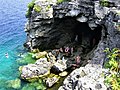 The Grotto in Bruce Peninsula National Park, Canada


.jpg)

See also
[edit]
- Cave
- Architecture of cathedrals and great churches
- Caves of Hercules
- Grotto-heavens, Chinese religious usage associated with Daoist religion
- Karst
- Shell grotto
- Tunnels in popular culture
Notes
[edit]- ^ "Grotto". Encyclopædia Britannica. Retrieved 23 February 2026.
- ^ "Sea cave". Encyclopædia Britannica. Retrieved 23 February 2026.
- ^ "Grotto". Oxford English Dictionary (Online ed.). Oxford University Press. Retrieved 23 February 2026.
- ^ G. W. Elderkin, "The Natural and the Artificial Grotto", Hesperia 10.2 (1941), pp. 125–137.
- ^ E. E. Rice, "Grottoes on the Acropolis of Hellenistic Rhodes", The Annual of the British School at Athens 90 (1995), pp. 383–404.
- ^ A. R. A. van Aken, "Some Aspects of Nymphaea in Pompeii, Herculaneum and Ostia", Mnemosyne 4.3/4 (1951), pp. 272–284.
- ^ Webster Smith, "Pratolino", The Journal of the Society of Architectural Historians 20.4 (1961), pp. 155–168.
- ^ Frederick Bracher, "Pope's Grotto: The Maze of Fancy", The Huntington Library Quarterly 12.2 (1949), pp. 141–162; Anthony Beckles Willson, "Alexander Pope's Grotto in Twickenham", Garden History 26.1 (1998), pp. 31–59.
- ^ Victoria Lambert, "Inside Alexander Pope's hidden grotto", The Telegraph, 15 September 2015.
- ^ Alison Hodges, "Painshill, Cobham, Surrey: The Grotto", Garden History 3.2 (1975), pp. 23–28.
- ^ James Turner, "The Structure of Henry Hoare's Stourhead", The Art Bulletin 61.1 (1979), pp. 68–77; Malcolm Kelsall, "The Iconography of Stourhead", Journal of the Warburg and Courtauld Institutes 46 (1983), pp. 133–143; Kenneth Woodbridge, "Henry Hoare's Paradise", The Art Bulletin 47.1 (1965), pp. 83–116.
- ^ "What is Scott's Grotto". 13 May 2005. Archived from the original on 13 May 2005. Retrieved 18 October 2005.
- ^ Alderslade, Jessica (2014). "An Introduction to the Grotto and Its Place within Contemporary Design". Reinterpreting the Grotto in Contemporary Design. Australia.
- ^ "ArtNotes". Art Monthly. April 2008. p. 15.
- ^ Ghadiok, Mrinalini (July 2017). "Elemental". Mondo Arc India (15). New Delhi: 6, 10, 50–63.
- ^ "Switzerland's ingenious cooling caves". BBC Travel. 2022-03-30. Retrieved 2022-06-07.
- ^ "Grotto culture in Italian Switzerland" (PDF). Living Traditions of Switzerland (in Italian). Swiss Confederation. 2018. Retrieved 2022-06-07.
- ^ "Im Vorgarten zum Paradies". Schweiz. Vallemaggia. 2 (1). 1999. doi:10.33926/gp.2019.1.5. ISSN 1421-8909.
Further reading
[edit]- Jackson, Hazelle (2001). Shell Houses and Grottoes. Oxford: Shire Books. — Traces the development of the grotto in Italy during the Renaissance and its popularity in the UK from the eighteenth century to the present; includes a gazetteer of UK grottoes.
- Jones, Barbara (1953). Follies and Grottoes. London: Constable. — A classic survey of grottoes and ornamental structures in Britain, with historical and architectural analysis.
- Miller, Naomi (1982). Heavenly Caves: Reflections on the Garden Grotto. New York: Braziller. — A study of the grotto from Antiquity to modern times, examining symbolic, artistic, and architectural traditions.
| International | |
|---|---|
| National | |
