Wiki Article
Harold Lowe
Nguồn dữ liệu từ Wikipedia, hiển thị bởi DefZone.Net
Harold Lowe | |
|---|---|
 Lowe, c. 1911, after joining the White Star Line | |
| Born | 21 November 1882 Eglwys Rhos, Caernarfonshire, Wales |
| Died | 12 May 1944 (aged 61) Deganwy, Caernarfonshire, Wales |
Resting place | St. Trillo's Churchyard, Rhos-on-Sea, Conwy County Borough, Wales |
| Occupations |
|
| Known for | Fifth officer on RMS Titanic |
| Spouse |
Ellen Marion Whitehouse
(m. 1913) |
| Children | 2 |
| Military career | |
| Allegiance | United Kingdom |
Branch | Royal Naval Reserve |
Service years | 1904–1927 |
Rank | Commander |
Conflicts | World War I |
| Awards | |


Commander Harold Godfrey Lowe RD RNR (21 November 1882 – 12 May 1944) was a British merchant mariner and naval officer who served as the fifth officer aboard the RMS Titanic during its ill-fated maiden voyage, and was one of the four ship's officers to survive the disaster.
In charge of lifeboat No. 14, Lowe received praise for his conduct during the sinking and for returning to the wreck site after the ship sank in search for survivors, the only boat which voluntarily returned. Along with a volunteer crew, he rescued four survivors from the water and at least twelve others from the swamped Collapsible Boat A, and took them to safety aboard RMS Carpathia. Lowe went on to participate in both inquiries into the disaster.
Lowe went on to serve in the merchant naval service until retiring from seafaring in 1931. He served in the Royal Naval Reserve during World War I and, despite his failing health, as an air raid warden in World War II. In retirement, he entered local politics as a councillor in Deganwy, Wales. In 1944, he became the first surviving officer of Titanic to die, following two years of ill-health after a stroke.
Early life
[edit]
Lowe was born in Eglwys Rhos, Caernarfonshire, Wales, on 21 November 1882, in his paternal grandfather's home "Bryn Lupus." He was the third of seven children born to Emma Harriet (née Quick) and George Edward Lowe. Though he spent most of his shore life in Wales, Lowe was mostly English by ancestry; his father was from Cheshire, born to a family of prominent jewellers who owned the firm Lowe & Sons, and his mother was born in Liverpool, the daughter of a police superintendent. He spoke Welsh fluently but when he spoke English, he did not speak with a Welsh accent.[1]
The family moved around North Wales for a time and eventually settled in the seaside town of Barmouth, Merionethshire, in 1891. There, Lowe and his brothers became enthusiastic boatsmen. They were also choir boys at St. David's Anglican Church.[2] He and his siblings lived in Penrallt House – Welsh for "House on the Slope" – which his mother Harriet ran as a hotel.[3] His father George, who was a painter, gained a reputation in Barmouth for being a drunk; Harold's son later said that George Sr. was "fond of the bottle," and one of his brothers later turned to alcoholism as well. This later influenced Lowe to refrain from alcohol completely, once saying, "I am not a teetotaller, I am a total abstainer."[4]
When Lowe was 13, his older brother George Jr. died in a boating accident. George, aged 17, had disappeared and his body was later found floating in Aberamffra Bay; it is speculated that he went to secure the punt he often sailed in and accidentally fell into the water, could not swim, and subsequently drowned. Lowe himself had a similar accident a year later; he took his father's punt out on the Aberamffra Bay during bad weather and it capsized. However, unlike his brother, Harold could swim and managed to make his way back to shore.[5]
Maritime career beginnings
[edit]
After the death of his brother, Lowe became the eldest son in the family. His father, in turn, had ambitions for him to be apprenticed to a Liverpool businessman and had him transferred to Barmouth County Intermediate School in preparation for that career path.[4] However, Lowe was determined to go to sea and wanted to be paid for his work, explaining later on, "I was not going to work for anybody for nothing." As a result, he ran away from his home around the age of fifteen and began his career at sea as a ship's boy aboard Welsh coastal schooners, likely in Portmadoc.[6][7] Lowe would eventually reconcile with his family as he was using his family home, Penrallt, as his shore address again by 1901.[8]
Lowe's earliest known registered vessel was the schooner William Keith, on which he signed as an ordinary seaman from May to October 1900, sailing to Dublin and back. He served the same position on the schooner British Queen from January to June 1901.[9] Lowe joined the Cortez, a square-rigged sailing ship, as an able seaman from June 1901 to April 1902, sailing on it to Chile, as well as rounding Cape Horn; it was his first deep-sea voyage. In March 1903, Lowe joined the Ormsary, another square-rigged vessel, on its maiden voyage as an able seaman, sailing on it to Australia and Hawaii. He was on the ship for over a year, and it would be his last sailing ship; he left the Ormsary in May 1904 and joined the Royal Naval Reserve (RNR) as a rating some time afterwards.[10]
Lowe made the transition from sail to steam following his RNR training, joining the Blue Funnel Line which made voyages to Japan and the west coast of Canada and the United States. His first steamship was the SS Prometheus which he joined as an able seaman in August 1904. In November 1904, he was aboard the ship when it was involved in a collision with the SS Petcan. He was later called to testify in front of a Board of Trade inquiry into the incident.[11] He later joined the SS Telemachus which notably carried a Chinese crew in addition to the regular British crew. Lowe came to hold his Chinese shipmates in high regard, considering them honest and hard-working. During this time, he reportedly risked his own life to save a Chinese sailor who had fallen overboard, by jumping overboard and holding him afloat until help came for both of them. With the Telemachus, Lowe also made his first visit to Canada and the U.S., stopping over in Vancouver, Seattle, and Tacoma.[12]

In January 1906, Lowe failed at his attempt gaining his second mate's certificate. Afterwards, he joined the Ellerman Line, joining the Justin and then the Fabian, sailing to Mediterranean ports, before resitting for the certificate again and passing in August 1906. He soon joined the SS Ardeola of the Yeoward Line as its third officer. As he had never been an apprentice, Lowe was considered a hawsepiper, taking what was seen as an unconventional route to becoming a ship's officer.[13]
That same year, Lowe joined Elder Dempster Line, travelling along with West African Coast. His first ship with the line was the SS Charma as fourth officer, before being promoted to third officer aboard the SS Bonny. In 1908, he attained his first mate's certificate on his second attempt and was made second officer for SS Madeira and served in the same role on the SS Oron; briefly, during the voyage, he was also made Chief Officer. Lowe contracted malaria during this time and, while he survived, it would become a recurring health issue in his later years.[14]
Between March 1908 and June 1909, Lowe took an extended leave from seafaring. This is likely because his mother Harriet had fallen ill following a stroke and died in March 1909. Soon after her death, he would return to sea on the SS Addah, again as second officer. In 1910, he gained his Master's certificate on a second attempt. From December 1910 to March 1911, he would sail on the SS Zaria, his last ship with the Elder Dempster Line.[15]
In April 1911, Lowe joined the White Star Line. By that point he had, his own words, "experience with pretty well every ship afloat – the different classes of ships afloat – from the schooner to the square-rigged sailing vessel, and from that to steamships, and of all sizes." His first berth would be with the SS Tropic, a cargo ship, as third officer. He was then transferred to the SS Belgic where he served in the same position.[7]
RMS Titanic
[edit]
On 26 March 1912, Lowe reported to White Star's Liverpool offices at nine o'clock in the morning, with orders to join the RMS Titanic. Along with three fellow junior officers, he travelled to Belfast and signed on the ship the following day. Despite his numerous years at sea, the maiden voyage of the Titanic was to be Lowe's first crossing of the North Atlantic. He later described himself as being a "stranger to everyone aboard" the ship as he had never worked with the other officers before, and they had all travelled the North Atlantic routes before at least once while he had not.[7]
In Belfast, Lowe and Sixth Officer James Moody were tasked with inspecting the starboard lifeboats and their equipment. On sailing day, 10 April, Lowe and Moody were each put in charge of two starboard lifeboats which were lowered and rowed around the dock to satisfy the Board of Trade officials that Titanic met safety regulations.[16]
White Star operated a watchkeeping system whereby the three senior officers worked the same four-hour watches in every 12-hour period while the junior officers stood the traditional system of four hours on/four hours off with the rest of the Titanic's deck crew. This was divided into two watches, designated Port and Starboard, and pairs of junior officers were assigned to each watch. Lowe was assigned to the Port Watch, standing duties with Third Officer Herbert Pitman.[17]
During delivery trip from Belfast to Southampton, and then again during departure from Southampton, Lowe's departure position was in the wheelhouse, in charge of the bridge telephones; his duty was relaying messages and commands from the captain and harbour pilot to his fellow officers stationed at their respective departure positions.[18]
The sinking
[edit]On 14 April 1912, Lowe was relieved at 8:00 PM by Sixth Officer Moody. He was asleep in his quarters when the ship scrapped by an iceberg at 11:40 PM, remaining asleep through it as well as Fourth Officer Joseph Boxhall's attempt to awaken him. As he explained later, "We do not have any too much sleep, and therefore when we sleep, we die." Eventually Lowe was awakened by noises outside his cabin and found passengers in the officer's quarters who were wearing lifebelts. He got dressed and headed out on deck where he realised the seriousness of the situation due to the ship being noticeably down by the bow.[7] It is not fully known when he got his personal firearm, described by Lowe as a "Browning Automatic." It is likely he retrieved it after a few male passengers jumped into a lifeboat and injured a woman as he was later heard to have said, "I will stop that. I will go down and get my gun."[19]
First Officer William Murdoch charged Lowe with loading lifeboat No. 5. During this time, White Star Line chairman J. Bruce Ismay came along side, getting "trifle excited" and began telling the crew there to, "Lower away, lower away, lower away!" Lowe, who had personally been handling one of the davit falls to help lower the boat, angrily ordered him away for interfering with his duties: "If you will get to hell out of that I shall be able to do something! Do you want me to lower away quickly? You will have me drown the whole lot of them!"[7]
Around 1:30 AM, Lowe engaged in a conversation with Sixth Officer Moody: While launching lifeboats Nos. 14 and 16 on the port side of the ship, the two junior officers felt that this group of boats needed to have an officer with them. Moody insisted that Lowe should get onto lifeboat No. 14 and that he would get on another lifeboat. Able Seaman Joseph Scarrott, in Boat 14, also recalled Lowe ordering Moody to take charge of Lifeboat No. 16.[20]
By the time lifeboat 14 was being launched, things were beginning to get precarious on the boat deck as the majority of passengers began to realise that the giant ship was foundering. As lifeboat 14 was descending, Lowe used his pistol to fire three shots along the side of the ship in order to frighten away a group of men attempting to leap into the lifeboat. During the Senate Inquiries, Lowe was emphatic in stating that he had not hit anyone, saying that he had looked where he was shooting, and this is backed by several eyewitnesses.[21]
Lifeboat 14 and Carpathia
[edit]
After reaching the water, Lifeboat 14's ropes jammed, leaving one end of the boat touching the water while the other end was still hanging above the surface. Lowe attempted to undo the ropes at the high end but ended up having to cut them loose from the height of about five feet. The boat splashed down heavily into the sea, frightening many aboard.[22][23] He then ordered it to be rowed about 150 yd (140 m) away from Titanic. By the time the ship foundered at around 2:20 AM, Lowe had begun to gather several lifeboats together into a flotilla.[a] Several eyewitnesses noted that Lowe wished to return to pick up survivors as soon as possible and, after passengers under his care protested against his plan, he began to redistribute them amongst the flotilla, in order to ready his own lifeboat for a search for additional survivors.[24]
In charge of lifeboat No. 14, Lowe and a team of six volunteer crewmembers went back to the site of the sinking. After finishing the redistribution, they followed the sounds back to the side of the wreck. It was only well into the operation that they realised they had returned too late; the water was simply too cold for anyone to survive any great amount of time.[7] In total, there were four men taken out of the water, one of whom died soon after being pulled from the water.[b] Many more voices could be heard in the darkness, but locating them proved to be a largely fruitless task, despite the best efforts of the crew. Lowe's lifeboat is noted as being the only lifeboat to return to the wreck site for survivors, and one of two lifeboats to pick up survivors from the water, the other being Lifeboat No. 4, which had been near enough to the foundering ship to allow some people to swim up to it.
After leaving the wrecksite, Lowe had his crew of men raise the mast and put up a sail; a testament to his skills as a boatman, his was the only lifeboat to do so. Using a breeze that had sprung up, he continued on to take Collapsible D in tow, as it was having difficulty in rowing due to lack of seamen and with the sea becoming rougher. He later spotted the swamped Collapsible A and rescued around 12 survivors from there into Boat 14, including the only woman to be picked up from the water, Rhoda Abbott.[26] Lowe and his group of lifeboats were picked by the RMS Carpathia around 7:30 PM. A series of photographs taken by passenger Louis Ogden on the Carpathia clearly show Lowe at the tiller of lifeboat 14 as they approach rescue. He remained aboard his lifeboat long enough to ship the mast and make certain everything was properly stowed before boarding the ship.[27]
Inquiries
[edit]
The Titanic survivors arrived at Pier 54 in New York on 18 April. Immediately upon landing Lowe was served with a warrant which called upon him to testify in the American inquiry into the sinking. According to sur Second Officer Charles Lightoller, the surviving officers considered the inquiry 'a farce' and were highly resentful owing to perceived poor treatment by the American authorities. They were especially bemused that an enquiry into the sinking of a ship was being conducted by men with no knowledge of sailing, or the sea.[28]
Unlike the other officers, Lowe, known for his bluntness, was vocally critical about the inquiry, telling a journalist from The Washington Post: "We all welcome this inquiry. But you Americans got up against us, and now we Britishers are up against you, and we shall see how it comes out." He also developed an intense dislike towards the American press and their photographers, particularly what he saw as their intrusive behavior.[29]
During his Day 5 testimony, Lowe was direct and the exchanges between him and Senator William Alden Smith, chair of the Senate inquiry, were noted to have been antagonistic. When Smith asked him what an iceberg was composed of, Lowe responded, "Ice, I suppose, sir." He also admitted to swearing at White Star Line chairman J. Bruce Ismay when ordering him away from Lifeboat No. 5. When reluctant to repeat his words, Ismay encouraged him to, "Give us what you said," to which Lowe retorted with, "The chairman is examining me."[7]
Along with other surviving officers, Lowe boarded the RMS Adriatic on 2 May to return to England. At Liverpool, he was met by his father and sister Ada. He went on to participate in the British inquiry where he was noticeably more restrained in his language.[30] His testimony was mainly regarding his rescue attempt on Lifeboat 14 after the ship sank and regarding any ice reports he saw prior to the disaster.[22]
Upon his return to his home town of Barmouth 1,300 people attended a reception held in his honor at the Picture Pavilion. He was presented with a commemorative gold watch, with the inscription "Presented to Harold Godfrey Lowe, 5th officer R.M.S. Titanic by his friends in Barmouth and elsewhere in recognition and appreciation of his gallant services at the foundering of the Titanic 15th April 1912." He was also presented with a set of nautical equipment from survivor Renee Harris inscribed with "To Harold Godfrey Lowe, 5th Officer RMS Titanic. "The real hero of the Titanic." With deepest gratitude from Mrs Henry B. Harris of New York."[31]
Later career and retirement
[edit]After the inquiries, Lowe returned to sea aboard the SS Medic as the ship's third officer in July 1912. His presence on the ship attracted the attention of the local Australian newspapers but Lowe refused to discuss the disaster any further, remarking that he was "so sick of it all." During the ship's return voyage in October, he suffered a broken leg and was subsequently confined to bed for the remainder of it. In December 1912, he appointed third officer of the SS Gothic, again on the Australian run.[32]

In June 1913, Lowe received commission as a Sub-Lieutenant in the Royal Naval Reserve.[33] That same month, he appeared as a witness in the case of Ryan v. The Oceanic Steam Navigation Company.[34] In July 1914, Lowe was promoted to senior officer, being appointed as Second Officer aboard the SS Cornishman.[35]
Lowe was promoted to Lieutenant in July 1915, just under a year after World War I broke out.[36] During the war, Lowe was initially aboard HMS Donegal which was part of the Grand Fleet; the ship narrowly missed action in the Battle of Jutland, being sent on detached service in the mid-Atlantic just before the naval engagement. He was soon transferred to HMS Suffolk, and saw service in Vladivostok in the Siberian intervention during the Russian Civil War. During his service there, Lowe learned to speak Russian with some fluency.[37]
After the war, Lowe returned to serve with the White Star Line. Though he would reach the rank of chief officer, like his fellow surviving Titanic officers, Lowe never held a command of his own. He went on to serve as senior officer on ships such as the RMS Cedric (including his first voyage to New York since the Titanic disaster, in January 1920), the SS Gallic, the SS Suevic, the SS Laurentic, the RMS Baltic, and the SS Doric. The Doric would be his last ship before retiring from the White Star Line in 1931.[35]
In 1923, Lowe was promoted to the rank of Lieutenant Commander.[38] He was released from the Naval Reserves in 1927 with the rank of Commander, having received the Reserve Decoration.[39] The White Star Line honoured Lowe with a ceremony at the Oceanic Chambers in Liverpool where he was presented with the decoration by White Star Line Commodore Charles Bartlett.[35]
From 1932 to 1938, Lowe was a member of the Conwy Borough Council, representing the Deganwy Ward; he was elected for two terms unopposed before retiring. Lowe turned down an offer to run for mayor. Lowe was noted as being diligent during his time as a councillor, with his attendence surpassing those of his colleagues. He took particular interest in improving local infrastructure and amenities in Deganwy during his time in office. Lowe also volunteered to arrange Armistice Day celebrations every year. In 1937, he was present for the opening of a local Civic Centre where the guest of honour was former Prime Minister David Lloyd George.[40]
With the outbreak of World War II, Lowe served as an Air Raid Warden and volunteered his home as a sector post, until a stroke in 1942 obliged him to take to a wheelchair and forced him to abandon his wartime role.[41]
Personal life
[edit]In September 1913, Lowe married Ellen Marion "Nellie" Whitehouse and began using Colwyn Bay, where his wife's family lived, as his shore address. They had two children together: Florence Josephine Edge (known as "Josie"; 1914–1996), and Harold William George (1918–1999) who was born while Lowe was serving in World War I. Lowe's grandson, John Harold Lowe, son of Josie, was a captain in the British Merchant Navy.[42]
According to his Board of Trade certification applications, Lowe had a tattoo on his right forearm, of his initials "HGL" in a heart.[43]
Lowe had six siblings: two sisters, Ada Florence and Annie May; and four brothers, George Ernest, Edgar Reginald, Arthur, and Edward. Two of his younger brothers followed Lowe into the merchant service. Edgar became a captain in the Union Company, after settling down in New Zealand. Edward, who also settled in New Zealand, was lost at sea when he was swept overboard from the SS Waitemata in 1927.
He was initiated as a freemason in the St. Trillo Lodge in 1921.
After retiring from seafaring in 1931, Lowe moved his family from Colwyn Bay to Deganwy. He served as a churchwarden, and spent time fishing on his motorboat Pirate on River Conwy. He was an enthusiastic shooter, and was considered a great shot, once even being invited to participate at the King's Prize in the annual Imperial Meeting competition. Lowe also developed into an avid amateur photographer later in life.[44]
Lowe was a life-long teetotaler, a life choice likely influenced because of his father's alcoholism. An allegation made during the U.S. inquiries that he was drunk during the night the Titanic sank made him noticeably angry and upset; he had to be persuaded to not take the matter any further after vehemently denying it, saying, "I am an abstainer... I say it, sir, without fear of contradiction."[45]
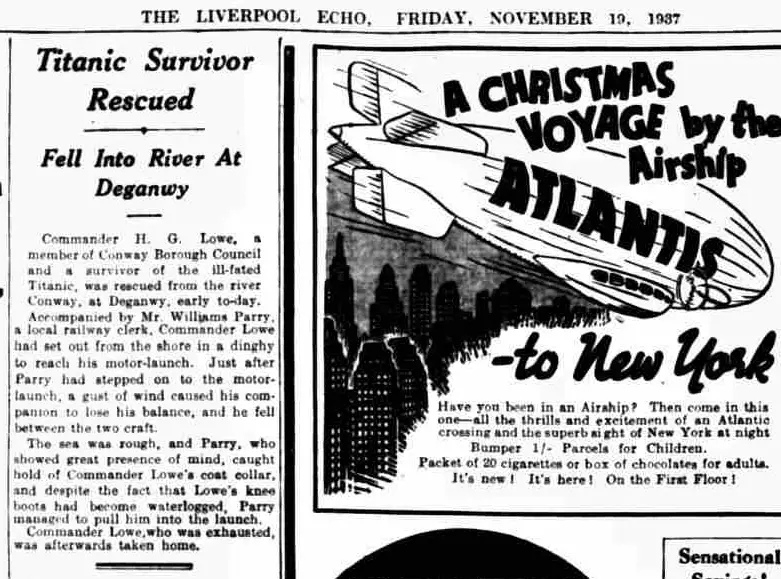
In November 1937, Lowe nearly drowned in the Conwy River. He was accompanied by his friend William Parry, a railway clerk, and the pair set out in a dinghy to reach his motorboat, Pirate in choppy waters. While Parry managed to step onto the Pirate, a gust of wind caused Lowe to lose his balance and fall between the two crafts. Parry managed to grab Lowe's coat collar and pulled him into the motorboat despite the fact Lowe's knee-length boots had become waterlogged.[46] The incident made news in the Liverpool Echo, and caused Lowe much embarrassment.[47]
A stroke in 1942 left Lowe wheelchair-bound for the remainder of his life. He died of hypertension and chronic malaria on 12 May 1944 at the age of 61; he was the first of the surviving officers of the Titanic to die. His body was buried at St. Trillo's Churchyard in Rhos-on-Sea.[48][49]
Legacy
[edit]In researching on her biography of Lowe, Titanic historian Inger Sheil noted the overwhelmingly positive response Lowe received from survivors and the press for his conduct during the sinking. She remarked the volume of feeling shown towards Lowe by the people he helped, but also "a surprising depth." Many passengers remarked that his decisive leadership and organisational skills as having been decisive in their survival. Survivor Renee Harris, writing in 1932, asserted that through all the years, Lowe had stood out in her memory as "one of the finest men it has been my privilege to meet."[50]
Lowe later received offers of money (which he turned down) and received multiple gifts from grateful passengers. He also showed appreciation for the responses he got, though usually brushing them off by saying he had only been doing his duty. Writing in response to passenger Selena Rogers Cook a year later, he remarked, "Several survivors of the Titanic have written letters to me, but I fancy they have been rather too glowing, any way I suppose it is from their hearts."[51]
.JPG)

In 2004, a menu of the first meal ever served aboard Titanic, which Lowe had sent to his then-fiancée when the ship was docked in Ireland, sold for £51,000, breaking the record for auctioned Titanic memorabilia at that time.[52]
On 7 April 2012, a blue plaque was unveiled by the Deganwy History Group at Lowe's final residence at 1 Marine Crescent in Deganwy, where he lived until his death in 1944.[53][54]
A slate plaque in Lowe's memory was hung on the centennial anniversary of Titanic's sinking in Barmouth. Memorializing Lowe's service, the plaque is inscribed in both Welsh and English, with pictures of Lowe and Titanic. It reads: "In Commemoration of local hero 5th Officer Harold Godfrey Lowe who left Barmouth aged 14 to go to sea. He played a heroic role in the rescue of survivors during the sinking of RMS Titanic on 15 April 1912." The plaque was unveiled by his grandson, John Lowe and Maddy Matthews, a student who petitioned for the memorial.[55][56]
An oft-repeated allegation originates from a Semi-Monthly Magazine article ghost-written for Titanic passenger Charlotte Collyer which alleged that Lowe initially refused to save one passenger from the water because he was a "Jap" and was picked up only after passengers pressured Lowe to. This account, published in May 1912, is almost certainly false. For one, the passenger was Fang Lang, one of the Chinese passengers aboard Titanic, not Japanese. Further, Titanic historian Inger Shiel notes that Collyer was not in Lifeboat 14 when it returned, having been transferred to another boat with all other passengers except one – second class Charles Williams volunteered to return with the boat – before Lowe and his crew returned to the wrecksite; this was confirmed by several eyewitnesses, including two crewmembers in No. 14 and Collyer's own daughter. Supporting this are Collyer's further claims that the women in her lifeboat later had to row to the Carpathia once dawn arrived, which happened only to the occupants of boats 10 and 12. Lifeboat 14 approached the Carpathia under sail and with a boat in tow, meaning Collyer could not have witnessed the events she described.[57]
Shiel also notes that Lowe was known to be respectful of the Chinese, having served with them while with the Blue Funnel Line and held them in high regard. Earlier in his maritime career, he risked his life to save a Chinese sailor from drowning by diving into the water and keeping his shipmate afloat until help came along, despite being on the ship's 'sick list' with blood poisoning at the time of the incident.[58] Steven Schwankert, author of The Six, a book on the Chinese passengers of Titanic, notes that the story was likely embellished by editors – not an uncommon occurence amongst Titanic newspaper accounts – from whom Collyer accepted payment for publishing her account, after the loss of her husband on Titanic and of all her possessions left her destitute.[59]
Portrayals
[edit]Lowe has been portrayed on screen several times. Most notably, he was portrayed by Welsh actor Ioan Gruffudd in the 1997 film Titanic, and was depicted rescuing fictional first-class passenger Rose DeWitt Bukater (Kate Winslet) from the freezing ocean.
- Howard Pays - A Night to Remember (1958)
- Karl Howman - S.O.S. Titanic (1979)
- Kavan Smith - Titanic (1996)
- Ioan Gruffudd - Titanic (1997)
- Ifan Meredith - Titanic (2012)[60]
- Chris Bohan - Unsinkable (2024)
- Oisín Thompson - Titanic Sinks Tonight (2025)[61]
Notes
[edit]- ^ The flotilla consisted of lifeboats 10, 12, and 4, and collapsible boat D.[23]
- ^ Three of the four men are known to be first-class passenger William F. Hoyt, who died soon after being pulled into the boat, steward Harold Phillimore, and third-class passenger Fang Lang. The identity of the fourth man has never been established.[25] Lowe himself did not know the identity of the people rescued by Lifeboat 14, safe for that of Hoyt whom he identified from items on his person prior to Hoyt's burial at sea from aboard RMS Carpathia.[7]
References
[edit]- ^ Sheil 2012, pp. 12–15 21.
- ^ Sheil 2012, p. 20.
- ^ "Penrallt House: History". Penrallt Barmouth. Retrieved 2 March 2026.
- ^ a b Sheil 2012, pp. 20–22.
- ^ Sheil 2012, pp. 17–19.
- ^ Wade, Wyn Craig (1986). The Titanic: End of A Dream. Penguin Books. pp. 196–197. ISBN 978-0140166910.
- ^ a b c d e f g h "United States Senate Inquiry, Day 5: Testimony of Harold G. Lowe". Titanic Inquiry Project.
- ^ Sheil 2012, p. 32.
- ^ Pleming, Ifan (Autumn 2025). "Harold Lowe: His Early Welsh Ships". Atlantic Daily Bulletin. British Titanic Society.
- ^ Sheil 2012, pp. 24–33.
- ^ Sheil 2012, pp. 36–38.
- ^ Sheil 2012, pp. 38–39.
- ^ Sheil 2012, pp. 40–42.
- ^ Sheil 2012, pp. 42–45.
- ^ Sheil 2012, pp. 45–46.
- ^ Georgiou, Ioannis. "The forgotten drills aboard Titanic". Encyclopedia Titanica. Retrieved 1 May 2026.
- ^ Babler, Günter (2019). Guide to the Crew of Titanic. The History Press. ISBN 978-0750992336.
- ^ Parkes, Dan; Krom, Gavin. "Titanic Officers On Duty". Titanic's Officers. Retrieved 2 May 2026.
- ^ Sheil 2012, p. 64.
- ^ "British Wreck Commissioner's Inquiry, Day 2: Testimony of Joseph Scarrott". Titanic Inquiry Project.
- ^ Eaton, John P.; Haas, Charles A. (1987). Titanic: Destination Disaster: The Legends and the Reality. Patrick Stephens. ISBN 978-0850598681.
- ^ a b "British Wreck Commissioner's Inquiry, Day 13: Testimony of Harold G. Lowe". Titanic Inquiry Project. Retrieved 10 May 2026.
- ^ a b Bigham, Randy Bryan. "Titanic's Aft Lifeboats". Encyclopedia Titanica. Retrieved 10 May 2026.
- ^ Sheil 2012, pp. 8–10, 76–78.
- ^ Sheil 2012, pp. 79–81.
- ^ Lord, Walter (2005) [1955]. A Night to Remember. St. Martin's Griffin. pp. 207–208. ISBN 978-0805077643.
- ^ Sheil 2012, pp. 8–10.
- ^ Lightoller, Charles (1935). "Chapter 35: The Rescue". Titanic and Other Ships. Ivor Nicholson and Watson.
- ^ Sheil 2012, p. 88.
- ^ Sheil 2012, pp. 96–100.
- ^ Sheil 2012, p. 102–106.
- ^ Sheil 2012, pp. 108–110, 152–154.
- ^ "No. 28729". The London Gazette. 17 June 1913. p. 4307.
- ^ Molony, Senan. "The Third Titanic Inquiry: Ryan v. OSNC". Encyclopedia Titanica. Retrieved 13 May 2026.
- ^ a b c Sheil 2012, pp. 152–154.
- ^ "No. 30075". The London Gazette. 18 May 1917. p. 4797.
- ^ Sheil 2012, pp. 113–122.
- ^ "No. 32852". The London Gazette. 10 August 1923. p. 5494.
- ^ "No. 33298". The London Gazette. 29 July 1927. p. 4910.
- ^ Sheil 2012, pp. 139–140.
- ^ Sheil 2012, pp. 141–142.
- ^ "Titanic hero Harold Lowe: Grandson tells of pride as plaque unveiled". BBC News. 10 April 2012. Retrieved 18 February 2026.
- ^ Parkes, Dan. "What Did the Titanic's Officers Look Like?". Titanic's Officers. Retrieved 2 May 2026.
- ^ Sheil 2012, pp. 137–140.
- ^ Sheil 2012, p. 90.
- ^ Sheil 2012, pp. 138–139.
- ^ "Titanic Survivor Rescued - Fell into River in Deganwy". Liverpool Echo. 19 November 1937.
- ^ Fitch, Layton & Wormstedt 2012, p. 1015.
- ^ "Harold Lowe: Profile". BBC Wales North West. Archived from the original on 3 November 2012.
- ^ Sheil 2012, pp. 77–87, 94–96, 138.
- ^ Sheil 2012, p. 109–110.
- ^ "Titanic hero's menu smashes record". BBC News. 2 April 2004. Retrieved 11 June 2006.. The BBC 2004 states incorrectly that Lowe was one of "only two of the ship's officers" survived the Titanic disaster. In fact, four officers survived the sinking.
- ^ "Titanic hero Harold Lowe: Blue plaque unveiled at Deganwy home". BBC News. 10 April 2012.
- ^ "Newsletter 8, Spring 2012". Deganwy History Group.
- ^ "Schoolgirl's bid to honour Barmouth's Titanic hero". BBC. 10 June 2010.
- ^ "Welsh hero of Titanic remembered 100 years on". ITV. 15 April 2012. Retrieved 17 April 2012.
- ^ Sheil 2012, pp. 78–81.
- ^ Sheil 2012, pp. 38–39, 81.
- ^ Schwankert, Steven (2025). The Six: The Untold Story of the Titanic's Chinese Survivors. Pegasus Books. ISBN 978-1639368679.
- ^ Bevan, Nathan (24 March 2012). "Actor Ifan Meredith plays the real-life Welsh hero at the heart of the Titanic saga". Wales Online. Retrieved 5 March 2026.
- ^ "Titanic Sinks Tonight". BBC. 2025. Retrieved 9 January 2026.
Sources
[edit]- Sheil, Inger (2012). Titanic Valour: The Life of Fifth Officer Harold Lowe. The History Press. ISBN 978-0752469966.
- Fitch, Tad; Layton, J. Kent; Wormstedt, Bill (2012). On A Sea of Glass: The Life & Loss of the R.M.S. Titanic. Amberley Books. ISBN 978-1848689275.
Further reading
[edit]- Jones, Mari (16 April 2013). "A little girl's memories of Harold Lowe the fifth officer from the Titanic". North Wales Live.
External links
[edit]


| International | |
|---|---|
| National | |
| People | |