Wiki Article
Holoptychius
Nguồn dữ liệu từ Wikipedia, hiển thị bởi DefZone.Net
| Holoptychius | |
|---|---|

| |
| Fossil of H. jarviki in the Field Museum of Natural History, Chicago | |
Scientific classification 
| |
| Kingdom: | Animalia |
| Phylum: | Chordata |
| Order: | †Porolepiformes |
| Family: | †Holoptychiidae |
| Genus: | †Holoptychius Agassiz, 1839 |
| Type species | |
| †Holoptychius nobilissimus Agassiz, 1839
| |
| Species | |
| |
Holoptychius (from Greek: όλος holos, 'whole' and Greek: πτυχή ptyche 'fold')[1] is an extinct genus of marine & freshwater porolepiform lobe-finned fish from the Late Devonian period. It is known from fossils worldwide, from North America, South America, and much of Europe. The genus was first described by Louis Agassiz in 1839.[2]
Description
[edit]Holoptychius was a streamlined predator about 50 centimetres (20 in) long (though largest specimen could grow up to 2.5 metres (8.2 ft)), which fed on other bony fish. Its rounded scales and body form indicate that it could have swum quickly through the water to catch prey.[3][4] Similar to other rhipidistians, it had fang-like teeth on its palate in addition to smaller teeth on the jaws. Its asymmetrical tail sported a caudal fin on its lower end. To compensate for the downward push caused by this fin placement, the pectoral fins of Holoptychius were placed high on the body.
It was likely an ambush predator with a similar lifestyle to the modern arapaima. It had a distinct layer of hard but flexible scales that may have helped to fend off attacks from other predatory lobe-finned fish.[5]
Species
[edit]A number of Holoptychius species have been described, the majority being dubious species known only from isolated scales. Only the following valid species are known by diagnostic remains:[6][7][8]
- H. bergmanni Downs, Daeschler, Jenkins & Shubin, 2013 - Frasnian of Ellesmere Island, Arctic Canada (Fram Formation)[7]
- H. flemingi Agassiz, 1844 - Famennian of Scotland (Glenvale Sandstone) & Belgium (Evieux Formation)[9]
- H. jarviki Cloutier & Schultze, 1996 - Frasnian of Quebec, Canada (Escuminac Formation)
- H. nobilissimus Agassiz, 1839 (type species) - Late Frasnian to early Famennian of Scotland & England (Old Red Sandstone), potentially Latvia (Ketleri Formation), Norway & Oryol Oblast in Russia (Turgenevo Formation)
In past sources, H. jarviki was frequently referred to as H. quebecensis, due to its material being conflated with that of Quebecius quebecensis, necessitating its description as a distinct species in 1996.[9] The genus Glytolepis was also previously treated as a subgenus of Holoptychius.[8]
The following dubious and undescribed species are known:[8]
- H. americanus Leidy, 1856 - Late Devonian of Pennsylvania, US (Catskill Formation)
- H. halli Newberry, 1889 - Late Devonian of New York, US (Catskill Formation)
- H. giganteus Agassiz, 1845 - Devonian of Scotland, Belgium, and Russia
- H. sp. indet. from the Kennebecasis Formation of New Brunswick, Canada.[10]
- H. sp. indet. from the Cuche Formation of Colombia, known from an isolated tooth (UN-DG-PALV86) and preserved scales (UN-DG-PALV50-51).[11]
Distribution
[edit]Fossils of Holoptychius have been found in the Devonian of Belgium, Colombia (Boyacá),[12][11] Norway, Canada (Quebec & New Brunswick)[7][10], the Russian Federation (Oryol), Greenland, and the United States (New York & Pennsylvania).[6][7][8]
Palaeoecology
[edit]Isotopic analysis of Holoptychius remains from Greenland reveals that it was likely a euryhaline organism.[13]
Gallery
[edit]-
 H. flemingi
 -
 Life restoration of Holoptychius sp.
 -
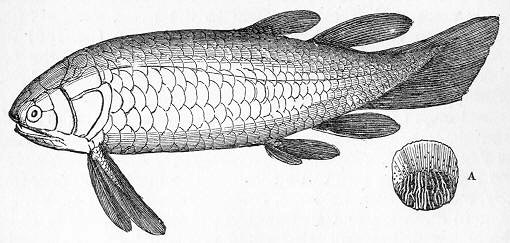 H. nobilissimus and scale


References
[edit]

- ^ Roberts, George (1839). An etymological and explanatory dictionary of the terms and language of geology. London: Longman, Orme, Brown, Green, & Longmans. p. 78. Retrieved 30 December 2021.
- ^ Species Holoptychius[permanent dead link]
- ^ Palmer, D., ed. (1999). The Marshall Illustrated Encyclopedia of Dinosaurs and Prehistoric Animals. London: Marshall Editions. p. 43. ISBN 1-84028-152-9.
- ^ Holland, Timothy (2010). "Upper Devonian osteichthyan remains from the Genoa River, Victoria, Australia" (PDF). Memoirs of Museum Victoria. 67: 35–44. doi:10.24199/j.mmv.2010.67.04. Archived from the original (PDF) on March 4, 2016. Retrieved 2017-04-04.
- ^ Fernández, Jorge Mondéjar; Meunier, François J (2020). "New histological information on Holoptychius Agassiz, 1839 (Sarcopterygii, Porolepiformes) provides insights into the palaeoecological implications and evolution of the basal plate of the scales of osteichthyans". Historical Biology. 33 (10): 2276–2288. doi:10.1080/08912963.2020.1786552. Retrieved 2026-06-01.
- ^ a b "PBDB Taxon". paleobiodb.org. Archived from the original on 2025-01-23. Retrieved 2026-06-01.
- ^ a b c d Downs, Jason P.; Daeschler, Edward B.; Jenkins, Farish A.; Shubin, Neil H. (2013-03). "Holoptychius bergmannisp. nov. (Sarcopterygii, Porolepiformes) from the Upper Devonian of Nunavut, Canada, and a Review ofHoloptychiusTaxonomy". Proceedings of the Academy of Natural Sciences of Philadelphia. 162 (1): 47–59. doi:10.1635/053.162.0104. ISSN 0097-3157.
- ^ a b c d Woodward (1891). Catalogue of the Fossil Fishes in the British Museum (Natural History).
- ^ a b Schultze, H. P.; Cloutier, R. (1996). "Porolepiform fishes (Sarcopterygii)" (PDF). Devonian fishes and plants of Miguasha, Quebec. Canada. Dr F. Pfeil, München.
- ^ a b Miller, Randall F.; Brazeau, Martin D. (2007-01-01). "A Late Devonian porolepiform fish (Holoptychius) and the age of the kennebecasis formation, southern New Brunswick, Canada". Atlantic Geology. 43: 187–197. doi:10.4138/5650.
- ^ a b Mondéjar-Fernández, Jorge; Janvier, Philippe (2014-10-01). "Further evidence for the presence of holoptychiid porolepiforms (Sarcopterygii, Dipnomorpha) from the Frasnian of Colombia". Comptes Rendus Palevol. 13 (7): 587–597. Bibcode:2014CRPal..13..587M. doi:10.1016/j.crpv.2014.03.009. ISSN 1631-0683.
- ^ Janvier & Villarroel, 1998
- ^ Goedert, Jean; Lécuyer, Christophe; Amiot, Romain; Arnaud-Godet, Florent; Wang, Xu; Cui, Linlin; Cuny, Gilles; Douay, Guillaume; Fourel, François; Panczer, Gérard; Simon, Laurent; Steyer, J.-Sébastien; Zhu, Min (30 May 2018). "Euryhaline ecology of early tetrapods revealed by stable isotopes". Nature. 558 (7708): 68–72. doi:10.1038/s41586-018-0159-2. ISSN 1476-4687. Retrieved 14 February 2025.
Bibliography
[edit]- Janvier, Philippe; Villarroel A, Carlos (1998). "Los Peces Devónicos del Macizo de Floresta (Boyacá, Colombia). Consideraciones taxonómicas, bioestratigráficas, biogeográficas y ambientales". Geología Colombiana. 23: 3–18. Retrieved 2017-03-31.
 Media related to Holoptychius at Wikimedia Commons
| |||||||||||||
.jpg)


 | This article about a prehistoric lobe-finned fish is a stub. You can help Wikipedia by adding missing information. |