Wiki Article
Lepidodendron
Nguồn dữ liệu từ Wikipedia, hiển thị bởi DefZone.Net
| Lepidodendron Temporal range:
| |
|---|---|

| |
| Life reconstruction | |
Scientific classification 
| |
| Kingdom: | Plantae |
| Clade: | Tracheophytes |
| Clade: | Lycophytes |
| Class: | Lycopodiopsida |
| Order: | †Lepidodendrales |
| Family: | †Lepidodendraceae |
| Genus: | †Lepidodendron Sternberg, 1820 |
| Species | |
| |
| Synonyms | |
| |
Lepidodendron, from Ancient Greek λεπίς (lepís), meaning "scale", and δένδρον (déndron), meaning "tree", is an extinct genus of primitive lycopodian vascular plants belonging to the order Lepidodendrales (also called "arborescent lycophytes"). Like other Lepidodendrales, species of Lepidodendron grew as large-tree-like plants in wetland coal forest environments. They sometimes reached heights of 50 metres (160 feet),[1] and the trunks were often over 1 m (3 ft 3 in) in diameter. They are often known as "scale trees", due to their bark having been covered in diamond-shaped leaf-bases which spiraled around the trunk and branches, from which the needle-like leaves attached before being shed from the lower parts of the plant as the tree grew. They thrived during the Carboniferous Period (358.9 to 298.9 million years ago), and persisted until the end of the Permian around 252 million years ago (though Permian remains may be better assigned to other lepiodendralean genera[2]). Sometimes erroneously called "giant club mosses", Lepidodendron was actually more closely related to modern quillworts than to modern club mosses. In the form classification system used in paleobotany, Lepidodendron is both used for the whole plant as well as specifically the stems and leaves.
Description and biology
[edit | edit source]Overview
[edit | edit source]
Lepidodendron species were comparable in size to modern trees. The plants had tapering trunks as wide as 2 m (6.6 ft) at their base that rose to about 40 m (130 ft)[3] and even 50 m (160 ft),[1] arising from an underground system of horizontally spreading branches that were covered with many rootlets. Though the height of the lycopsids make the plants similar to modern trees, the repeatedly dichotomising (division into two equal parts) of branches created a habit that contrasts with that of modern trees. At the ends of branches were oval-shaped strobili called Lepidostrobus that had a similar shape to modern cones of a spruce or fir that housed the spores with which the plant reproduced.[4]
Stem
[edit | edit source]

The stem of the lycopsids had a unifacial vascular cambium, contrasting with the bifacial vascular cambium of modern trees. Though the bifacial cambium of modern trees produces both secondary phloem and xylem, the unifacial cambium of Lepidodendron lycopsid produced only secondary xylem. As the lycopods aged, the wood produced by the unifacial cambium decreased towards the top of the plant such that terminal twigs resembled young Lepidodendron stems. Compared to modern trees, the stems and branches of the lycopsids contained little wood with the majority of mature stems consisting of a massive cortical meristem. The nearly-uniform growth of this cortical tissue indicates no difference in growth during changing seasons, and the absence of dormant buds further indicates the lack of seasonality in Lepidodendron species.[5] The outermost cortex of oldest stems developed into the bark-like lycopodiopsid periderm.[6] The bark of the lycopsid was somewhat similar to that of Picea species, as leaf scars formed peg-like projections that stretched and tore as the bark stretched. To resist the bending force of wind, Lepidodendron depended on their outer bark rather than their vascular tissues, as compared to modern trees that rely mostly on their central mass of wood.[4]
Leaves
[edit | edit source]


The leaves of Lepidodendron were needle-like, reaching several tens of centimetres in length and were densely spiraled about young shoots,[7] each possessing only a single vein. The leaves were similar to those of a fir in some species and similar to those of Pinus roxburghii in others, though in general the leaves of Lepidodendron species are indistinguishable from those of Sigillaria species. The leaves formed a cylindrical shell around branches. The leaves were only present on thin and young branches, indicating that, though the lycopsid were evergreen, they did not retain their needles for as long as modern conifers. The leaf-cushions were fusiform and elongated, growing at most to a length of 8 cm (3 in) and a width of 2 cm (3⁄4 in). The middle of leaf-cushions were smooth, diamond-shaped, longer than wide (as opposed to hexagonal in Sigillaria[7]) leaf scars were created when an abscission layer cut a leaf from its base. Each leaf scar was composed of a central circular or triangular scar and two lateral scars that were smaller and oval-shaped. This central scar marks where the main vascular bundle of the leaf connected to the vascular system of the stem. This xylem bundle was composed only of primary trachea.[citation needed] The two outer scars mark the forked branches of a strand of vascular tissue that passed from the cortex of the stem into the leaf. This forked strand is sometimes referred to as the "parichnos". Surrounding this strand were parenchyma cells and occasionally thick-walled elements. Surrounding both conducting tissues was a broad sheath of transfusion tracheids. Below the leaf scar the leaf-cushion tapered to a basal position. In this tapering area, circular impressions with fine pits were present. These impressions were continuous with the parichnos scars near the top of the tapering portion. This is because the impressions are formed by aerenchyma tissue that developed in closely with the parichnos. Above the leaf scar was a deep triangular impression known as the "ligular pit" for its similarities to the ligule of Isoetes. In some leaf-cushions a second depression was present above the ligular pit. Though its purpose is unclear, it has been suggested that the depression may mark the position of a sporangium. As the branch of a Lepidodendron lycopsid grew the leaf-cushion only grew to a certain extent, past which the leaf-cushion stretched. This stretching widened the groove that separated the leaf-cushions, creating a broad, flat channel.[4]
Underground structures
[edit | edit source]

The underground structures of Lepidodendron and similar lycopsid species known from the fossil record including Sigillaria are assigned to the form taxon, Stigmaria. The rootlets were dichotomously branched from the rhizomes similar to Isoetes. These rhizomorphic axes were shoot-like, and dichotomous branching of the rootlets structured the stigmarian systems. Rootlet scars can be seen from Stigmaria fossils where the root hairs used to be attached.[8] Hyphae are occasionally present in the tissues of Lepidodendron lycopsids, indicating the presence of mycorrhizal associations.[9]
Decay
[edit | edit source]Different fossil genera have been described to name the various levels of decay in Lepidodendron bark fossils. The name Bergeria describes stems that have lost their epidermises, Aspidiaria is used when cushions have been removed by deep decay, and Knorria is used when the leaf cushions and the majority of cortical tissues has decayed, with a shallow "fluted" surface remaining. However, it has been suggested that these are more likely growth forms than preserved bark types, as entire fossilized trunks have been discovered with dissimilar forms; if decay is assumed to be constant throughout the trunk, then different forms indicate growth rather than levels of decay. It is likely that the trunk of Lepidodendron lycopsids were subject to the growth forms Knorria, Aspidiaria, and Bergeria progressing up the trunk, respectively.[10]
Growth and reproduction
[edit | edit source]| External image | |
|---|---|
 Painting of lepidodendralean trees at various stages of growth by Annette Townsend |


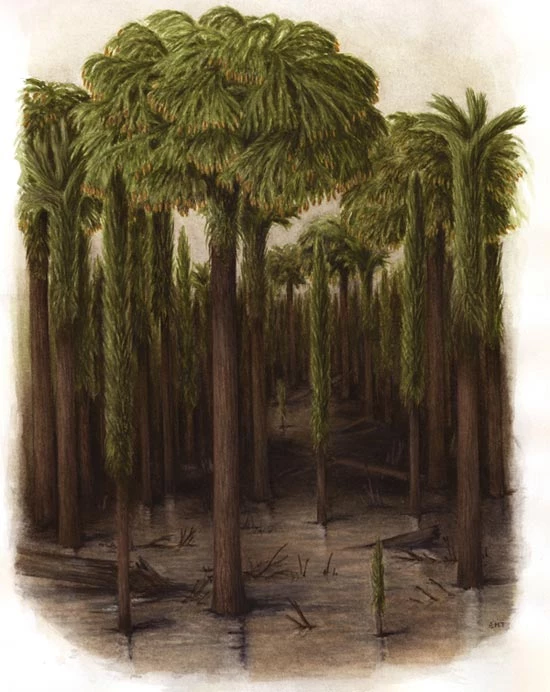
During the early stages of growth, Lepidodendron grew as single, unbranched trunk, with leaves growing out of the scale leaf bases (cushions). As the plant grew, the leaves on the lower part of the trunk became dry and withered before being shed, and near maturity, the upper part of the trunk repeatedly dichotomously (into two equally sized subdivisions) branched into a crown.[11][7] It has been disputed as to how far the leaf loss went in mature Lepidodendron, with some authors suggesting that the uppermost unbranched portion of the trunk and the inner canopy of the crown remained leafy, while others suggest that only the outer branches of the crown were covered in leaves.[7] In mature trees, the leaf scars on the lower trunk were also sloughed off, leaving the periderm exposed. The rate of growth of arborescent lycophytes is disputed, some authors contended that they had a rapid life cycle, growing to their maximum size and dying in only 10 to 15 years, while other authors argue that these growth rates were overestimated.[11] Rather than reproduce with seeds, Lepidodendron lycopsids reproduced with spores. The spores were stored in sporangia situated on fertile stems that grew on or near the main trunk. The fertile stems grew together in conifer cone-like strobili (Lepidostrobus) that clustered at the tips of branches,[12] with the plants spores being attached to the scale-like sporophylls. Unlike some other arborescent lycophytes such as Lepidophloios and Diaphorodendron, Lepidodendron proper probably only reproduced via spores at the very end of their life cycles (monocarpic), as opposed to over a broad span of their lifespan. It is unclear whether Lepidodendron proper was heterosporous, that is having the microspores and megaspores being produced on the different sporophylls within the same strobilus cone, as is known from Diaphorodendron species formerly assigned to Lepidodendron as opposed to homosporous (the microspores and megaspores being produced on the same sporophylls).[7]
Distribution and prevalence
[edit | edit source]
The lack of growth rings and dormant buds indicates no seasonal growth patterns, and modern plants with similar characteristics tend to grow in tropical conditions. However, Lepidodendron species were distributed throughout subtropical regions. The lycopsid inhabited an extensive area compared to tropical flora of the same time period, with lycopods growing as far north as Spitsbergen and as far south as South America, in a latitudinal range of 120°.[5] At their height during the Bashkirian–Moscovian stages of the Late Carboniferous, arborescent lycophytes like Lepidodendron may have accounted for 75-80% of the biomass of Euramerican coal swamp forests. Their density within the forests has been disputed, with estimates varying from 150 to over 570 plants per hectare.[7]
Extinction
[edit | edit source]In Euramerica, Lepidodendron became extinct at the end of the Carboniferous,[13] with the disappearance of arborescent lycophytes from the region largely complete by the end of Moscovian,[7] as part of a broader pattern of ecological change, including the increasing dominance of seed ferns (Medullosales) and tree ferns (Marattiales) in lowland wetland forests, and increasingly arid-adapted vegetation across the region as result of climatic changes brought by collision of Euramerica and Gondwana during the formation of Pangaea (Variscan orogeny), resulting in the disappearance of coal swamp forests in the region by the Early Permian.[7][14] However, in the Cathaysia region comprising what is now China, wet tropical environmental conditions continued to prevail, with Lepidodendron (in its broad sense, perhaps actually assignable to Synchysidendron and Diaphorodendron[2][15]) only becoming extinct around the end of the Permian, around 252 million years ago, as a result of the extreme environmental disturbance caused by the Permian-Triassic extinction event,[13][16] though by end of the Permian arborescent lycophytes were marginal and rare elements of Cathaysian ecosystems.[2]
Research history and taxonomy
[edit | edit source]Lepidodendron was originally described in 1820 by Kaspar Maria von Sternberg based on the characteristic leaf base-covered stem fossils found in Central Europe.[17][18] The type species (retrospectively declared by S. A. Miller in 1889[19][18]) Lepidodendron aculeatum was named in the study based on remains found in Radnice in what is now the Plzeň Region of the Czech Republic.[7] Sternberg originally also named the family that the genus belonged to "Lepidodendron", in violation of modern taxonomic rules, dividing the family into two tribes "Lepidotae" and "Alveolariae" (the former divided into two subtribes). Shortly after in 1822, Alexandre Brongniart split off the "Alveolariae" into its own genus, Sigillaria.[20][18] One of species that von Sternberg had described in the "Lepidotidae" later turned out to be the stem of a Mesozoic tree fern. In his first subtribe of "Lepidotae" von Sternberg named the species Lepidodendron aculeatum, L. crenatum, L. dichotomum, L. laricinum, L. obovatum, L. rimosum, and L. undulatum . The scope of these species has been subject of confusion by later scholars. Later study in the late 20th century suggested that some Lepidodendron species should be spit into additional genera based on morphological differences in the shape of the leaf bases, including Diaphorodendron, Synchysidendron and Hizemodendron based on petrifaction specimens.[18][21] The order to which Lepidodendron and other "scale trees" belong, Lepidodendrales belongs to the Lycopodiopsida, and is widely agreed to be most closely related to quillworts (Isoetes) among living lycophytes,[2][22] with Lepidodendrales sometimes being included within the quillwort order Isoetales.[21]
See also
[edit | edit source]- Archaeopteris
- Carboniferous
- Evolutionary history of plants
- Fossil Grove
- Glossopteris
- Lepidodendrales
- Lycophytes
- Lycopsid
- Stigmaria
- Sigillaria
References
[edit | edit source]- ^ a b V. V. Alekhin (1961). Geografiia rastenii s osnovani botaniki (Geography of plants and basics of botany). Gos. nauchno-pedagog. izd-vo. p. 167. Retrieved 2020-10-05.
- ^ a b c d Peng, Jungang; Slater, Sam M.; McLoughlin, Stephen; Rastier, Alexis; Vajda, Vivi (2026-08-11). "Global proliferation of opportunistic pleuromeian lycopsids following the disappearance of the end-Triassic forests". npj Palaeoecosystems. 1 (1). doi:10.1038/s44513-026-00002-8. ISSN 3091-390X.
- ^
A. V. Lopatin (2012). Палеонтологический музей имени Ю.А. Орлова (The Orlov Museum of Paleontology). Moscow: PIN RAN. p. 56. ISBN 978-5-903825-14-1. Retrieved 2020-10-05.
{{cite book}}: CS1 maint: publisher location (link) - ^ a b c Seward, Albert Charles (1898). Fossil plants: for students of botany and geology. Vol. 1. Cambridge University Press. pp. 93–192.
- ^ a b Vulf, Evgenii Vladimirovich and Brissenden, Elizabeth (1943). An introduction to historical plant geography. Chronica Botanica Company. pp. 176–177.
{{cite book}}: CS1 maint: multiple names: authors list (link) - ^ Karl J. Niklas (1997). The Evolutionary Biology of Plants (illustrated ed.). University of Chicago Press. p. 321. ISBN 978-0-226-58083-8.
- ^ a b c d e f g h i Pott, Christian; Schöllmann, Lothar (2026-09). "Insights into the canopy of the iconic Lepidodendron aculeatum , based on new articulated fossils from the Bashkirian (Pennsylvanian) of Hagen‐Vorhalle, Germany". Papers in Palaeontology. 12 (5). doi:10.1002/spp2.70118. ISSN 2056-2799.
{{cite journal}}: Check date values in:|date=(help) - ^ Hetherington, A.J.; Berry, C.M.; Dolan, Liam (2016). "Networks of highly branched stigmarian rootlets developed on the first giant trees". PNAS. 113 (24): 6695–6700. Bibcode:2016PNAS..113.6695H. doi:10.1073/pnas.1514427113. PMC 4914198. PMID 27226309.
- ^ Strullu-Derrien, Christine; Strullu, Désiré-Georges (November 2007). "Mycorrhization of fossil and living plants". Comptes Rendus Palevol. 6 (6–7): 483–494. Bibcode:2007CRPal...6..483S. doi:10.1016/j.crpv.2007.09.006.
- ^ Thomas, B.A. and Watson, Joan (1976). "A rediscovered 114-foot Lepidodendron from Bolton, Lancashire". Geological Journal. 11 (1). Wiley Online Library: 15–20. Bibcode:1976GeolJ..11...15T. doi:10.1002/gj.3350110102.
{{cite journal}}: CS1 maint: multiple names: authors list (link) - ^ a b Thomas, Barry A.; Cleal, Christopher J. (May 2018). "Arborescent lycophyte growth in the late Carboniferous coal swamps". New Phytologist. 218 (3): 885–890. doi:10.1111/nph.14903. PMID 29282734.
- ^ John Adam Dorr, Donald F. Eschman (1970). Geology of Michigan (illustrated ed.). University of Michigan Press. p. 429. ISBN 978-0-472-08280-3.
- ^ a b Feng, Ru; D'Rozario, Ashalata; Zhang, Jian-Wei (December 2019). "A new Bergeria (Flemingitaceae) from the Mississippian of Xinjiang, NW China and its evolutionary implications". Journal of Palaeogeography. 8 (1): 4. Bibcode:2019JPalG...8....4F. doi:10.1186/s42501-018-0020-4. ISSN 2524-4507.
- ^ Lucas, Spencer G.; DiMichele, William A.; Opluštil, Stanislav; Wang, Xiangdong (2023-06-14). "An introduction to ice ages, climate dynamics and biotic events: the Late Pennsylvanian world". Geological Society, London, Special Publications. 535 (1): 1–15. Bibcode:2023GSLSP.535..334L. doi:10.1144/SP535-2022-334. ISSN 0305-8719.
- ^ Pfefferkorn, Hermann W.; Wang, Jun (2009-09-01). "Stigmariopsis, Stigmaria asiatica, and the survival of the Sigillaria brardii-ichthyolepis group in the tropics of the late Pennsylvanian and Early Permian". Palaeoworld. Carboniferous and Permian Biota, Integrative Stratigraphy, Sedimentology, Palaeogeography, and Palaeoclimatology. 18 (2): 130–135. doi:10.1016/j.palwor.2009.04.005. ISSN 1871-174X.
- ^ Xu, Zhen; Hilton, Jason; Yu, Jianxin; Wignall, Paul B.; Yin, Hongfu; Xue, Qing; Ran, Weiju; Li, Hui; Shen, Jun; Meng, Fansong (September 2022). "End Permian to Middle Triassic plant species richness and abundance patterns in South China: Coevolution of plants and the environment through the Permian–Triassic transition". Earth-Science Reviews. 232 104136. Bibcode:2022ESRv..23204136X. doi:10.1016/j.earscirev.2022.104136.
- ^ Sternberg, K.M. von 1820. Versuch einer geognostisch-botanischen Darstellung der Flora der Vorwelt [An Attempt at a Geognostic-Botanical Presentation of the Flora of the Primeval World] vol. 1(1). Leipzig und Prag [Prague].
- ^ a b c d Thomas, Barry A.; Cleal, Christopher J. (2020-10). "The nomenclature of fossil‐taxa representing different preservational states: Lepidodendron as a case‐study". TAXON. 69 (5): 1052–1061. doi:10.1002/tax.12291. ISSN 0040-0262.
{{cite journal}}: Check date values in:|date=(help) - ^ Miller, S.A. 1889. North American geology and palaeontology for the use of amateurs, students, and scientists.[s.n.].
- ^ Brongniart, A. 1822. Sur la classification et la distribution des végétaux fossiles en général, et sur ceux des terrains de sediment supérieur en particulier [On the classification and distribution of fossil plants in general, and on those of the upper sedimentary strata in particular]. Mém. Mus. Hist. Nat. 8: 203–240, 297–348.
- ^ a b Bateman, Richard M.; DiMichele, William A. (2021-10). "Escaping the voluntary constraints of "tyre‐track" taxonomy". TAXON. 70 (5): 1062–1077. doi:10.1002/tax.12540. ISSN 0040-0262.
{{cite journal}}: Check date values in:|date=(help) - ^ Spencer, Victoria; Nemec Venza, Zoe; Harrison, Cecily Jill (May 2021). "What can lycophytes teach us about plant evolution and development? Modern perspectives on an ancient lineage". Evolution & Development. 23 (3): 174–196. doi:10.1111/ede.12350. hdl:1983/e2d92b26-7dfb-40f9-9a53-225f2e0f8775. ISSN 1520-541X. PMID 32906211. S2CID 221622444.
Further reading
[edit | edit source]
- Davis, Paul; Kenrick, Paul (2004). Fossil Plants. Washington, DC: Smithsonian Books. ISBN 1-58834-181-X.
- Morran, Robin C. (2004). A Natural History of Ferns. Portland: Timber Press. ISBN 0-88192-667-1.
- "Plant fossils of the British Coal Measures" by Christopher J.Cleal and Barry A.Thomas, publ. The Palaeontological Association, London, 1994, 222 pages, ISBN 0-901702-53-6
- J. M. Anderson and H. M. Anderson. 1985. Palaeoflora of Southern Africa. Prodromus of South African Megafloras Devonian to Lower Cretaceous 1-423
Genera of Lycopodiopsida | ||
|---|---|---|
| ||
| †Drepanophycales |
 | |
| Lycopodiales | ||
| †Protolepidodendrales | ||
| Selaginellales | ||
| Isoetales | ||
| †Lepidodendrales | ||