Wiki Article
Lezgin ethnic groups
Nguồn dữ liệu từ Wikipedia, hiển thị bởi DefZone.Net
 Lezgin sub-ethnic groups | |
| Total population | |
|---|---|
| approx. 1.5 million | |
| Regions with significant populations | |
 Russia Russia
| 725,694 (2021)[1] 608,898 (2021)[1] |
 Azerbaijan Azerbaijan | 600,000 – 900,000[2] |
| Languages | |
| Lezgic languages | |
| Religion | |
| Sunni Islam | |

The Lezgin sub-ethnic groups or Leks[3] are a collection of Caucasian-originated ethnic groups in Caucasus, who speak Lezgic languages. Their ancestors are referred to as Leks and Albans (Aluans).[4]
Etymology
[edit]Lekk; Strabo (XI.5.1): Legoi; Georgian: ლეკი (Lek’ni); Arab: اللاكزي (Lakzi); Russian: Лезгины (Lezginy); English: Lezgins, is the general name for the indigenous Lezgin ethnic groups of southern Dagestan inhabiting the basin of the River Samur from the Caucasus range to the Caspian Sea. Although the term was long used by Russian and Western authors for all of the peoples of Dagestan it is now considered to be proberly applied to only ten of the thirty ethnic groups of the region: The Aghul, Rutul, Tsakhur, Tabasaran, Budukh, Dzhek, Kryts, Khinalug, Archi, Udi, and Lezgins properly called.[5] The name Lek survives today in the name of the Lezgins, who live in southern Dagestan and northern Azerbaijan.[6]
List of subethnic groups
[edit]The Aguls, Archins, Budukhs, Jeks, Rutuls, Tabasarans, Tsakhurs, Khinalugs, Udis, and Kryts collectively form the Lezgin group within the Dagestanian branch of the Northeast Caucasian language family.[7]
Lezgin contemporary ethnic groups
| Ethnonym | Primary regions | Religion | Notes |
|---|---|---|---|
| Aghul | Agulsky District | Sunni Islam | Highland isolation contributed to the preservation of the Aguls' ethnocultural identity and protected them from external influence. |
| Acrhi | Archi | Sunni Islam | Have been significantly influenced by the Avars and are officially recorded as Avars in censuses.[8] |
| Budukh | Budukh | Sunni Islam | Most ethnologists today believe that the Shahdaghs have been all but completely assimilated by Azerbaijanis.[9] |
| Haput | Haput | Sunni Islam | |
| Jek | Jek | Sunni Islam | |
| Rutul | Rutulsky District | Sunni Islam | Have been significantly influenced by Azerbaijanis. |
| Tabasaran | Tabasaransky District | Sunni Islam | Have undergone substantial influence from Azerbaijanis; a portion of the population has lost proficiency in the Tabasaran language and now speaks Azerbaijani.[10] |
| Tsakhur | Zagatala, Qakh and Rutulsky | Sunni Islam | Have been significantly influenced by Avars, Georgians and Azerbaijanis. |
| Udi | Nij | Orthodox Christianity | Have been significantly influenced by Georgians and Armenians. |
| Kryts | Qırız | Sunni Islam | Most ethnologists today believe that the Shahdaghs have been all but completely assimilated by Azerbaijanis.[9] |
| Khinalug | Khinalug | Sunni Islam | |
| Yerguj | Yerguj | Sunni Islam |
Classification
[edit]A number of small Lezgin sub-ethnicities (historically tribes[11]) (Tabasarans, Rutuls, Aguls, and Tsakhurs), which had been regarded as subethnic groups of the Lezgins, were recorded in the 1959 population census as separate Lezgin ethnic groups rather than as subethnic groups of a single people. At the same time, one Lezgin subethnic group, the Archins, were recorded as Avars in the official censuses.[12] In the fundamental work Peoples of Dagestan (2002), prepared jointly with the Institute of History, Archaeology and Anthropology of the Dagestan Scientific Center, Aguls, Rutuls, Tabasarans, and Tsakhurs were included as subgroups (subethnic groups) of the Lezgins.[12]
Language
[edit]
The Lezgic languages (also Lekzi) are one of seven branches of the Northeast Caucasian language family. The Lezgic languages constitute a language branch of some 12 languages, spoken in the Caucasus. Some 1 million people have a Lezgic language as their native language. The Lezgic language with the greatest number of speakers is Lezgin proper, or Lekzi, the speakers of which account for about 80% of all Lezgic speakers.
| Eastern Lezgi | Southern Lezgi | Western Lezgi | Peripheral | |||||||||
|---|---|---|---|---|---|---|---|---|---|---|---|---|
| C. Alban (extinct)[14] | Lezgi | Agul | Tabasaran | Udi | Budukh | Jek | Kryts | Rutul | Tsakhur | Archi | Khinalug | |
| I | zow | zun | zun | uzu | zu | zyn | zyn | zyn | zy | zy | zon | zy |
| you | wun | vun | chun | uvu | hun | vyn | vun | vun | vy | hu | un | vy |
| we | žan | chun | hin | uhu | yan | yin | jin | zin | ji | shi | nenttu | kin |
| all | vari | vari | vari | vari | vari | pitin | vari | vari | vari | gyrgyn | hunniybu | chinel |
| one | sa | sad | sad | sab | sa | sad | sab | sar | sa | sa | os | sa |
| family | xza | xizan | xizan | xizan | kulfet | yeba | haile | kalfat | xizan | xizan | xizan | aile |
History
[edit]
In the 4th century BC, the numerous tribes speaking Lezgic languages united in a union of 26 tribes, formed in the Eastern Caucasus state of Caucasian Albania in 513 BC.[15][16] Adjacent to Bab-ul-Abvab (Derbent-ed.) to the borders of Islamic states along the seashore there is an area named Mascat, and next to it there is the land of the Lakzs (Lekzi, Lezgi-ed.). These last - a significant tribe, courageous, tall; they have plantations and a permanently inhabited area.[17] Lezgins or Leks is the general name for the indigenous people of southern Dagestan inhabiting the basinof the River Samur from the Caucasus range to the Caspian Sea. They are curiously unknown to Ptolemy.[18] The Lezgin speaking tribes participated in the battle of Gaugamela under the Persian banner against the invading Alexander the Great.[15] In 252–253, rule over the Lezgin tribes changed from Parthian to Sassanid Persian and Caucasian Albania became a vassal state.[19]
Demographics
[edit]Southern Dagestan and northern Azerbaijan is the home of the Lezgic group, with the Lezgin speech community actually straddling the now international Russo-Azerbaijani border.[20]

Religions
[edit].webp)
Leks (Lezgin subethnic groups) are predominantly Muslim of the Shafi`i school of thought of Sunni Islam. The majority of Lezgins (approx. 1 million[21]) and all Lezgin ethnic groups: Aguls, Archins, Budukhs, Jeks, Rutuls, Tabasarans, Tsakhurs, Khinalugs, and Kryts (approx. 200,000) are Muslim of the Shafi`i schools,[22][23] while Udi (approx. 10,000 people[24]) are Christian (Caucasian Albanian-Udi Church).[25]
In the 19th century, the doctrine of Muridizm, founded by the Lezgin Sheikh Muhammad Yarguvi, became widespread among the Leks (Lezgins) and related Lezgin subethnic groups. Lezgin murids did not recognize the authority of other imams, maintaining that only a Lek (Lezgin) could serve as imam for the Lezgin community.[26][27][28]
Origin
[edit]The Leks (Lezgin subethnic groups) have been referred to by various names, including Leks, Leagues, Albans (Aluans) in medieval Arab, Georgian and Armenian ethnography. Peter Uslar identifies ancient leks with modern Lezgins: “Lezgins, leagues, leks gave their name to the mountain range separating the Kura basin from the Rion basin. Colchis was sometimes even called by poets Ligistika, that is, the country of leagues. It is very likely that the leagues that Herodotus speaks of were Lezgi people ”. According to the Brockhaus and Efron Encyclopedic Dictionary, published in the late 19th - early 20th centuries, varnishes are classic legi (Λήγες), at the end of the 8th century.[29]
Genetics
[edit]| Population | n | J1 | R1b | G | J2 | E1b1b | I | L | R1a | R2a | T | Others | Reference |
|---|---|---|---|---|---|---|---|---|---|---|---|---|---|
| Lezgins (new) | 290 | 63 | 13 | 7 | 6 | 3 | Genes 2023[30] | ||||||
| Lezgins | 31 | 58.1 | 16.1 | 9.7 | 0.0 | 6.5 | 9.7 | 0.0 | 0.0 | 0.0 | 0.0 | Yunusbaev 2012[31] | |
| Rutulians | 24 | 58 | 0.0 | 37.5 | 4.2 | 0.0 | 0.0 | 0.0 | 0.0 | 0.0 | 0.0 | Nasidze 2004[32] | |
| Rutulians (new) | 43 | 63 | 5 | 14 | 5 | 7 | Genes 2023[30] | ||||||
| Tabassarans | 43 | 48.8 | 39.5 | 0.0 | 2.3 | 0.0 | 0.0 | 0.0 | 2.3 | 0.0 | 0.0 | C=7.0 | Yunusbaev 2012[31] |
| Tabassarans (new) | 67 | 14 | 64 | 12 | Genes 2023[30] | ||||||||
| Tsakhurs | 54 | 44 | Genes 2023[30] |
Gallery
[edit]-
![Jek people, 1880[33]](//upload.wikimedia.org/wikipedia/commons/thumb/b/bb/Ceklil%C9%99r_Cek_k%C9%99ndind%C9%99%2C_1880_%28ki%C5%9Fil%C9%99r%29-Yermakov_Dmitriy_Ivanovich.jpg/120px-Ceklil%C9%99r_Cek_k%C9%99ndind%C9%99%2C_1880_%28ki%C5%9Fil%C9%99r%29-Yermakov_Dmitriy_Ivanovich.jpg) Jek people, 1880[33]
Jek people, 1880[33] -
![Jek people, 1880[34]](//upload.wikimedia.org/wikipedia/commons/thumb/c/cf/Ceklil%C9%99r_Cek_k%C9%99ndind%C9%99%2C_1880_%28qad%C4%B1nlar%29-Yermakov_Dmitriy_Ivanovich.jpg/120px-Ceklil%C9%99r_Cek_k%C9%99ndind%C9%99%2C_1880_%28qad%C4%B1nlar%29-Yermakov_Dmitriy_Ivanovich.jpg) Jek people, 1880[34]
Jek people, 1880[34] -
 Lek (Lezgin) games
 -
 Lek (Lezgin) games, stone throwing
 -
 Khinalug resident of the village of Quba, Azerbaijan
 -
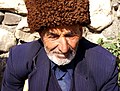 Khinalug
 -
 Khinalug resident of Quba District
 -
 Budukh women from the village of Buduq
 -
 Budukh village at the beginning of the 20th century
 -
 Tabasaran man in traditional costume
![Jek people, 1880[33]](/wiki/File:Ceklil%C9%99r_Cek_k%C9%99ndind%C9%99,_1880_(ki%C5%9Fil%C9%99r)-Yermakov_Dmitriy_Ivanovich.jpg)
![Jek people, 1880[34]](/wiki/File:Ceklil%C9%99r_Cek_k%C9%99ndind%C9%99,_1880_(qad%C4%B1nlar)-Yermakov_Dmitriy_Ivanovich.jpg)
.jpg)
.jpg)


See also
[edit]References
[edit]- ^ a b "Национальный состав России". pp. n.
- ^ Minahan, James (2002). Encyclopedia of the Stateless Nations. Greenwood Publishing Group. p. 1084. ISBN 9780313321115.: "Lezgin national organizations estimate the actual Lezgin population in Azerbaijan at between 600,000 and 900,000, much higher than the official estimates. The disparity arises from the number of ethnic Lezgins registered as ethnic Azeris during the soviet period and continue to claim Azeri nationality to escape job and education discrimination in Azerbaijan."
- ^ Бартольд, Василий Владимирович; Большаков, Олег Георгиевич (2002). Работы по исторической географии (in Russian). Издательская фирма "Восточная лит-ра" РАН. ISBN 978-5-02-018295-0.
- ^ "ЛЕЗГИНСКИЕ НАРОДЫ • Большая российская энциклопедия - электронная версия". old.bigenc.ru. Retrieved 2025-06-24.
- ^ H Hewsen, Robert (1992). The Geography of Anasias of Sirak. Wiesbaden: Dr Ludwig Reichert Verlag. ISBN 978-3882264852.
- ^ "Dictionary of Greek and Roman Geography (1854), LABANAE AQUAE, LAURI, LEGAE". www.perseus.tufts.edu. Retrieved 2021-02-04.
- ^ "ФОРМИРОВАНИЕ ЛЕЗГИНСКОЙ НАЦИОНАЛЬНОЙ ЛИТЕРАТУРЫ" (PDF). pp. 23–24.
- ^ Pashaeva, Sheri. "Арчинцы. Перепись по РД с 2002 по 2021 гг данные" [Archintsy. Census data for the Republic of Dagestan from 2002 to 2021]. academia.edu (in Russian).
- ^ a b Olson, James Stuart; Pappas, Lee Brigance; Pappas, Nicholas Charles (1994-01-01). An Ethnohistorical Dictionary of the Russian and Soviet Empires. Greenwood Publishing Group. p. 591. ISBN 9780313274978.
- ^ Ikhilov, Mikhail Matatovich (1967). Народности лезгинской группы: этнографическое исследование прошлого и настоящего лезгин, табасаранцев, рутулов, цахуров, агулов (in Russian).
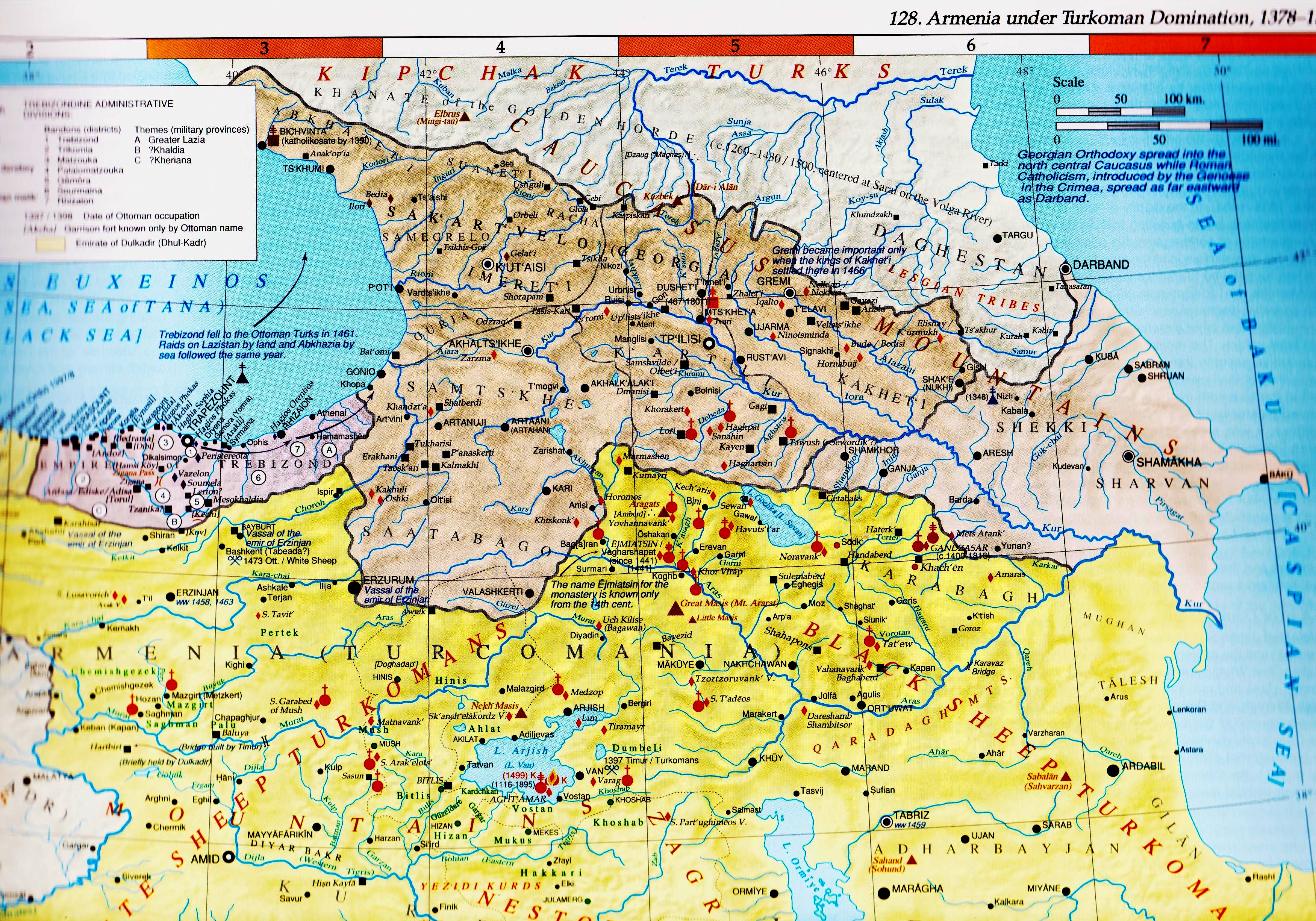
- ^ Hewsen, Robert (1378). "Caucasus 1378".
- ^ a b Тишков, В.А.; Кисриев, Э.Ф. (2007). МНОЖЕСТВЕННЫЕ ИДЕНТИЧНОСТИ МЕЖДУ ТЕОРИЕЙ И ПОЛИТИКОЙ (ПРИМЕР ДАГЕСТАНА (PDF) (in Russian).
{{cite book}}: line feed character in|title=at position 33 (help)CS1 maint: date and year (link) - ^ "IDS - Entry "I"". ids.clld.org. Retrieved 2026-02-28.
- ^ murugvi (2020-08-07). "ИСТОРИЯ ДИФФЕРЕНЦИАЦИИ И ПРЕЕМСТВЕННОСТЬ ЛЕЗГИНСКИХ ЯЗЫКОВ, ГРУППЫ И ДИАЛЕКТЫ". АЛАМ (in Russian). Retrieved 2026-03-01.
- ^ a b Chaumont, M. L. (1985). "Albania". In Yarshater, Ehsan (ed.). Encyclopædia Iranica (Online ed.). Encyclopædia Iranica Foundation. Retrieved 21 January 2025.
- ^ Bruno Jacobs, "ACHAEMENID RULE IN Caucasus" in Encyclopædia Iranica. January 9, 2006. Excerpt: "Achaemenid rule in the Caucasus region was established, at the latest, in the course of the Scythian campaign of Darius I in 513–512 BC. The Persian domination of the cis-Caucasian area (the northern side of the range) was brief, and archeological findings indicate that the Great Caucasus formed the northern border of the empire during most, if not all, of the Achaemenid period after Darius"
- ^ Al-Istahri, 930, From the "Book of the Paths of the Kingdoms." issue XXIV, pp. 15-17.
- ^ Mosis Chorenensis. HISTORIÆ ARMENIACÆ. Libri III. Epitome Geographiæ. LONDINI, 1736. Page 118.
 This en contains too many or overly lengthy quotations. (March 2026)
 - ^ Yarshater, Ehsan (1983). The Cambridge History of Iran. Vol. 3.1. Cambridge University Press. p. 141. ISBN 9781139054942.
- ^ Price, Glanville (1998-09-11). Encyclopedia of the Languages of Europe. Wiley. ISBN 978-0-631-19286-2.
- ^ Cornell, Svante (2005). Small Nations and Great Powers: A Study of Ethnopolitical Conflict in the Caucasus. Routledge. p. 259. ISBN 9781135796693.
- ^ Cole, Jeffrey, ed. (2011). "Lezgins". Ethnic Groups of Europe: An Encyclopedia. ABC-Clio. p. 237. ISBN 9781598843033.
The Lezgins are Muslims; the great majority are Sunni of the Shafi'i rite.
- ^ Hahn, Gordon M. (2007). Russia's Islamic Threat. Yale University Press. pp. 100, 217. ISBN 9780300120776.
- ^ "Ethnic Groups in Georgia # 3 – Udis". The Georgian Times. 2008-04-17. Archived from the original on 2008-08-29. Retrieved 2008-04-17.
- ^ Sergei Markedonov. Azerbaijan: an Islamist Threat to Religious Harmony. Memo.ru
- ^ Баламирзоева, Б.Д. "НАЧАЛО "НОВОГО УЧЕНИЯ" ЛЕЗГИНСКОГО АЛИМА МАГОМЕДА ЯРАГСКОГО".
- ^ АГАЕВ, А. Г. (1996). "МАГОМЕД ЯРАГСКИЙ" (PDF). Makhachkala.
- ^ Кисриев, 2007
- ^ К, Услар П. (2013-03-13). Этнография Кавказа: Языкознание (in Russian). ООО ДиректМедиа. ISBN 978-5-9989-7643-8.
- ^ a b c d Anastasia Agdzhoyan; Nasib Iskandarov; Georgy Ponomarev; Vladimir Pylev; Sergey Koshel; Vugar Salaev; Elvira Pocheshkhova; Zhaneta Kagazezheva; Elena Balanovska (2023-09-09). "Origins of East Caucasus Gene Pool: Contributions of Autochthonous Bronze Age Populations and Migrations from West Asia Estimated from Y-Chromosome Data". Genes. 14 (9). doi:10.3390/genes14091780. ISSN 2073-4425. Archived from the original on 2025-05-14.
- ^ a b CITEREFYunusbayev2012
- ^ Nasidze 2004a
- ^ "Ермаков Дмитрий Иванович. Группа мужчин и мальчиков из селения Джег. Джеки". Archived from the original on 1 April 2012. Retrieved 15 January 2013.
- ^ "Ермаков Дмитрий Иванович. Группа девочек и старуха из селения Джег. Джеки". Archived from the original on 1 April 2012. Retrieved 15 January 2013.

Bibliography
[edit]- Ихилов, М.М. (1967). НАРОДНОСТИ ЛЕЗГИНСКОЙ ГРУППЫ (PDF) (in Russian). Makhachkala: ДАГЕСТАНСКИЙ ФИЛИАЛ АКАДЕМИИ НАУК СССР ИНСТИТУТ ИСТОРИИ, ЯЗЫКА И ЛИТЕРАТУРЫ ИМЕНИ Г.ЦАДАСЫ.
- Азизов, Серкер Абдулазизович. Большесемейные и семейно-родственные организации лезгинской группы народов Южного Дагестана и Северного Азербайджана во второй половине ХIХ - начале ХХ вв.
- Акимова Аида Акимовна, Гусейнова Райганат Таджибовна. Лезгинские народы в составе Кавказской Албании
- Б. Г. Алиев, М.С. К Умаханов. ИСТОРИЧЕСКАЯ ГЕОГРАФИЯ ДАГЕСТАНА XVII — нач. XIX в.
- Тишков В. А., Кисриев Э. Ф. Множественные идентичности между теорией и политикой (пример Дагестана) // Этнографическое обозрение. — 2007. — № 5. 94-124
External links
[edit]
| Caucasian (areal) |
|  | ||||||||||||||||
|---|---|---|---|---|---|---|---|---|---|---|---|---|---|---|---|---|---|---|
| Indo- European |
| |||||||||||||||||
| Turkic |
| |||||||||||||||||
| Others | ||||||||||||||||||