| Sultan Mosque Masjid Sultan | |
|---|---|
مسجد سلطان | |
_-_img_08.jpg) Sultan Mosque in 2023 | |
| Religion | |
| Affiliation | Islam |
| Branch/tradition | Sunni Islam |
| Location | |
| Location | 3 Muscat Street Singapore 198833 |
| Country | Singapore |
.svg)  Location in Singapore | |
 Interactive map of Sultan Mosque Masjid Sultan | |
| Coordinates | 1°18′08″N 103°51′32″E / 1.3022°N 103.8590°E |
| Architecture | |
| Architect | Denis Santry of Swan & Maclaren |
| Type | Mosque |
| Style | Indo–Saracenic |
| Established | 1824 (original) 1929 (current) |
| Groundbreaking | 1824 (original) 1924 (current) |
| Completed | 1826 (original) 1932 (current) |
| Construction cost | 3,000 spanish dollars (original) S$200,000 (current)[a] |
| Capacity | 5,000 |
| Designated as NHL | |
| Designated | 8 March 1975 |
| Reference no. | 14 |
| Website | |
| sultanmosque | |
Sultan Mosque or Masjid Sultan is a mosque located at Muscat Street and North Bridge Road within the Kampong Glam precinct of the district of Rochor in Singapore. It was named after Sultan Hussain Shah. The mosque was completed in 1932, having been rebuilt from a previous mosque on the same site which dates back to 1826. In 1975, it was designated as a national monument of Singapore.[1]
History
[edit]The 1819 Singapore Treaty between Hussein Shah of Johor and Stamford Raffles of the British East India Company (EIC) had allowed the British to formally establish a trading settlement in Singapore. Not long after, Sultan Hussein requested that a mosque be built beside his royal residence, the Istana Kampong Glam, to serve the local Muslim community. Raffles pledged support for the project and contributed 3,000 spanish dollars from the EIC towards its construction.[1]
The original mosque was completed in 1826 as a modest brick structure of a single storey, featuring a double tiered pitched roof typical of Southeast Asian architectural styles of the period. By 1924, after more than a century of use, the building had fallen into severe disrepair. The trustees subsequently decided that the ageing structure should be demolished and replaced with a new and larger mosque, resulting in the construction of the present building.[1]
The reconstructed mosque was two-thirds complete when it was formally opened on 27 December 1929.[2] The mosque was fully completed in 1932.[3] The first known installation of a microphone–loudspeaker set occurred in 1936 in the mosque; it was reported that the summons to prayer could 'carry more than a mile'. Some mosque attendees were initially sceptical of the new electric system, however most believed it was necessary to empower the muezzin's voice to transcend a city's noises.[4]
The Sultan Mosque has stayed relatively unchanged since it was rebuilt, with only repairs carried out to the main hall in 1968. It was gazetted as a national monument on 8 March 1975. An annex was added in 1993. The mosque is managed by its own board of trustees and management board.
Transportation
[edit]The mosque is accessible from Bugis MRT station and Jalan Besar MRT station on the Mass Rapid Transit (MRT) network. There are also numerous public bus stops in the vicinity, including at the adjacent North Bridge Road.
See also
[edit]Gallery
[edit]-
 Gateway to the mosque.
 -
 Masjid Sultan Sign.
 -
 Masjid Sultan at Muscat Street in Kampong Glam.
 -
 Masjid Sultan Aerial Perspective in 2008.
 -
 Aerial perspective of Masjid Sultan in Singapore.
 -
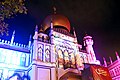 Festive Light and Sound Show on the façade in April 2022 to celebrate Ramadan.
 -
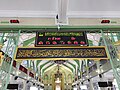 Electronic sign with times for prayer.
 -
 Tourists at the mosque.
 -
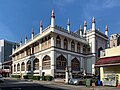 Eastern facade.
 -
 The mosque's walking street.
_-_img_01.jpg)


_-_img_06.jpg)
_-_img_05.jpg)
_-_img_07.jpg)
Notes
[edit]- ^ Estimated, the common currency used in Singapore at the time was the Straits dollar.
References
[edit]- ^ a b c "Sultan Mosque". www.roots.gov.sg. National Heritage Board. 15 October 2020. Retrieved 23 December 2025.
- ^ "New Sultan Mosque at Kampong Glam". Retrieved 2018-09-24.
- ^ "Matters of Muslim Interest". Retrieved 2018-09-24.
- ^ Winters, Bryan (2015). The Bishop, the Mullah, and the Smartphone: The Journey of Two Religions into the Digital Age. Eugene, Oregon: Wipf and Stock Publishers. p. 318. ISBN 9781498217934. Retrieved 12 October 2019.
- National Heritage Board (2002), Singapore's 100 Historic Places, Archipelago Press, ISBN 981-4068-23-3
External links
[edit]


| International | |
|---|---|
| National | |
| Other | |
