| This is the talk page for discussing improvements to the Catholic Church article. This is not a forum for general discussion of the subject of the article. |
Article policies
|
| Find sources: Google (books · news · scholar · free images · WP refs) · FENS · JSTOR · TWL |
Archives: 1, 2, 3, 4, 5, 6, 7, 8, 9, 10, 11, 12, 13, 14, 15, 16, 17, 18, 19, 20, 21, 22, 23, 24, 25, 26, 27, 28, 29, 30, 31, 32, 33, 34, 35, 36, 37, 38, 39, 40, 41, 42, 43, 44, 45, 46, 47, 48, 49, 50, 51, 52, 53, 54, 55, 56Auto-archiving period: 30 days  |
 | The contentious topics procedure applies to this article. This article relates to abortion, a contentious topic. Editors are advised to familiarise themselves with the contentious topics procedures before editing this page. Editors who repeatedly or seriously fail to adhere to the purpose of Wikipedia, any expected standards of behaviour, or any normal editorial process may be blocked or restricted by an administrator. |
 | Discussions on this page have often led to previous arguments being restated. Please read recent comments and look in the archives before commenting. |
 | This article is written in British English with Oxford spelling (colour, realize, organization, analyse; note that -ize is used instead of -ise) and some terms may be different or absent from other varieties of English. According to the relevant style guide, this should not be changed without broad consensus. |

 | This article has previously been nominated to be moved. Please review the prior discussions if you are considering re-nomination.
Discussions:
|
 | This  level-3 vital article is rated GA-class on Wikipedia's content assessment scale. level-3 vital article is rated GA-class on Wikipedia's content assessment scale.It is of interest to multiple WikiProjects. | |||||||||||||||||||||||||||||||||||||||||||||||||||||||||||||||||||||||||||||||||||||||||||||||||||||||||||||||||||||||||||||||||||||
| ||||||||||||||||||||||||||||||||||||||||||||||||||||||||||||||||||||||||||||||||||||||||||||||||||||||||||||||||||||||||||||||||||||||


.svg)

 | Other talk page banners | |||||||||||||||||||||||||||||||||||||||||||||||||||||||||||||||||||||||||||||||||||||||||||||||||||||||||||||||||||||||||||||||||||||||||||||||||||||||||||||||||||||||||||||||||||||||||||||||||||||||||||||||||||||||||||||||||||||||||||||||||||||||||||||||||||||||||||||||||||||||||||||||
| ||||||||||||||||||||||||||||||||||||||||||||||||||||||||||||||||||||||||||||||||||||||||||||||||||||||||||||||||||||||||||||||||||||||||||||||||||||||||||||||||||||||||||||||||||||||||||||||||||||||||||||||||||||||||||||||||||||||||||||||||||||||||||||||||||||||||||||||||||||||||||||||||


GA Reassessment
[edit]The following discussion is closed. Please do not modify it. Subsequent comments should be made on the appropriate discussion page. No further edits should be made to this discussion.
- Article (edit | visual edit | history) · Article talk (edit | history) · Watch • • Most recent review
- Result: No consensus. ~~ AirshipJungleman29 (talk) 00:27, 1 March 2024 (UTC)
Several uncited sections, including almost the entire first section of the History section. History focuses disproportionately on 20th and 21st century. Z1720 (talk) 17:27, 2 February 2024 (UTC)
- Disagree that the history weighting is a significant problem. Might require a minor rebalancing—-I’m not sure why John Paul II has his own section while other popes do not (aside from Francis, but the case for having a section on the current pope is strong)—-but that’s a modest edit, not a reason to delist. The several uncited paragraphs in the History section (which look to be the only significantly uncited section to me) do need fixed, but I note that History of the Catholic Church has a pretty well-cited early history section, so that shouldn’t be a hard fix. Reassessment seems a pretty big overreaction for these problems—-it’s pretty firmly WP:JUSTDOIT territory. El Sandifer (talk) 20:25, 2 February 2024 (UTC)
- Keep on grounds offered. The first part of the History section appears to be a lede-style summary of the subsections afterward (a la WP:LEADCITE), with the relevant citations in the respective subsections. If truly desired, go and move the relevant citations back up, but this is a style that isn't unreasonable. As for focus - the Catholic Church is a topic where multi-volume books have been written on it, there is no one perfect amount to cover on each time period. I will say that random readers are probably more interested in the recent history aspect, so it wouldn't shock me if the 2424 article on the Catholic Church disproportionately focuses on the 24th century. SnowFire (talk) 21:56, 12 February 2024 (UTC)
- Delist 1) if the unsourced content in the history section is a sourced elsewhere in the article, it is redundant and needs to be removed per GACR#3b 2) obvious recentism in the history section. The Catholic Church has a really long history so the twentieth and twenty first centuries need to be covered in similar amount of detail as other historical epochs, and summary style needs to be used. Note that I did not look at the rest of the article (t · c) buidhe 17:41, 13 February 2024 (UTC)
- Keep There is no obvious "recentism" in the history section. The 20th century section does not appear disproportionately long compared to the rest of the section. I also see no uncited sections. Note that my comments pertain to this most recent revision. –Zfish118⋉talk 18:58, 26 February 2024 (UTC)
- Note that Zfish118's comment follows my examination and removal of the offending parts. ~~ AirshipJungleman29 (talk) 03:04, 27 February 2024 (UTC)
- Excellent work in trimming the history section! –Zfish118⋉talk 03:30, 27 February 2024 (UTC)
Semi-protected edit request on 1 November 2025
[edit]}} 172.97.226.26 (talk) 04:44, 1 November 2025 (UTC) i want to put more specific term on here ...
 Not done. This request is effectively blank. ~ Pbritti (talk) 06:16, 1 November 2025 (UTC)

1.7+ Billion Catholics
[edit]Lots more Catholics in this Earth than listed in this article. 49.182.197.118 (talk) 06:31, 1 November 2025 (UTC)
Bloat and lack of focus
[edit]The article has much material and detail that should be removed or moved to other articles. For example, the section on WWII here is larger than that in the supposed "main" article, History of the Catholic Church: Hitler wanting to kidnap the Pope is interesting, but not appropriate for a general article on the Church IMHO.
The article also is perhaps over-concerned with the institution and the political state, IMHO, at the expense of what the Church itself defines as the church (i.e. the people and the religious).
Also, as mentioned below, many of the items in the Reference section belong in the notes section. Rick Jelliffe (talk) 23:37, 1 November 2025 (UTC)
- Updated x2: concerning the institution, there are several problems with talking of the Catholic church as a monolithic institution. Formally, because it is an association of particular churches in communion with the diocese of Rome. But also because it may suggest to readers that there is a quasi-corporate legal structure where Rome is the legal HQ, and dioceses are branch offices related by ownership or control by Rome, and local parishes are like regional offices or (slightly more realistic) franchises. But dioceses and parishes have a high degree of autonomy, which becomes an issue when trying to figure out if a parish priest is an employee: if so, of whom? the parish may be an unincorporated association, and any contract with the diocese (if it exists legally) may not be that of employment. (The hierarchy may still have obligations for evil priests under the law of tort (in jurisdictions where this exists), or some contract law, even if not under employment law.) This confusion comes up regularly in newspaper articles which expects that priests are simple employees of the diocese, and therefore the diocese is responsible for compensation: when it comes out in court or pleadings that this has never been the case (depending on the region) there is the suspicion that this is a dubious loophole being used of wiggle out of financial responsibility. Rick Jelliffe (talk) 02:43, 2 November 2025 (UTC)
 I have revised the lead, in particular the second paragraph, to build the organization on parishes. This may not fix the misconceptions mentioned above, but I think is still a better summary of the situation, and a perhaps more interesting narrative for readers.Rick Jelliffe (talk) 12:05, 2 November 2025 (UTC)
- I'm liking your edits so far. Just wanted to quickly remind you that minor edits such as correcting typos and punctuation should be marked as such for easier tracking. Nautical Mongoose (talk) 02:53, 4 November 2025 (UTC)
- Some of these removals, particularly to the lead, have been a bit too significant. I agree with the three reversions Willthacheerleader18 has made. The proposed alternative image is absolutely inferior to St. Peter's. However, I'm glad for your willingness to help cut some of the bloat, Rick Jelliffe. ~ Pbritti (talk) 15:58, 4 November 2025 (UTC)
- Some of the new wording/phrasing on certain sentences (e.g. the parts about Hus) were clearly superior to the previous versions IMO. I think the third reversion goes too far in the other direction. What parts of the lede do you think should be retained? Nautical Mongoose (talk) 17:34, 4 November 2025 (UTC)
- It's hard to imagine such a complex and broad subject possessing a lead that isn't about as long as the one present in the article. Comprehensiveness on a subject this large requires many articles across many, many topic areas, but the main article will necessarily possess a rather long lead. A good comparison can be found in the lead to Isaac Newton, where a broad subject's main article possessive a fairly long lead. ~ Pbritti (talk) 19:16, 4 November 2025 (UTC)
- While we're figuring this out I think we should restore the changes that weren't the mass-removals from the lead since those got reverted as well. Nautical Mongoose (talk) 19:25, 4 November 2025 (UTC)
- If you want to individually restore those changes, please do so in separate edits with clear summaries so we can discuss each change without accidentally performing more wholesale reversions. Best, ~ Pbritti (talk) 19:32, 4 November 2025 (UTC)
- Image I disagree with the reversion on the image, but defer to other editors.
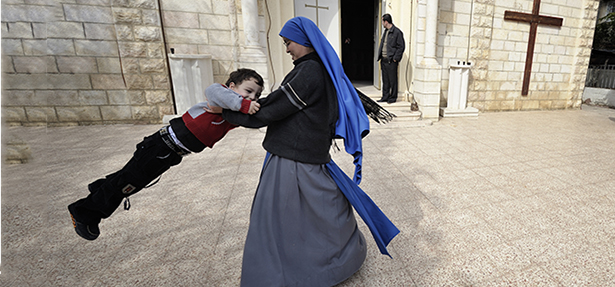
- Obviously some people will consider an static image of the outside of an old impressive building with no humans represents the Catholic church more than an image of a Catholic sacrament & liturgy attended joyfully by Catholic people in a vibrant Catholic interior featuring statues and images of saints, and in a Middle Eastern city: but it makes as much sense to me as a picture of an empty cage in an article on zoos. If we must show a building, it would be better to show St Peter's Square with the Bernini arms... (The reverter is a good-faith fan of church buildings, having created 54 pages on churches, 50 of which have no humans in any image: that is their aesthetic fair enough, but it does not make more "sense".)
- Leaving off subjective questions about what makes most "sense", I have two more substantive objections: first, St Peters exterior is already in an image in the next sidebar, so it is a duplication. Second, I think the St Peter's building image may contribute to the factually incorrect corporatist view of the church (corporate HQ: see start of this thread) and so may be unoptimal for an encyclopedia article, which we want to overcome misapprehensions not tend to perpetuate them. (On the level of what is more emblematic: I note the previous pope's schtick that the "the church is a love story, not an NGO": and I suggest that a building is not an emblem of a love story; a picture of a wedding is.)
- Speaking in St Peter's square the former pope said "But the church as the temple of God is more than a building, he said, it is Christ’s living body and is built not with material stones, but with the living stones of each of the baptized." Now, of course, Wikipedia does not need to follow the marketing rhetoric of some person or organization (but isn't that what using St Peter's building as an emblem for the Church is doing?) but to a certain extent Wikipedia needs to reflect what the subject says about itself as well as what other think of it... Rick Jelliffe (talk) 20:38, 4 November 2025 (UTC)
- I think that an image of St. Peter's is appropriate. As per MOS:LEADIMAGE, the "natural" image for an article about an ancient Church is its principal building, which is specifically designed to visually represent the whole organization. This is the convention we've decided for the articles on the Eastern Orthodox Church, the Coptic Orthodox Church, and the Armenian Apostolic Church, to name the most notable examples. Depictions of life and worship in the Church would be too particular and situational and more importantly not be representative of what is supposed to be an article about the entire Church itself.
- Your suggestion to have a different picture with the Bernini arms is interesting, but I can see issues trying to find a good, objective composition due to the irregular shape (and the likely crowds that would distract from the tone/mood - those crowds in the current photo are barely discreet enough). A brief search brings up some good close-ups of the main structure that might look better however. Nautical Mongoose (talk) 22:13, 4 November 2025 (UTC)
- I like the sentiment with an image of people, and even the specific of having a Mass at Holy Family as a parish in Palestine, but I'm not sure that the particular choice was the best - for one, it's a little low-res. Maybe we can look for a better one that still captures the sense of a body of people rather than a building. Seltaeb Eht (talk) 01:54, 5 November 2025 (UTC)
- Maybe something like:
- If you want to individually restore those changes, please do so in separate edits with clear summaries so we can discuss each change without accidentally performing more wholesale reversions. Best, ~ Pbritti (talk) 19:32, 4 November 2025 (UTC)
- While we're figuring this out I think we should restore the changes that weren't the mass-removals from the lead since those got reverted as well. Nautical Mongoose (talk) 19:25, 4 November 2025 (UTC)
- It's hard to imagine such a complex and broad subject possessing a lead that isn't about as long as the one present in the article. Comprehensiveness on a subject this large requires many articles across many, many topic areas, but the main article will necessarily possess a rather long lead. A good comparison can be found in the lead to Isaac Newton, where a broad subject's main article possessive a fairly long lead. ~ Pbritti (talk) 19:16, 4 November 2025 (UTC)
- Some of the new wording/phrasing on certain sentences (e.g. the parts about Hus) were clearly superior to the previous versions IMO. I think the third reversion goes too far in the other direction. What parts of the lede do you think should be retained? Nautical Mongoose (talk) 17:34, 4 November 2025 (UTC)
- Some of these removals, particularly to the lead, have been a bit too significant. I agree with the three reversions Willthacheerleader18 has made. The proposed alternative image is absolutely inferior to St. Peter's. However, I'm glad for your willingness to help cut some of the bloat, Rick Jelliffe. ~ Pbritti (talk) 15:58, 4 November 2025 (UTC)

.jpg)
- It still shows St. Peter's, buthas people in the square, waving various flags, at a Mass with the Pope honoring previous Popes. Just a suggestion. Seltaeb Eht (talk) 02:16, 5 November 2025 (UTC)
- Not bad. But still, too many backs of heads of people which is exactly the wrong emphasis (real docility is not facelessness: my suggested Gaza wedding picture could be accused of the same perhaps): I like having the faces of saints/popes though, to demonstrate the communion of saints, not a hierarchy: images needs to graphically complement the article text not be some semi-abstract logo to fill space in an infobox: the thrust of the article is not "The Catholic Church is famous for its people-less grand buildings: look how big this one is." The image I would really like is this one: https://www.thecatholictelegraph.com/wp-content/uploads/2014/08/Holy-Family.jpg outside the same church, but it is not open licensed, I think.
- (RANT-ETTE: Personally, I found St Peters rather repellent, as a Catholic: a vanity project that bankrupted the Roman treasury, by bad popes who then encouraged dodgy and semi-simonatical financing schemes that scandalized the Catholic world of the time (e.g. read the letters between the humanists) and lead to the Reformation and the Wars of Religion with its hundreds of thousands of deaths... Not as repellent as some other Imperial cathedrals - St Pauls in London being the worst as a temple of militarism, and Seville being eyebrow-raising in its benefiting from colonial exploitation. Maybe St Peter's noxious story makes it a better emblem of the Catholic Church in the view of some. :-) If the Assamkirche in Munich was photogenic, it would be better. The Sagreda Familia would be a great choice too, as another people-driven project. But IMHO picture of some well-known building or artifact is a misleading emblem, compared to e.g. a Mass or the human faithful. So if a picture with humans does not fit with the pictures of articles about Assyrians etc then perhaps those article's pictures need to be changed for the same reason...?) Rick Jelliffe (talk) 07:06, 5 November 2025 (UTC)
- With all due respect, I don't think this sentiment is common in the average reader, which is what the article should target. Nautical Mongoose (talk) 15:55, 5 November 2025 (UTC)
- Sure. (I understand the point, but disagree.) Rick Jelliffe (talk) 06:11, 7 November 2025 (UTC)
- With all due respect, I don't think this sentiment is common in the average reader, which is what the article should target. Nautical Mongoose (talk) 15:55, 5 November 2025 (UTC)
- It still shows St. Peter's, buthas people in the square, waving various flags, at a Mass with the Pope honoring previous Popes. Just a suggestion. Seltaeb Eht (talk) 02:16, 5 November 2025 (UTC)
- Text The reverter did not give a single justification for their wholesale revision of scores of edits and citations. They did not engage in the Talk pages. They did not follow the WP:BRD policy: "If you revert, be specific about your reasons in the edit summary or on the talk page."
- Therefore I propose the correct remedy is bulk unrevert. The original revisions were done on small scale with justifying comments. There is no need to repeat the small scale justifications again: look them up in the history pages and in the Talk following. If there are mistakes or improvement, they can be done incrementally (and using the talk pages.)
- The changes made to the lead is certain worthy of discussion: I raised several of the editorial issues in the Talk pages, and was encouraged by other editors. If the reverter had given any justification and followed WP:BRD, it might have been OK to keep the reversion and incrementally revisit. But they did not: the appropriate thing according to WP:BRD would be to unrevert then deal with any specific issues in the normal way.
- That editor also reverted changes made to fix the issues in "Article concerns and classification" below. Again, no justification given. They are completely out of line here. Rick Jelliffe (talk) 20:50, 4 November 2025 (UTC)
- I've restored the bulk of your changes (with my own edits) except for the ones in the lead.
- I agree that the bulk reversion was not appropriate. However I decided it's best to just restore the changes that are not being specifically contested, so that at least those changes can be published. Nautical Mongoose (talk) 21:59, 4 November 2025 (UTC)
- Actually, none of the specific text changes have actually being editorially contested. Not even in the lead.
- Thanks for your effort, which should have been unnecessary.
- And if I have not followed Wikipedia procedure enough, then please let me know and I will try to do better. I certainly tried to keep the first sentences of the lead intact, and many of the changes such as rearrangement of paragraphs are editorial not content-related. But for the lead content, I think I gave my rationale for the small additions such as the sentence on parish numbers, and going bottom-up (rather than corporatist top-down), in the second paragraph. The old first phrase in the final paragraph on the Holy See was barely grammatical in the original, and confusing, and I think the changes, e.g. using the concept "quasi-state", helps: it is a quite difficult thing to explain the difference between the Holy See and the Vatican State.
- Rick Jelliffe (talk) 22:21, 4 November 2025 (UTC)
- Pbritti objected to the lead changes in particular, and TBF that wasn't part of the original spot check conducted by Otr500. Your large edits to the Liturgy and 20th Century sections weren't part of the spot check, either, but I restored them because I think they independently stand on their own merits (and since they're separate edits it'll be easier to deal with them). The lead is "special" though so I left that alone for now. Nautical Mongoose (talk) 22:30, 4 November 2025 (UTC)
- I guess there are four sets of edits.
- 1) Edits related to the spot check. Dealt with in Talk item below.
- 2) Edits related to the issues I raised in this Talk item: size and over-focus on institution/political concerns (rather than human/local/spiritual). E.g. in the lead adding number of parishes and priests, explaining a parish is "community" level. Removing slightly off-topic details on BVMary. Hitler.
- 3) General usual editing: e.g. adding counts of transitional deacons to sidebar; improving ungrammatical sentence in lead on Holy See and giving more comprehensible description; replacing strange and unhistorical material on Huss inspiring Luther originally, and improving on Luther/Papal escalation; replace semi-dodgy citations with better and more academic WP:RS (Kelly); liturgy; etc. I tied to do these as separate edits, so that the comment would give the basic thinking, rather than discussion in Talk page. I believe this follows WP:BRD, especially I think they were not controversial and/or were justifiable as summaries from WP:OS and/or massaged the wording to be clearer.
- 4) Replace trite duplicate image with more colourful and relevant-to-topic one. I am still not sure why people prefer the old one, or think that the matter is absolute enough to revert. I would/should have mooted the change in the Talk section, but I did not think it would be a big deal.
- I note that Pbritti (whose editorial acumen I respect) did not mention any specifics. Therefore it is not correct to say that he "objected to the lead changes in particular" as the lead is not a single particular thing: if he would mention the "specific text changes" I was talking about it would be useful. In the absence of any actual specifics, restoration of the lead (with whatever further improvements) is appropriate IMHO.
- Rick Jelliffe (talk) 23:07, 4 November 2025 (UTC)
- Pbritti objected to the lead changes in particular, and TBF that wasn't part of the original spot check conducted by Otr500. Your large edits to the Liturgy and 20th Century sections weren't part of the spot check, either, but I restored them because I think they independently stand on their own merits (and since they're separate edits it'll be easier to deal with them). The lead is "special" though so I left that alone for now. Nautical Mongoose (talk) 22:30, 4 November 2025 (UTC)
- That editor also reverted changes made to fix the issues in "Article concerns and classification" below. Again, no justification given. They are completely out of line here. Rick Jelliffe (talk) 20:50, 4 November 2025 (UTC)
Article concerns and classification
[edit]- Informal review. If issues are not addressed, the article will need to be reassessed.
- The B-class criteria #1 states:
The article is suitably referenced, with inline citations. It has reliable sources, and any important or controversial material which (Editor added, "that") is likely to be challenged is cited.
A reassessment might end up C-class. - The Good article criteria is more broad and indepth. The section, "The six good article criteria" #2, b:
Wikipedia:Content that could reasonably be challenged
, and #2c:It contains no original research
.
The article is in the following categories:
- Articles with unsourced statements from May 2025,
- Other categories:
- Articles containing potentially dated statements from 2006
- Articles containing potentially dated statements from 2010
- Articles containing potentially dated statements from 2016
- Articles containing potentially dated statements from 2021
- Articles with specifically marked weasel-worded phrases from September 2024. The six good article criteria; #1b.
- The "Good article criteria" includes a visible link: "This must include a spot-check of a sample of the sources in the article to verify that each source supports the text in the article that it covers, and that no copyrighted material has been added to the article from the source." This is inline with #2b.
- Spot check: I did not check the lead. This page in a nutshell:
The lead should identify the topic and summarize the body of the article with appropriate weight.
While there are exceptions, as a generally accepted practice, the lead, as a summary, is sourced in the body of the article.
- Content that does not follow the "Good article criteria": A pattern or practice of adding material after a reference does not comply with #2b.
- "Apostolic era and papacy" subsection: The last sentence of the third paragraph includes the unsourced, "...question whether there was a formal link between Peter and the modern papacy."
- Moved existing citation to end of sentence. Rick Jelliffe (talk) 22:23, 1 November 2025 (UTC)
- "20th century" subsection: The last sentence of the first paragraph: "From the late 20th century, the Catholic Church has been criticized for its doctrines on sexuality, its inability to ordain women and its handling of sexual abuse cases."
- "Holy See, papacy, Roman Curia, and College of Cardinals" subsection. Last sentence of the first paragraph: "Directly serving the pope is the Roman Curia, the central governing body that administers the day-to-day business of the Catholic Church."
- Citation added Rick Jelliffe (talk) 23:23, 1 November 2025 (UTC)
- The last sentence of the second paragraph: "The Holy See also confers orders, decorations and medals, such as the orders of chivalry originating from the Middle Ages."
- Deleted uncited sentence for lack of notability in this top-level article. Rick Jelliffe (talk) 22:26, 1 November 2025 (UTC)
- The entire third paragraph is unsourced.
- ?? There is a citation of Raymond Brown book Rick Jelliffe (talk) 22:42, 1 November 2025 (UTC)
- "Canon law" subsection": The last sentence of the first paragraph: "...while the distinctive traditions of Eastern Catholic canon law govern the 23 Eastern Catholic particular churches sui iuris."
- Citation added Rick Jelliffe (talk) 23:27, 1 November 2025 (UTC)
- "Latin and Eastern churches": The last sentence of the fifth paragraph: "While the Latin Church's canons do not explicitly use the term, it is tacitly recognized as equivalent."
- The last sentence of the sixth paragraph: "The pope does not generally appoint bishops or clergy in the Eastern Catholic Churches, deferring to their internal governance structures, but may intervene if he feels it necessary."
- "Saints and devotions": Last three sentences of the first paragraph: "The first persons honoured as saints were the martyrs. Pious legends of their deaths were considered affirmations of the truth of their faith in Christ. By the fourth century, however, "confessors"—people who had confessed their faith not by dying but by suffering—began to be venerated publicly."
- Improve link in first sentence. Delete second. Add citation to third. Rick Jelliffe (talk) 11:53, 2 November 2025 (UTC)
- "Sacraments of healing" subsection has links but no reference.
- Remove sentence flagged as uncited. I have no problem with this, actually, since it is an intro. But the parallel subsection "Sacraments of Initiation" does not have an intro, so this is consistent and makes the article smaller. Rick Jelliffe (talk) 22:31, 1 November 2025 (UTC)
- "Holy Orders": The last sentence of the first paragraph: "After becoming a Catholic priest, a man may not marry (see Clerical celibacy) unless he is formally laicized." This would require an expert or astute follower to understand. The "see Clerical celibacy" is not linked, and laicized would be defrocked.
- Add link on laicized and citation. I don't believe "defrocked" is a widely known term nowadays, but I suppose some editor could add "(defrocked)" after laicized if they felt it helped. Rick Jelliffe (talk)
- "Liturgy" section: The last three sentences of the second paragraph: "In certain circumstances, the 1962 form of the Roman Rite remains authorized in the Latin Church. Eastern Catholic Churches have their own rites. The liturgies of the Eucharist and the other sacraments vary from rite to rite, reflecting different theological emphases."
- I moved this text to Western rites subsection with citation issue unfixed. Rick Jelliffe (talk) 12:02, 2 November 2025 (UTC)
- "Western rites" subsection: The last sentence of the first paragraph: "The present ordinary form of Mass in the Roman Rite, found in the post-1969 editions of the Roman Missal, is usually celebrated in the local vernacular language, using an officially approved translation from the original text in Latin. An outline of its major liturgical elements can be found in the sidebar."
- Add citation for first sentence. Second sentence does not need citation. Rick Jelliffe (talk) 23:17, 1 November 2025 (UTC)
- The last sentence of the fifth paragraph: "... an accommodation protested by Anglican leaders."
- removed phrase for lack of notability in a summary article: article already too big for many details, even if interesting Rick Jelliffe (talk) 22:50, 1 November 2025 (UTC)
- "Catholic social teaching" subsection: The last sentence of the first paragraph: "Its foundations are widely considered to have been laid by Pope Leo XIII's 1891 encyclical letter Rerum novarum which upholds the rights and dignity of labour and the right of workers to form unions."
- Add citation which is more explicit
- "Divorce and declarations of nullity" subsection: "In some predominantly Catholic countries, it is only in recent years that divorce was introduced (Italy (1970), Portugal (1975), Brazil (1977), Spain (1981), Ireland (1996), Chile (2004) and Malta (2011)), while the Philippines and the Vatican City have no procedure for divorce (The Philippines does, however, allow divorce for Muslims.)."
- Removed sentence as it is off-topic: it about secular law in Catholic countries, not Catholic Church. Rick Jelliffe (talk) 22:46, 1 November 2025 (UTC)
-- Otr500 (talk) 13:45, 1 November 2025 (UTC)
- Thanks for this spot check. Please do not de-assign as Good Article in a hurry, to give time to fix: 16 or so issues in an article of over 257,000 bytes is not bad, in the scheme of things, though of course we want 0. I would flag two issues I see: first is that the article is too long --there can be no scope for detail in such a broad topic-- (in which case, rather than finding citations, editors might be brutal with deleting the uncited content), and second that there are items in the References section which should go in the Notes section IMHO. Rick Jelliffe (talk) 22:17, 1 November 2025 (UTC)
Lead image
[edit]I think I prefer both of Dylam's suggestions to the current one. File:Petersdom von Engelsburg gesehen.jpg is less obscured by other parts of the building than File:Saint Peter's Basilica facade, Rome, Italy.jpg, while still showing them, and File:St. Peter's Basilica in Vatican City.jpg is clear and bright. I think I lean slightly towards the Petersdom, for greater context. SarekOfVulcan (talk) 18:15, 12 November 2025 (UTC)


- Each image is partially obstructed, each image only captures a portion of the basilica, but the long-standing image captures a greater proportion of the basilica (including its loggia), shows other portions of the Vatican, and is at an extraordinarily high resolution compared to the other images. ~ Pbritti (talk) 19:07, 12 November 2025 (UTC)
- What motivated me to change the current lead image is that I see it as quite disturbing visually (regardless of it having an excellent resolution). First of all, the image is not purely focused on the Basilica itself, it has a lot of trees and buildings that are making the picture pretty crowded and visually cluttered, and more importantly they are blocking a complete view of the front of the basilica (specifically the basilica's facade). In addition, the cloudy weather in the image does not make it look professional (The article for the Catholic Church is a very high-visibility page so Its lead image's visual quality is important). A more professional looking image of a building should have it depicted in a clear and bright day to better reflect on the building's architectural details and for better visuality.
- I initially proposed File:St. Peter's Basilica in Vatican City.jpg, as it is depicting the basilica in a bright day and is purely focused on the basilica itself. But I later realised that the dome is not completely visible and the St. Peter's square's obelisk in the middle is taking a big part of the image. I later proposed File:Petersdom von Engelsburg gesehen.jpg as it has all of the advantages that I mentioned in the previous image I initially proposed, and very clearly shows every architectural detail of the front of St. Peter's basilica, whether it's the facade or the dome. The only downside of the proposed image is that it has less resolution than the currently used one, but I argue we should focus more on the content of the image rather than its resolution.
- I currently support replacing the current lead image with File:Petersdom von Engelsburg gesehen.jpg and I hope we can reach a consensus on this decision. Dylam X (talk) 01:12, 13 November 2025 (UTC)
- Your reasoning runs contradictory to the standards used across most articles. Looking at other Wikipedias, the current image is used as the infobox image on the Wikis for Spanish, French, Chinese, Russian, Vietnamese, Esperanto (!), Portuguese, Scots, and Turkish (twice!). A lower-quality image like either of the above proposals are inferior and inconsistent with the other consensuses previously established on this article, other Wnglish language articles, and other Wikipedias. Best, ~ Pbritti (talk) 01:26, 13 November 2025 (UTC)
- How is it contradictory? The English Wikipedia is the most widely viewed Wikipedia, and many articles of other Wikipedias (discussing the same topic), usually copy the some of the content from the article in the English Wikipedia as it is more detailed, and gives more insight (as most sources are in English). It's very common to happen and you can see it in the Image used for example. Dylam X (talk) 01:38, 13 November 2025 (UTC)
- Precisely why we shouldn't pick a low resolution, angled image of part of a building when we have one that covers a good portion of the Vatican and has been a consistent element of this article since 2017, when it replaced one of the proposed images. Best, ~ Pbritti (talk) 02:42, 13 November 2025 (UTC)
- Well, the aim of the lead image in the Infobox is to depict St. Peter's Basilica, not to depict a landscape view of the Vatican in front of St. Peter's square. And yes, the Image has been a consistent element of the article for 8 years by now simply because it is the highest resolution image depicting the basilica there is, but regardless of that, the image has many visual downsides that I pointed out previously, and that it doesn't fulfil Its aim of depicting only St. Peter's Basilica (which is the only element of the image that is needed in the infobox) but instead gives a landscape view of the Vatican from the front St. Peter's square, which in turn has many other buildings and trees blocking the view of a lot of the basilica's architecture. The image I'm proposing despite not directly facing the basilica, captures every architectural detail of the front part of the basilica, in a clear and bright day, Which the current image does not offer. Dylam X (talk) 12:53, 13 November 2025 (UTC)
- Precisely why we shouldn't pick a low resolution, angled image of part of a building when we have one that covers a good portion of the Vatican and has been a consistent element of this article since 2017, when it replaced one of the proposed images. Best, ~ Pbritti (talk) 02:42, 13 November 2025 (UTC)
- How is it contradictory? The English Wikipedia is the most widely viewed Wikipedia, and many articles of other Wikipedias (discussing the same topic), usually copy the some of the content from the article in the English Wikipedia as it is more detailed, and gives more insight (as most sources are in English). It's very common to happen and you can see it in the Image used for example. Dylam X (talk) 01:38, 13 November 2025 (UTC)
- I’m with you on this. The current lead image feels messy and doesn’t really highlight the Basilica itself. There are too many buildings and trees in the way, and the cloudy sky makes the picture look dull, which isn’t ideal for such an important article. A proper lead image should show the Basilica clearly on a bright day so its details stand out.
- That’s why Petersdom works better. It presents the whole front and the dome clearly without anything blocking the view. Yes, the resolution is a bit lower, but the actual content and clarity of the scene are more important. WalkingPie7 (talk) 14:58, 15 November 2025 (UTC)
- @Dylam X and WalkingPie7: Have you noticed that you both seem to share a lot of opinions on several topics? I have started a sockpuppetry investigation. Best, ~ Pbritti (talk) 16:38, 15 November 2025 (UTC)
- I don't know or recognise @WalkingPie7, and they seem like a fake persona account made to repeat what I said to trigger a sockpuppetry investigation. They had no right to change the lead image as we had not reached a consensus yet. Thank you for understanding. Dylam X (talk) 17:05, 15 November 2025 (UTC)
- @Dylam X and WalkingPie7: Have you noticed that you both seem to share a lot of opinions on several topics? I have started a sockpuppetry investigation. Best, ~ Pbritti (talk) 16:38, 15 November 2025 (UTC)
- Your reasoning runs contradictory to the standards used across most articles. Looking at other Wikipedias, the current image is used as the infobox image on the Wikis for Spanish, French, Chinese, Russian, Vietnamese, Esperanto (!), Portuguese, Scots, and Turkish (twice!). A lower-quality image like either of the above proposals are inferior and inconsistent with the other consensuses previously established on this article, other Wnglish language articles, and other Wikipedias. Best, ~ Pbritti (talk) 01:26, 13 November 2025 (UTC)
Dylam X and WalkingPie7 blocked for sockpuppetry. ~ Pbritti (talk) 11:25, 16 November 2025 (UTC)