Wiki Article
Talk:Natural logarithm
Nguồn dữ liệu từ Wikipedia, hiển thị bởi DefZone.Net
 | This  level-5 vital article is rated C-class on Wikipedia's content assessment scale. level-5 vital article is rated C-class on Wikipedia's content assessment scale.It is of interest to the following WikiProjects: | ||||||||||
| |||||||||||


Calculator
[edit]Regarding recent edits adding and then removing a calculator gadget from this article: See discussion at Talk:Binary_logarithm#Calculator, which I started there before realizing that this article was also involved. —David Eppstein (talk) 07:21, 20 January 2025 (UTC)
Plot caption
[edit]The plot under the function plot reads, in part, “... slowly goes to negative infinity as x approaches 0.” This is clearly a misstatement, as the function goes to negative infinity very rapidly. Marktomory (talk) 20:17, 17 March 2025 (UTC)
- As precised just after that:" "slowly" as compared to any power law of x". --Sapphorain (talk) 20:32, 17 March 2025 (UTC)
The statement that e^{ln(x)} is defined only for positive reals
[edit]Isn't it always defined even if the logarithm is multi-valued for negative numbers? So, this part,Shouldn't that be,If then does not pose any problems. This is effectively saying that , which is accurate from the side and fixed by convention from the side. And is definitely accurate as the repeated values for all generate the exact same final value of because is just 1. 2600:1700:A410:C4E0:4037:F77F:F23D:7E5C (talk) 03:23, 8 June 2025 (UTC)
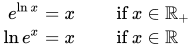


- No, sorry, that's incorrect. In the most straightforward formulation, is simply undefined. It's true that you could come up with a function to the extended reals where you would treat as , and you could similarly extend the exponential function to make , but this is rarely done; it has little advantage and brings in annoying complications. --Trovatore (talk) 18:02, 9 June 2025 (UTC)
- That formulation, accurate and complete, does make by just making be an identity mapping, that is, .
- I noticed you didn't say anything about the negative numbers. 2600:1700:A410:C4E0:A48F:F30C:4B6E:7354 (talk) 17:49, 16 June 2025 (UTC)
- ln(x) is not a well-defined function except when x > 0. Yes one can play around and ask that it be a multi-valued function. And/or, yes, one can ask that limits be used whenever the equations otherwise don't make sense. But one can also decline to do that stuff. If it is deemed sufficiently notable we can entertain those musings ... but I'd want to see text to describe which extra assumptions are being made, and a worthy citation that indicates that this is sufficiently noteworthy. —Quantling (talk | contribs) 19:02, 16 June 2025 (UTC)
- Yeah, look, as much fun as we could have with this, I think we're drifting away from what might be found in the bulk of reliable sources. Note also that the current text doesn't say it isn't true for x negative; it just doesn't address the question, which, given the added complexities, strikes me as the correct choice. 2600, feel free to ask a question on the math refdesk. --Trovatore (talk) 19:16, 16 June 2025 (UTC)
- ln(x) is not a well-defined function except when x > 0. Yes one can play around and ask that it be a multi-valued function. And/or, yes, one can ask that limits be used whenever the equations otherwise don't make sense. But one can also decline to do that stuff. If it is deemed sufficiently notable we can entertain those musings ... but I'd want to see text to describe which extra assumptions are being made, and a worthy citation that indicates that this is sufficiently noteworthy. —Quantling (talk | contribs) 19:02, 16 June 2025 (UTC)


A fast approximation
[edit]This is not mentioned in the article

just even at n=2 it becomes a decent aproximation between values of x among 0.5 and 4 45.181.122.234 (talk) 23:12, 11 July 2025 (UTC)
- Hmm. How would one compute this fast approximation for some particular value of n without making use of the natural logarithm? Regardless, for inclusion in the article, you'd have to find a noteworthy source with this formula. —Quantling (talk | contribs) 20:25, 13 July 2025 (UTC)
- You can get a good approximation for by solving for a in using a root-finding algorithm like Newton’s method: . As long as n is an integer, the exponents in said method can be calculated without the need for a natural logarithm. 107.9.36.50 (talk) 19:18, 14 July 2025 (UTC)
- Good point. Newton's method (with quadratic convergence):
- or Halley's method (with cubic convergence):
- would converge pretty quickly. (I suppose we'd need to quantify how many steps are required to get to accuracy.) Regardless, we still need to establish noteworthiness with well-established publications. —Quantling (talk | contribs) 19:59, 14 July 2025 (UTC)
- I took the approximation from here: https://math.stackexchange.com/q/5082264/909869
- And in an answer some user deliver an even faster approximation: https://math.stackexchange.com/a/5083712/909869
- 45.181.122.234 (talk) 22:57, 22 July 2025 (UTC)
- Stack Exchange is not a reliable source thanks to most of it being user-generated content. See this: Wikipedia:Reliable sources#User-generated content
- Sure, the approximations you provided can be true: https://www.desmos.com/calculator/dysayegx99
- But the source you used is not reliable. If you want any chance of getting that approximation put in the article, you need to find an actual reliable source that shows it, like a peer-reviewed paper. 107.9.36.50 (talk) 23:30, 24 July 2025 (UTC)
- You can get a good approximation for by solving for a in using a root-finding algorithm like Newton’s method: . As long as n is an integer, the exponents in said method can be calculated without the need for a natural logarithm. 107.9.36.50 (talk) 19:18, 14 July 2025 (UTC)
- This is not a good method in practice (the catastrophic cancellation of subtracting 1 from a number very close to 1 means you can't use floating point numbers to compute this). —Kusma (talk) 21:05, 13 July 2025 (UTC)
- this could ve avoided though:
- for an even positive integer number.
- 45.181.122.234 (talk) 23:00, 22 July 2025 (UTC)
- this could ve avoided though:


One definition or multiple definitions
[edit]Thank you @Rgdboer for your bold edits. I have undone them because I think they need to be discussed before we go forward with them. I have created this talk section for this purpose. —Quantling (talk | contribs) 12:42, 28 July 2025 (UTC)
- The new graphics show sections created with two straight rays from the origin to the curve y = 1 / x. Other than that the curve in question is the same hyperbola that is used to define the natural logarithm via an integral, how are these important enough to be in the Definition section? In contrast to rays from the origin, the Riemann definition of an integral divides the area to be integrated along the x axis so that we are looking at areas that are bounded by segments of the x axis, two vertical lines and the curve itself. —Quantling (talk | contribs) 12:46, 28 July 2025 (UTC)
- The edit changes the section name from "Definitions" to "Definition", yet even after the edit two definitions are provided: (1) a particular integral, and (2) the inverse of ex. What is the reasoning there? —Quantling (talk | contribs) 12:49, 28 July 2025 (UTC)
Thank you for opening this discussion. Logarithm is a challenging concept for novices in mathematics. The definition in terms of the "region against an asymptote" is asymmetric and merely identifies a region with area said to be the logarithm. Continuing students learn that the logarithm is a measure that persists under a transformation group, but advancing that notion to the novice probably is unhelpful. As indicated in my contribution, the logarithm is hyperbolic angle in disguise. Rather than bring up the repressed angle, reference was made to hyperbolic sectors which have areas in agreement with the area against an asymptote. Since the sectors have symmetry and have area preserved by the transformation group, they have more intuitive appeal than the four-sided figure along the asymptote. The second image posted shows the four-sided figure has area equal to the corresponding sector, thus motivating the figure. Further, the contribution puts Euler's approach in place rather than the ex nihilo of the so-called first definition. Exponentiation and logarithm are transcendental functions which deserve to be handled more sensitively than algebraic functions. Common practice has students learning by rote the use of these transcendentals, only to be stumped when asked for foundations. The thrust of the posting appeals to well-known mathematics so that a reader may perceive the thread of the foundation: a function, on intervals in the positive real numbers, that depends only on the ratio of the endpoints. — Rgdboer (talk) 21:46, 28 July 2025 (UTC)
- While the result using rays from the origin is interesting, I remain unconvinced that it deserves this much prominence in the natural logarithm article. Let's see what other authors say. —Quantling (talk | contribs) 22:09, 28 July 2025 (UTC)
Summer doldrums! For ease of reference the animation, image and text have been posted to Hyperbolic angle#Natural logarithm. — Rgdboer (talk) 22:35, 29 July 2025 (UTC)
In wikibooks now, at b:Algebra/Chapter_12/Natural Logarithm via Hyperbolic Angle, there is the suggestion for improved representation of the topic. — Rgdboer (talk) 02:07, 16 October 2025 (UTC)
Reorder
[edit]
There is a circularity to the use of ex to first define logarithm as its inverse, since e is known as providing a unit area through the second definition. Ever since Introduction to the Analysis of the Infinite (1748) the facility of exponential functions defining logarithms has enriched mathematical technique, but strides over the preceding hyperbolic logarithm. Therefore, it is proposed that the two definitions now in the article be interchanged. — Rgdboer (talk) 01:06, 9 November 2025 (UTC)