Wiki Article
Talk:Similarity (geometry)
Nguồn dữ liệu từ Wikipedia, hiển thị bởi DefZone.Net
| This is the talk page for discussing improvements to the Similarity (geometry) article. This is not a forum for general discussion of the subject of the article. |
Article policies
|
| Find sources: Google (books · news · scholar · free images · WP refs) · FENS · JSTOR · TWL |
Archives: 1Auto-archiving period: 2 years  |
 | This  level-5 vital article is rated C-class on Wikipedia's content assessment scale. level-5 vital article is rated C-class on Wikipedia's content assessment scale.It is of interest to the following WikiProjects: | ||||||||||
| |||||||||||


Lines?
[edit]Can Lines (or line segments, or "sides" of a figure) be said to be "similar"? Usually it seems the word "proportional" is just used. But if curves (like parabolas) are described as being similar, it seems that all line segments must be similar. The lead paragraph just uses the word "objects" as what similarity applies to, and later in the article it says it applies to "polygons", and "curves". But what about lines (line segments, & "sides" of figures)? Limitations of what the term properly applies to is not clear, but lines (segments) aren't mentioned in the lists/examples. DKEdwards (talk) 02:10, 16 November 2021 (UTC)
- I have added lines and line segments to § Similar curves. I have also clarified in the lead that congruent shapes are similar (this applies to lines but not to line segments). D.Lazard (talk) 10:17, 16 November 2021 (UTC)
- (straight) lines and line segments on their ownare always similar (contrary to other curves), which is probably the reason it wasn't mentioned specifically as similarity in this case is automatically given and loses its distinguishing feature.--Kmhkmh (talk) 13:40, 16 November 2021 (UTC)
Example of coefficient on a new image
[edit]

I propose to illustrate the current section titled “Ratios of sides, of areas, and of volumes”
with the present image.
Arthur Baelde (talk) 13:47, 14 January 2022 (UTC)
- This triangle partition seems very specific to this triangle and this similitude ratio. So, instead of clarifying the concept, it may confuse non-mathematicians. I am against to add this image. D.Lazard (talk) 14:34, 14 January 2022 (UTC)
- What specificity? We are not in considerations of the article “Square‑cube law”. We have to say neophytes that a similarity is an object of pure mathematics. Its coefficient cannot always be written as a scale in percent like displayed by a machine that prints onto papers. Of course I thought of √2 among irrational square roots of integers. But isosceles right triangles are all similar, and anyone will know one fine day the story that multiplies an area of square by 2, if interested in mathematics. And then I thought of a triangular tiling that would be √3 times as large as each element of tiling: a right triangle having a 60 degrees angle. But if we are moving away from √2, we might as well choose √5. Notice I am not the inventor of this kind of tiling, the article could include a link to “Pinwheel tiling”.
Arthur Baelde (talk) 10:42, 15 January 2022 (UTC)
- What specificity? We are not in considerations of the article “Square‑cube law”. We have to say neophytes that a similarity is an object of pure mathematics. Its coefficient cannot always be written as a scale in percent like displayed by a machine that prints onto papers. Of course I thought of √2 among irrational square roots of integers. But isosceles right triangles are all similar, and anyone will know one fine day the story that multiplies an area of square by 2, if interested in mathematics. And then I thought of a triangular tiling that would be √3 times as large as each element of tiling: a right triangle having a 60 degrees angle. But if we are moving away from √2, we might as well choose √5. Notice I am not the inventor of this kind of tiling, the article could include a link to “Pinwheel tiling”.

.Its coefficient is
- You may prefer one equality only on the new image, instead of three. So here is on the right a possible version to insert in the article.
Arthur Baelde (talk) 14:24, 18 January 2022 (UTC)
- You may prefer one equality only on the new image, instead of three. So here is on the right a possible version to insert in the article.
- The first image in Pinwheel tiling is much clearer and much more aesthetic. It is thus more convenient for illustating the section on triangles. D.Lazard (talk) 15:24, 18 January 2022 (UTC)
- Here you are talking about the first section,
so I repeat. I propose to illustrate the fifth section titled “Ratios of sides, of areas, and of volumes”, with one or the other image here presented.
Arthur Baelde (talk) 17:53, 18 January 2022 (UTC)
- Here you are talking about the first section,
- The relationship of your image with this section is really unclear, and this makes the image unsuitable. Here, it is the square-cube law that deserves to be illustrated. A good choice would be an image of a Rubik's Cube, with the explanation that it is formed with cubes, counting the non-visible interior cube. D.Lazard (talk) 18:47, 18 January 2022 (UTC)

- You look like someone who does not understand. First I propose a square, not a cube. Later perhaps we could include a more difficult three‑dimensional example.
Arthur Baelde (talk) 14:12, 19 January 2022 (UTC)
- You look like someone who does not understand. First I propose a square, not a cube. Later perhaps we could include a more difficult three‑dimensional example.
by Another multiplies areas by 5,


An infinite tiling can be contructed
from this triangular tessellation.
An equality such as a/b = c/d , scarce in the current article, is written in this improved drawing , conceived with the present caption for the section about area ratios and volume ratios. I'm finally ready to insert it. Do you agree?
Arthur Baelde (talk) 15:57, 15 March 2022 (UTC)

Against an obstructionism
[edit]The only one to answer me on the talk page had straight away blocked the discussion, about an image proposed for the article. At 14:34, 14 January 2022, he wrote:This triangle partition seems very specific to this triangle and this similitude ratio…
In other words, the only flaw of my example was to be an example.
At 18:47, 18 January 2022, he argued that:The relationship of your image with this section is really unclear, and this makes the image unsuitable…
So my example so specific ceased suddenly to be an example for the indicated section, now titled “Area ratio and volume ratio”. This utter contempt for the most elementary logic could have discouraged me from replying.
My opponent's inconsistency ended up being a luck when he inserted, in the first section of article, a ressembling image I had quoted. I had been then careful not to criticise his ironic contribution on the talk page, contenting myself to write, at 17:53, 18 January 2022:Here you are talking about the first section
so I repeat. I propose to illustrate the fifth section…
Later I put on hold the semblance of discussion about my own image, and without writing any more on the talk page, I announced the deletion of the opposing image by correcting its caption at first. And then I took advantage of the removal of the bad image to create the section titled “Similarity with a center”, and insert two drawings there without having warned on the talk page.
Finally I inserted my image, with slashes as fraction strokes in the caption like on the right. I got three successive refusals of this caption.
In short, I am going to enhance the section despite D.Lazard, upset to see my image inserted and eager to impoverish its caption. Later he had also happened, more aggressive, to be surrounded by two ironic fellows, in order to delete several of my images here or there.
Arthur Baelde (talk) 12:16, 21 February 2023 (UTC)
- Apparently, you have not yet undeerstood what Wikipedia is (see WP:About) and what Wikipedia is not (see WP:Not). Also, the tone of this post shows that ignore the five pillars, and the fourth one in particular (WP:5P4).
- As Wikipedia is a collaborative work, eveery change requires a consensus among editors. It is normal and very common that some autors disagree. In such cases, several dispute resolution methods have been established, which are described in WP:BRD. Also, when no consensus is reach, this is the previous stable version of the article that prevails. D.Lazard (talk) 14:30, 21 February 2023 (UTC)
Nothing on this talk page about your wrong deed in the article, so my only reference will be what I read on the history page: Reverted 3 edits by Arthur Baelde (talk): Wrong (a ratio does not requires the defintion of a unit). Unsourced.. In any cse, such a major change requires a consensus on the talk page
- I read nothing on the history page about my first contribution. I deduce you agree to the insertion of my SVG image and its caption.
- In my comment of the image, here is the first sentence:
Mathematical writings and reasonings about sizes presuppose a unit is chosen.
You wroteWrong
on the history page, because your mind hastily replaced “sizes” with “ratios”. Yet you really agree that all our ratios don't depend on a length unit. So your refusal of my second contribution is irrelevant. - On the history page I read nothing about the article hierarchy. I deduce you agree to my third contribution.


for my opponent D.Lazard.
I think you could have written as justification:
“ deletion of 3 successive contributions all equivalent for me ”
I am going to restore my work and improve my comment.
Arthur Baelde (talk) 13:26, 1 March 2023 (UTC)
- Please, read WP:BRD again, and respect Wikipedia rules. If you continue to edit warring, you may be blocked for editing Wikipedia. D.Lazard (talk) 14:17, 1 March 2023 (UTC)
- Please, read again the Wikipedia rules. You flouted this rule extracted from Wikipedia:BOLD, revert, discuss cycle:
Revert an edit if it is not an improvement, and only if you cannot immediately refine it.
Arthur Baelde (talk) 14:56, 1 March 2023 (UTC)
- Please, read again the Wikipedia rules. You flouted this rule extracted from Wikipedia:BOLD, revert, discuss cycle:
Similar Geometrics Shapes Image
[edit]
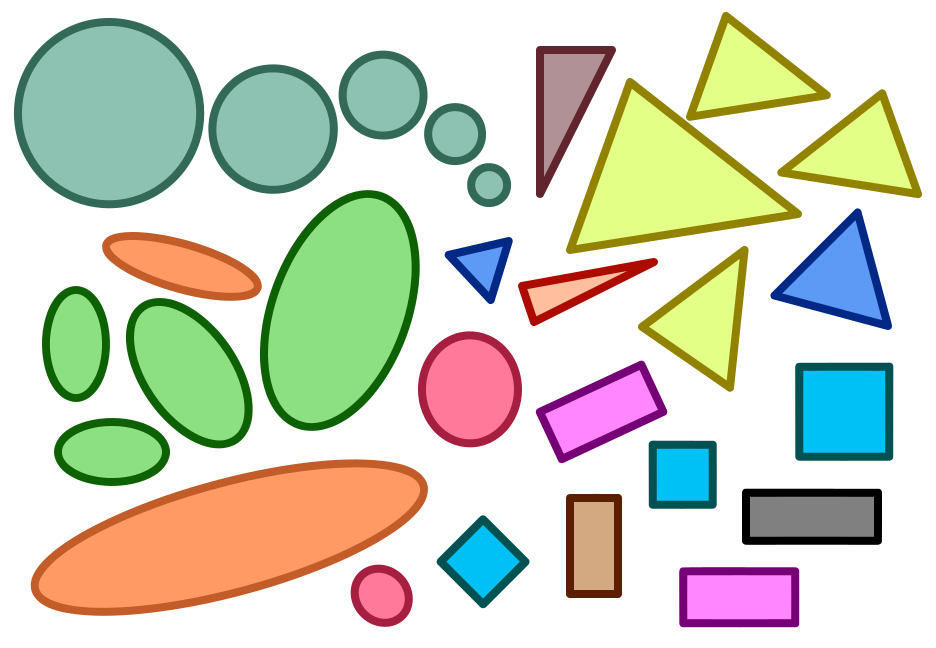
I think the image of similar geometric shapes is lacking in a few ways, and could use some improvements:
- There are no examples of similar reflected shapes
- The blue and yellow triangles are close in shape
- The brown and pink rectangles are close in shape — Preceding unsigned comment added by R0uge (talk • contribs) 17:55, 7 January 2025 (UTC)
- The color scheme has some close colors which could raise confusion (the orange ovals and red triangle especially), and is not colorblind safe
- The similar objects are not all grouped next to each other. This makes it hard to compare the shapes which aren't clustered
https://upload.wikimedia.org/wikipedia/commons/5/5d/Similar-geometric-shapes.svg
R0uge (talk) 17:49, 7 January 2025 (UTC)
Example under "Self-similarity" subhead - is its mentioned form correct?
[edit]Request clarification whether for the example given under "Self-similarity" subhead in this article, the mentioned form {2i, 3·2i} is correct or should this be {2i, 3·2i-1} - the text mentions "i" ranges over all integers. Jn.mdel (talk) 09:10, 6 January 2026 (UTC)
- D.Lazard, Kmhkmh - I notice that you both have been responding on this talkpage sometimes - hence, messaging if either of you could possibly clarify - thanks. Jn.mdel (talk) 06:54, 7 January 2026 (UTC)
- If you read that as set of numbers (rather than a sequence of pairs) then an (independent) index shift in either exponent should not matter, as in any case the index moves through all integers and you always create the same (infinite) set of numbers (and for a set the order does not matter, i.e. {1,2} and {2,1} denote the same set).
- However without being particularly familiar with the topic of self similarity, i have a couple of other issues with that section.
- a) the given definition of self similarity doesn't seem to match that of the target article.
- b) It mostly seems to talk about translational similarity rather than self similarity.
- c) the given number set example doesn't seem to be a good example or illustration in its current form. In particular if the argument is that logarithmic plots reveal (ordinary) simillarity, those plots should be shown.
- --Kmhkmh (talk) 11:13, 7 January 2026 (UTC)
- @Kmhkmh Thanks a lot for knowing that I am reading the given form as a "sequence of pairs" - I understand now your point that for the given "set" notation, the sequence may not matter as all integers would eventually get included one way or the other - so thanks again for your explanatory response.
- Your other concerns about the said section - I am sure some more qualified users would be able to address / discuss the same soon - which i sincerely lack !! With regards, Jn.mdel (talk) 14:27, 7 January 2026 (UTC)