Wiki Article
Three-term recurrence relation
Nguồn dữ liệu từ Wikipedia, hiển thị bởi DefZone.Net
 | This article has multiple issues. Please help improve it or discuss these issues on the talk page. (Learn how and when to remove these messages)
|


In mathematics, and especially in numerical analysis, a homogeneous linear three-term recurrence relation (TTRR, the qualifiers "homogeneous linear" are usually taken for granted)[1] is a recurrence relation of the form
- for


where the sequences and , together with the initial values govern the evolution of the sequence .


Applications
[edit]If the and are constant and independent of the step index n, then the TTRR is a Linear recurrence with constant coefficients of order 2. Arguably the simplest, and most prominent, example for this case is the Fibonacci sequence, which has constant coefficients .

Orthogonal polynomials Pn all have a TTRR with respect to degree n,

where An is not 0. Conversely, Favard's theorem states that a sequence of polynomials satisfying a TTRR is a sequence of orthogonal polynomials.
Also many other special functions have TTRRs. For example, the solution to
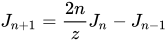
is given by the Bessel function . TTRRs are an important tool for the numeric computation of special functions.

TTRRs are closely related to continued fractions.
Solution
[edit]Solutions of a TTRR, like those of a linear ordinary differential equation, form a two-dimensional vector space: any solution can be written as the linear combination of any two linear independent solutions. A unique solution is specified through the initial values .[2]
See also
[edit]Literature
[edit]- Walter Gautschi. Computational Aspects of Three-Term Recurrence Relations. SIAM Review, 9:24–80 (1967).
- Walter Gautschi. Minimal Solutions of Three-Term Recurrence Relation and Orthogonal Polynomials. Mathematics of Computation, 36:547–554 (1981).
- Amparo Gil, Javier Segura, and Nico M. Temme. Numerical Methods for Special Functions. siam (2007)
- J. Wimp, Computation with recurrence relations, London: Pitman (1984)