Wiki Article
Usekh collar
Nguồn dữ liệu từ Wikipedia, hiển thị bởi DefZone.Net

The usekh or wesekh was a type of broad collar necklace used in ancient Egypt. It was composed of tubular and/or teardrop-shaped beads arranged in curved rows, often fitted with terminals and sometimes a counterweight.[1] The usekh is depicted as being worn by deities as well as by both women and men from as early as the Old Kingdom (c. 2670–2195 BC).[1]

Etymology
[edit]The ancient Egyptian word wsḫ can mean "breadth" or "width", and the ornament is therefore commonly referred to as a broad collar.[2]
Construction
[edit]
The usekh collar was worn over the shoulders and around the neck and was fastened at the back. It was typically made from faience, glass, stone, or metal beads, produced in a wide range of colors and strung together with linen thread.[1] Scenes depicting the manufacture of usekh collars appear in a small number of ancient Egyptian tombs.[3]
Over time, the usekh underwent numerous variations in form. These changes may reflect shifting mythological concepts or regional differences within Egypt.[4]
Deities
[edit]A scene in the Fourth Dynasty tomb of Wepemnofret at Giza associates the usekh collar with dwarfs and the deity Ptah. Bernd Scheel has argued that Ptah, who is sometimes depicted wearing a broad collar, protected the deceased through the collar, and that dwarfs had access to this protective power through their role in manufacturing such ornaments.[5]
In the Fifth Dynasty tomb chapel of Akhethotep—originally located at the Saqqara burial ground and now housed in the Louvre—one scene distinguishes between two types of collars: the broad collar and the šnw, or "encircling", collar.[6]
Gallery
[edit]-

-
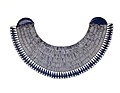 Broad Collar, c. 1336–1327 BC, c. 1327–1323 BC, or c.1323–1295 BC; faience; Brooklyn Museum
 -
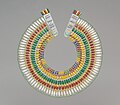 Broad Collar, c. 1353–1336 BC, faience, Metropolitan Museum of Art
 -
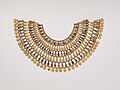 Broad Collar of Nefer Amulets from the Tomb of the Three Foreign Wives of Thutmose III, c. 1504–1450 BC, gold, glass, Egyptian blue, Metropolitan Museum of Art.
 -
 Broad Collar, 1479–1425 B.C; gold, carnelian, obsidian, glass; Metropolitan Museum of Art
 -
 Broad Collar Terminal; Metropolitain Museum of Art
 -
![Tutankhamun's Usekh collar: the 18th Dynasty inlaid with glass and gemstones, symbolizing divine protection and currently housed in the Grand Egyptian Museum.[7]](//upload.wikimedia.org/wikipedia/commons/thumb/d/d2/Usekh_of_Tutankhamun.jpg/120px-Usekh_of_Tutankhamun.jpg) Tutankhamun's Usekh collar: the 18th Dynasty inlaid with glass and gemstones, symbolizing divine protection and currently housed in the Grand Egyptian Museum.[7]
Tutankhamun's Usekh collar: the 18th Dynasty inlaid with glass and gemstones, symbolizing divine protection and currently housed in the Grand Egyptian Museum.[7]


![Tutankhamun's Usekh collar: the 18th Dynasty inlaid with glass and gemstones, symbolizing divine protection and currently housed in the Grand Egyptian Museum.[7]](/wiki/File:Usekh_of_Tutankhamun.jpg)
See also
[edit]References
[edit]- ^ a b c Andrews, Carol (1990). Ancient Egyptian jewellery. British Museum. London: British Museum Publications. pp. 119–123. ISBN 978-0-7141-0954-1.
- ^ Faulkner, Raymond O. (1991). A concise dictionary of Middle Egyptian (Repr ed.). Oxford: Griffith Inst., Ashmolean Museum. p. 169. ISBN 978-0-900416-32-3.
- ^ Clarke, Gavin. "مجوهرات الأحجار الكريمة المصرية القديمة". www.gemselect-arabic.com (in Arabic). Retrieved 2025-12-24.
- ^ Saaed, Sama. "Adorning the Ancients: Exploring Iconic Pharaoh-Era Jewelry from Headbands to Anklets". Yom 7 journal.
{{cite web}}: CS1 maint: url-status (link) - ^ Scheel, Bernd (1999). "Ptah und die Zwerge". In Altenmüller, Hartwig; Germer, Renate (eds.). Miscellanea Aegyptologica: Wolfgang Helck zum 75. Geburtstag. Hamburg: Archäologisches Institut der Universität Hamburg. pp. 159–164.
- ^ Brovarski, Edward (1997). "Old Kingdom beaded collars". In Phillips, Jacke (ed.). Ancient Egypt, the Aegean, and the Near East: Studies in Honour of Martha Rhoads Bell. [San Antonio]: Van Siclen Books. pp. 137–162.
- ^ "قبل عرضها رسميًا.. 5 قلادات لتوت عنخ آمون داخل المتحف المصري الكبير | صور". القاهرة 24 (in Arabic). 2022-08-30. Retrieved 2025-12-24.
External links
[edit]
.png) | This article about subjects relating to ancient Egypt (c. 3150 BC – 30 BC) is a stub. You can help Wikipedia by adding missing information. |