Wiki Article
Walls of Babylon
Nguồn dữ liệu từ Wikipedia, hiển thị bởi DefZone.Net
.jpg)
The walls of Babylon were the city walls surrounding the ancient Mesopotamian city of Babylon, the political and religious centre of the Neo-Babylonian Empire.
The walls of Babylon were included in many early versions of the Seven Wonders of the Ancient World. In a study of the original sources for the Seven Wonders, Wilhelm Heinrich Roscher found that they were the second-most frequently chosen, with only the Colossus of Rhodes being chosen more frequently.[1] Ancient writers such as Herodotus, Strabo, and the author of the Book of Jeremiah described them.
They were by far the largest structures in Babylon;[2] the German archeological team led by Robert Koldewey estimated their height to be 12-24m and their thickness to be 17-22m.[3]
Today, the remains of Babylon are the best-understood topographically of all known cities from the 1st millennium BC, due to the city walls being visible as earthworks even prior to the first excavations in 1899.[4]
Classical and Biblical descriptions
[edit]
The historian Herodotus wrote a detailed description of the walls in Histories, stating that the walls formed a square measuring 120 stades on each side (c. 22 km or 14 mi), with a total circuit of 480 stades (c. 86 km or 53 mi), 50 royal cubits thick (c. 24 m or 79 ft) and 200 cubits high (c. 97 m or 318 ft), built of baked brick bonded with bitumen.[5][6]
Later classical writers largely repeated Herodotus.[7] Strabo in Geography XVI 1.5 emphasised the city's rectangular plan and colossal perimeter, while Diodorus Siculus and Quintus Curtius Rufus transmitted variants of the same tradition. In the Bible, Jeremiah 51 verse 58 mentions the walls: "Babylon's thick wall will be leveled, and her high gates set on fire."[8]
History
[edit]The walls are thought to have been first built in the early second millennium BC, with cuneiform tablets mentioning members of the Hammurabi dynasty, including his son Samsu-iluna, referring to the construction or rebuilding of city walls, gates and moats.[9]
In the mid-first millennium BC, Nabopolassar built or rebuilt two walls – mudbrick walls and baked-brick embankments – named Imgur-Enlil and Nēmet-Enlil.[10] His son Nebuchadnezzar II expanded the walls subsequently, doubling their size.[11]
Nebuchadnezzar II's inner wall (Imgur-Enlil) was made of baked brick in bitumen mortar, and his outer wall (Nēmet-Enlil) consisting of a massive mudbrick rampart. A moat, fed from the Euphrates river, was built in between the two walls.[12]
Written and archaeological evidence shows that the fortifications remained in use and under repair into the Hellenistic and even the Parthian periods, contradicting Herodotus' notion of a single "Chaldean" monument.[13][14] However, Herodotus' account exerted a formative influence on the interpretation of the walls' ruins from the 19th century onward.[15]
Archaeology, current status and reconstruction
[edit]Archaeology
[edit]The first systematic excavations were led by German archaeologist Robert Koldewey between 1899 and 1917.[16] Koldewey excavated a number of stretches of the wall system in depth, while other sections were only mapped at surface level or recorded as visible ridges.[16] Archaeological evidence for the upper parts of Babylon's walls and gates was and remains limited.[17]
Later Iraqi excavations, first in 1938 and later in the late 1970s and 1980s, investigated the Ishtar Gate complex and the eastern inner city wall, including the Marduk and Zababa Gates.[16] The later campaigns introduced substantial restorations and reconstructions.[16]
Current status
[edit]Today, extensive unexcavated portions of the walls remain visible, including partly excavated mudbrick walls between the palaces, and lower levels of the Ishtar Gate showing baked brick with relief decoration.[16] Some sections of the walls have been damaged or removed by illegal modern construction, notably in the northwest of the western city, where satellite imagery from the 1960s recorded walls that have since largely disappeared.[16]
Reconstructions
[edit]Following the excavations, several full-scale reconstructions of Babylonian walls and gates were created both in Berlin and in Babylon itself.[18]
In Berlin, the Pergamon Museum houses reconstructions of the lower northern façade of the Ishtar Gate and sections of the Processional Way. Much of these structures had been taken apart by brick miners in the pre-modern era.[19] The reconstructions incorporate a mixture of original glazed brick fragments recovered from the site and modern bricks manufactured in the 1920s; approximately 80% of the visible surface is modern.[20]
In Babylon, major reconstructions were undertaken in the late 1970s and early 1980s, all of which were along the eastern inner city wall.[21] These include the rebuilt inner gate of the Marduk Gate, sections of the mudbrick city wall given reconstructed inner façades, and partial reconstructions around the Ishtar Gate.[21] In several cases, baked brick was used instead of the original unbaked mudbrick to ensure durability.[21] About 180 m of wall flanking the Processional Way north of the Ishtar Gate were reconstructed, according to the interpretations of the German excavators,[22] to illustrate the presumed relationship between the street levels and the surrounding walls, although this arrangement has not been conclusively demonstrated archaeologically.[23] A half-scale modern copy of the Ishtar Gate, erected in Babylon in 1958–1959, stands apart from the ancient remains and has served as a prominent touristic and national symbol of Iraq.[22]
Gallery
[edit]Maps
[edit]-
 Map of Babylon showing the walls
 -
 Robert Koldewey's 1919 plan of the walls


Archaeology
[edit]-
 1932
1932 -
 1959
1959 -
 Inner walls, 2012

.jpg)

Reconstructions
[edit]-
 Ishtar Gate reconstruction in Babylon
 -
 Ishtar Gate reconstruction in Berlin
 -
 Processional Way reconstruction in Berlin
 -
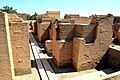 Processional Way partial reconstruction in Babylon
 -
 Processional Way partial reconstruction in Babylon


See also
[edit]References
[edit]- ^ Roscher, Wilhelm Heinrich (1906). "d) Die sieben Weltwunder (θεάματα, ἔργα μεγάλα)". Die Hebdomadenlehren der griechischen Philosophen und Aerzte (in German). Teubner. pp. 186–193. Retrieved 2025-04-20.
- ^ Pedersén 2021, p. 39: "Owing to their length, in particular, but also their thickness and height, the city walls with their gates were by far the largest structures in Babylon."
- ^ Koldewey, Robert; Johns, Agnes Sophia Griffith (1914). The Excavations at Babylon. Macmillan and Company, limited. p. v. ISBN 978-0-598-71689-7. Retrieved 2025-12-28.
The city walls, for instance, which in other ancient towns measure 3 metres, or at the most 6 or 7 metres, in Babylon are fully 17 to 22 metres thick. On many ancient sites the mounds piled above the' remains are not more than 2 or 3 to 6 metres high, while here we have to deal with 12 to 24 metres, and the vast extent of the area that was once inhabited is reflected in the grand scale of the ruins.
{{cite book}}: ISBN / Date incompatibility (help) - ^ Baker 2022, p. 15: "Of all the Babylonian cities of the first millennium BC, Babylon itself is undoubtedly the one whose plan is best known [...] The basic outline of the city could already be discerned prior to the beginning of the German excavations in 1899, as is clear from the excavators' contour plan of the site (Wetzel 1930: pl. 1) which they drew up before beginning their work. The city walls in particular were visible as earthworks, and within them were a series of mounds where occupation levels were subsequently uncovered."
- ^ Herodotus, Histories I, 178–181
- ^ Heinsch & Kuntner 2011, p. 500.
- ^ Boiy, T., Late Achaemenid and Hellenistic Babylon. p. 68–70 and 75f.; Leuven 2004 and Heller, A., Das Babylonien der Spätzeit (7.–4. Jh.) in den klassischen und keilschriftlichen Quellen. 20–24 und 36–74; Berlin 2010.
- ^ Jeremiah 51:58 (NIV)
- ^ Pedersén 2021, p. 40: "The traditional rectangular city wall (Figs. 1.1, 2.1), whether or not it was called Imgur-Enlil from the beginning, was probably planned and constructed sometime during the Hammurapi dynasty. For lack of other evidence, the oldest known references to the traditional city wall in Babylon have been Marduk-šāpik-zēri (1081–1069 BC) building Imgur-Enlil, and Adad-apla-iddina (1068–1047 BC) rebuilding the old wall, called Imgur-Enlil. This period, or just before, has often been taken as the beginning of the traditional, planned city wall of Babylon. A more recently published late Old Babylonian text, however, points to an earlier dating. It registers the acquisition of a building plot at the Ištar Gate in the New Town area of Babylon in the 11th year of Samsu-ditana, i.e. 1614 BC, at which time the gate (obviously) already existed. The same document refers to an earlier acquisition of the same plot in the 19th year of Samsuiluna, i.e. 1730 BC."
- ^ Pedersén 2021, p. 42.
- ^ Pedersén 2021, p. 44-45.
- ^ Pedersén 2021, p. 44–45.
- ^ Heinsch & Kuntner 2011, p. 500–502: "Wie stark Herodots Beschreibungen unser Bild der Stadtmauern beherrscht, zeigt sich schließlich im methodischen Ansatz, diese Ruinen als ein singulär neubabylonisches Monument zu behandeln, wenngleich das Fortbestehen und die Instandhaltung der Befestigungsmauern durch schriftliche Quellen bis ins 1. Jahrhundert v. Chr. belegt werden kann. Insbesondere die keilschriftlichen Quellen haben wesentlich zur Revidierung oder zumindest Hinterfragung des allein der Chaldäerzeit zugeschriebenen Babylon-Befundes geführt."
- ^ Pedersén 2021, p. 44: "The city walls, or at least an enclosable section of them, were still functioning in the Hellenistic and early Parthian periods. This is clear from a reference, in the Astronomical Diaries for the year 123 BC, to the closure of the city gates because of fighting with Arabs. It is not clear, however, if this refers to the complete old traditional city walls, sections of them, or some other kind of structure."
- ^ Heinsch & Kuntner 2011, p. 500–502: "Somit bleibt festzuhalten, dass dem archäologischen Befund beziehungsweise den von den deutschen Ausgräbern gebotenen Interpretationen weder die notwendige Aufmerksamkeit geschenkt, noch die durch die klassischen Quellen vorgegebene Interpretationsfolie auch nur annäherungsweise kritisch hinterfragt worden wäre. Trotz der erkenn baren Widersprüche, proklamierten Lücken und Unvollständigkeiten wird jedoch diesen Interpretationen weiterhin gefolgt, obwohl diese den ausgegrabenen und dokumentierten archäologischen Befunden bei weitem nicht gerecht werden."
- ^ a b c d e f Pedersén 2021, p. 45.
- ^ Pedersén 2021, p. 46.
- ^ Pedersén 2021, p. 82.
- ^ Pedersén 2021, p. 83.
- ^ Pedersén 2021, p. 82, 85: "The original height of the Ištar Gate is not known, and the excavators themselves made alternative suggestions as already discussed. The façade of the gate as it stands consists of some 80% modern flat glazed coloured bricks produced in the Berlin area in the 1920s. Some 20% of the façade, including the 26 bulls and 16 dragons, with some other decorations, and the cuneiform inscription were put together according to the types of original fragments discarded by the brick miners and placed in the modern gate fabric. The content of the original inscription is not known; what is now shown is put together according to another inscription of Nebuchadnezzar. In the same museum, there is also a reconstruction of a section of the 180 m-long walls on both sides of the upper Level 1 of the Processional Way north of the Ištar Gate. On each side of the full-scale reconstruction, 12 lions put together from small fragments of glazed relief bricks can be seen (compared with originally some 60 lions on each side). The width of the reconstructed street in the museum is only 7 m compared with some 20 m in Babylon."
- ^ a b c Pedersén 2021, p. 85.
- ^ a b Pedersén 2021, p. 86.
- ^ Pedersén 2021, p. 85–86: "A more complete reconstruction in baked brick up to the top of the walls has been done for the walls stretching about 180 m from the Ištar Gate in the northern direction, on both sides of the preserved Level 3 of the Processional Way. The preserved walls here were considered by the excavators to be the foundations for an upper street Level 1, where glazed relief bricks with lions were exposed. It has not been definitely proven archaeologically that the reconstructed walls belonged to the same level as the preserved street, but the sequence of expansion of the palace area makes it probable [...]"
Bibliography
[edit]- Baker, Heather D. (2022). "Reconstructing Ancient Babylon: Myth and Reality". Canadian Society for Mesopotamian Studies Journal. 14: 15–28.
- George, A. R. (1992). Babylonian Topographical Texts. Orientalia Lovaniensia analecta 40. Leuven, Belgium: Departement Oriëntalistiek; Peeters Press. ISBN 90-6831-410-6. OCLC 27918563. Retrieved 2025-10-07.
- Heinsch, Sandra; Kuntner, Walter (2011). "Herodot und die Stadtmauern Babylons". In R. Rollinger (ed.). Herodot und das Persische Weltreich. Classica et Orientalia 3. Wiesbaden, Germany: Harrassowitz Verlag. pp. 499–529.
- Pedersén, Olof (2021). Babylon: The Great City. Münster, Germany: Zaphon. ISBN 978-3-96327-136-6.