Wiki Article
Litavis
Nguồn dữ liệu từ Wikipedia, hiển thị bởi DefZone.Net

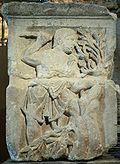
Litavis (Gaulish: Litauī 'Earth', lit. 'the Broad One') is a Gallic deity whose cult is primarily attested in east-central Gaul during the Roman period, where she mainly appears as the consort of Mars Cicolluis. She was probably originally an earth-goddess.[2][1][3] The divine pair Mars Cicolluis–Litavis was likely associated with fertile and nourishing land, an interpretation supported by the meanings of both divine names.[4] In medieval Celtic languages, various terms derived from the name *Litauia (meaning 'land' or 'country') came to designate the Brittany Peninsula.[2]
Name and etymology
[edit]Etymology
[edit]The Gaulish divine name Litauī ('Earth', lit. 'the Vast One') is generally derived from Proto-Celtic *flitawī ('broad'; cf. Old Breton litan, Middle Welsh llydan), itself going back to Proto-Indo-European *Pl̥th₂éwih₂.[5] This form is commonly interpreted as an epithet of the Proto-Indo-European Earth-goddess *déʰǵʰōm. Cognates are found in the Vedic Earth-goddess Pṛithvī Mātā (पृथ्वी) ('Mother Earth, the Vast One') and in Ancient Greek Plátaia (Πλάταια), a naiad described as the consort of Zeus, as well as in ritual expressions such as Old Hittite palḫiš dankuiš daganzipaš ('broad dark earth-genius') and Young Avestan ząm pərəθβīm ('broad earth').[6][7]
Derived terms
[edit]Cassius Dio, in his account of the events of the Gallic War in 52 BCE, cites an Aeduan bearing this name, Litaouikou (Λιταουίκου). Julius Caesar likewise mentions several Gauls whose names derive from Litavis, including Convictolitavis and Litaviccus.[4] The latter represents the Latinized form of Gaulish Litauicos, meaning 'sovereign' (literally 'possessor of the land'), a formation that is cognate with Welsh Llydewig ('pertaining to Brittany'), pointing to a shared Proto-Celtic term *Litauī-kos built with the determinative suffix *-kos.[1]
The medieval Celtic names for the Brittany Peninsula (Old Irish Letha, Old Welsh Litau, Old Breton Letau, Latinized Letavia) all stem from an earlier *Litauia, meaning 'Land' or 'Country'.[2] In the Middle Irish Lebor Bretnach (11th c.), Bretain Letha denotes the 'Britons of the Continent or Armorica', i.e. the Bretons. Linguist Rudolf Thurneysen proposed that these forms reflect a semantic development from an Ancient Celtic term meaning 'broad land, continent', applied in the Insular Celtic languages to the part of the European mainland nearest the British Islands.[1]
Epigraphic evidence
[edit]A goddess Litavis, consort of the Gaulish Mars Cicolluis, is attested on several stelae from the region of Aignay-le-Duc and especially from Mâlain, in Burgundy. These finds situate her cult on the frontier between the territories of the Lingones and the Mandubii. Among the Petrocorii, a dedication to Cobledu-Litavus, a god associated with springs, is also recorded. A protected-spring fibula, discovered at Alesia, bears the inscription Litaiccos.[4] A Latin dedicatory inscription from Narbonne (southern Gaul) likewise records the formula MARTI CICOLLUI ET LITAVI, meaning 'To Mars Cicolluos and Litavis'.[8][9]
The divine pair Mars Cicolluis–Litavis was probably connected with fertile and nourishing land, since Cicolluis has been interpreted as meaning 'the Nourisher' (cf. Middle Irish cích 'breast'), and the etymology of Litavis points to the Proto-Indo-European name for the deified Earth, *pleth₂wih₁.[4]
References
[edit]- ^ a b c d Koch 2005, p. 1159.
- ^ a b c Delamarre 2003, pp. 204–205.
- ^ West 2007, pp. 177–178.
- ^ a b c d Buisson 1994, pp. 182–183.
- ^ Maier 1994, p. 208; Delamarre 2003, pp. 204–205; Koch 2005, p. 1159; Matasović 2009, p. 135; West 2007, pp. 177–178
- ^ West 2007, p. 174–175, 178–179.
- ^ García Ramón 2017, pp. 5–6.
- ^ Koch 1991.
- ^ Barbet, Gérald; Billerey, Robert. "Une plaque de bronze avec dédicace découverte en Franche-Comté". In: Gallia, tome 61, 2004. p. 286. DOI: https://doi.org/10.3406/galia.2004.3065; www.persee.fr/doc/galia_0016-4119_2004_num_61_1_3065
Bibliography
[edit]- Buisson, André (1994). "La localisation du tombeau du Lingon, Bulletin de la Société Historique et archéologique de Langres". Bulletin de la Société Historique et Archéologique de Langres (315): 177–185.
- Delamarre, Xavier (2003). Dictionnaire de la langue gauloise: Une approche linguistique du vieux-celtique continental. Errance. ISBN 9782877723695.
- García Ramón, José L. (2017). Reconstructing Indo-European phraseology: Continuity and renewal (PDF). The Split: Reconstructing Early Indo-European Language and Culture. University of Copenhagen.
- Koch, John T. (1991). "Ériu, Alba, and Letha: When Was a Language Ancestral to Gaelic First Spoken in Ireland?". Emania. 9: 17–27.
- Koch, John T. (2006). Celtic culture : a historical encyclopedia. ABC-CLIO. ISBN 1-85109-440-7.
- Maier, Bernhard (1994). Lexikon der keltischen Religion und Kultur. A. Kröner. ISBN 978-3-520-46601-3.
- Matasović, Ranko (2009). Etymological Dictionary of Proto-Celtic. Brill. ISBN 9789004173361.
- West, Martin L. (2007). Indo-European Poetry and Myth. Oxford University Press. ISBN 978-0-19-928075-9.
Further reading
[edit]- "Litavia" — article in Jones' Celtic Encyclopedia by Mary Jones
- Etymological translations of "Litanus," "Litaui/Litavi," "Litauis/Litavis," etc. by Patrick Cuadrado (in French); automatic Google translation into English