Wiki Article
Monochrom
Nguồn dữ liệu từ Wikipedia, hiển thị bởi DefZone.Net
 | |
| Formation | 1993 |
|---|---|
| Type | International art-technology-philosophy group |
| Purpose |
|
| Headquarters | Museumsquartier, Vienna, Austria |
| Staff | 9 |
| Website | www |


Monochrom (stylised as monochrom) is an international art-technology-philosophy group, publishing house and film production company. It was founded in 1993,[1] and defines itself as "an unpeculiar mixture of proto-aesthetic fringe work, pop attitude, subcultural science and political activism".[2] Its main office is located at Museumsquartier/Vienna (at 'Q21').[3]
The group's members are: Johannes Grenzfurthner, Evelyn Fürlinger, Harald Homolka-List, Anika Kronberger, Franz Ablinger, Frank Apunkt Schneider, Daniel Fabry, Günther Friesinger and Roland Gratzer.
The group is known for working with different media and entertainment formats, although many projects are performative and have a strong focus on a critical and educational narrative. Johannes Grenzfurthner calls this "looking for the best weapon of mass distribution of an idea".[4] Monochrom is openly left-wing and tries to encourage public debate, sometimes using subversive affirmation or over-affirmation as a tactic.[5] The group popularized the concept of "context hacking".[6]
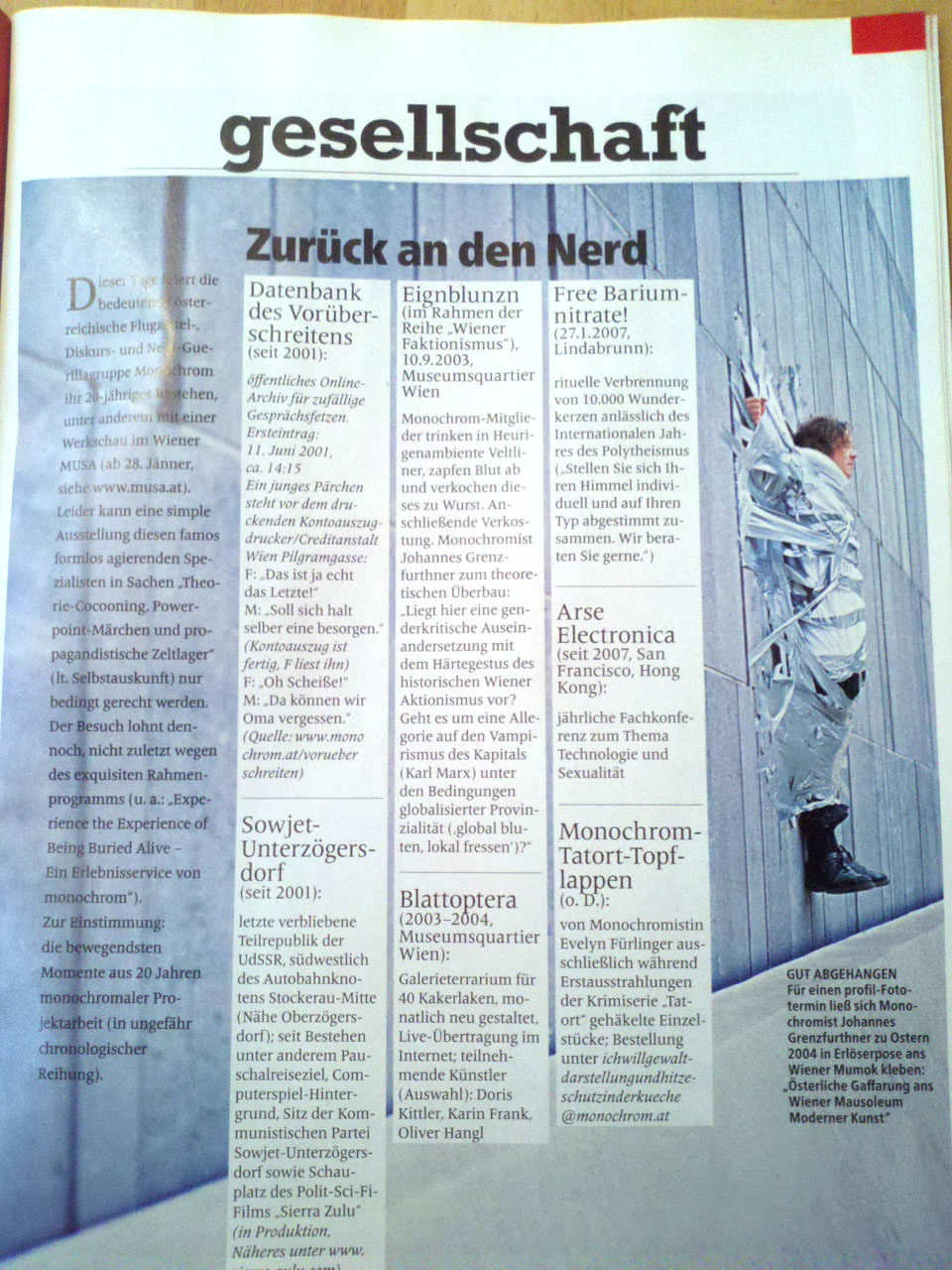
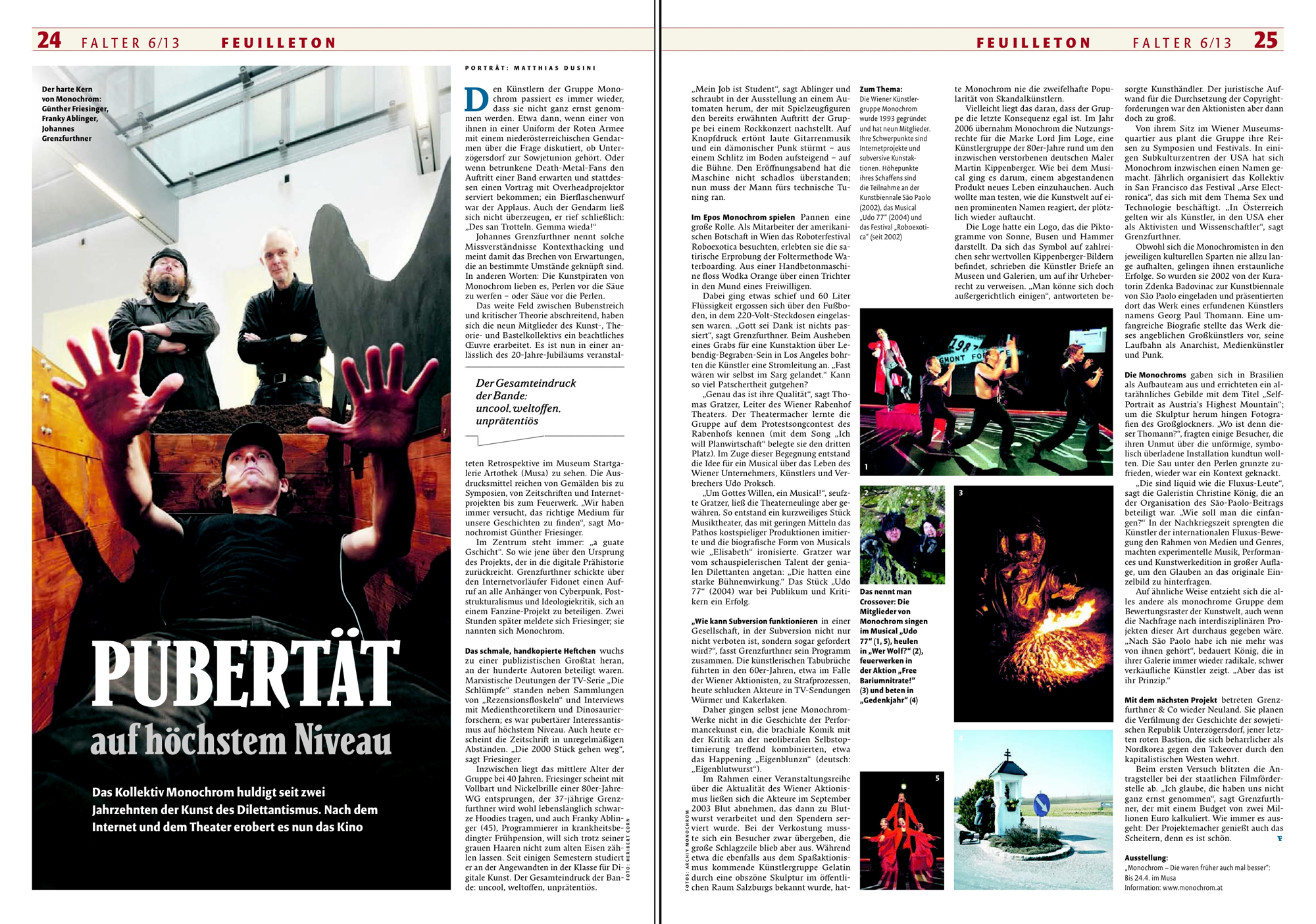
On the occasion of Monochrom's 20th birthday in 2013, several Austrian high-profile media outlets[7][8][9][10][11][12] paid tribute to the group's pioneering contributions within the field of contemporary art and discourse.
History and philosophy
[edit]
In the early 1990s, Johannes Grenzfurthner was an active member of several BBS message boards.[13] He used his online connections to create a zine or alternative magazine that dealt with art, technology and subversive cultures, and was influenced by US magazines like Mondo 2000.[14][15] Grenzfurthner's motivations were to react to the emerging conservatism in cyber-cultures of the early 1990s[16] and to combine his political background in the Austrian punk and antifa movement with discussion of new technologies and the cultures they create.[17][18] Franz Ablinger joined Grenzfurthner and they became the publication's core team.[19]
The first issue was released in 1993. Over the years the publication featured many interviews and essays, for example by Bruce Sterling, HR Giger, Richard Kadrey, Arthur Kroker, Negativland, Kathy Acker, Michael Marrak, DJ Spooky, Geert Lovink, Lars Gustafsson, Tony Serra, Friedrich Kittler, Jörg Buttgereit, Eric Drexler, Terry Pratchett, Jack Sargeant and Bob Black,[20] in its specific experimental layout style.[21]
In 1995 the group decided to cover new artistic practices[22][23][24] and started experimenting with different media: performances, computer games, robots, puppet theater, musical, short films, pranks, conferences, online activism.

In 1995 we decided that we didn't want to constrain ourselves to just one media format (the "fanzine"). We knew that we wanted to create statements, create viral information. So a quest for the best "Weapon of Mass Distribution" started, a search for the best transportation mode for a certain politics of philosophical ideas. This was the Cambrian Explosion of monochrom. We wanted to experiment, try stuff, find new forms of telling our stories. But, to be clear, it was (and still is) not about keeping the pace, of staying up-to-date, or (even worse) staying "fresh". The emergence of new media (and therefore artistic) formats is certainly interesting. But etching information into copper plates is just as exciting. We think that the perpetual return of 'the new', to cite Walter Benjamin, is nothing to write home about – except perhaps for the slave-drivers in the fashion industry. We've never been interested in the new just in itself, but in the accidental occurrence. In the moment where things don't tally, where productive confusion arises.[18]
All the other core team members joined between 1995 and 2006.
Grenzfurthner is the group's artistic director. He defines Monochrom's artistic and activist approach as 'Context hacking'[25] or 'Urban Hacking'.[26]
The group monochrom refers to its working method as "Context Hacking", thus referencing the hacker culture, which propagates a creative and emancipatory approach to the technologies of the digital age, and in this way turns against the continuation into the digital age of centuries-old technological enslavement perpetrated through knowledge and hierarchies of experts. ... Context hacking transfers the hackers' objectives and methods to the network of social relationships in which artistic production occurs, and upon which it is dependent. ... One of context hackers' central ambitions is to bring the factions of counterculture, which have veered off along widely diverging trajectories, back together again.[6]
Community and network
[edit]
From its very foundation, the group defined itself as a movement, culture[18] (referring to Iain M. Banks's sci-fi series) and "open field of experimentation".[2] Monochrom supported and supports various artists, activists, researchers and communities with an online publishing platform, a print publishing service (edition mono),[27] and organizes in-person meetings, screenings, radio shows, debate circles, conferences, online platforms.[28] It is fundamental for the group's core members to combine artistic and educational endeavors with community work[29] (cf. social practice).
Some collaborations have been rather short-lived (for example the publication of a 1993 fringe science paper[30] by Jakob Segal, projects with the Billboard Liberation Front and Ubermorgen or the administration of Dorkbot Vienna[31]), some have been going for many years and decades (for example with Michael Marrak, Cory Doctorow, Jon Lebkowsky, Fritz Ostermayer, V. Vale, eSeL, Scott Beale/Laughing Squid, Machine Project, Emmanuel Goldstein, Jason Scott, Jonathan Mann, Jasmin Hagendorfer and the Porn Film Festival Vienna), Michael Zeltner, Anouk Wipprecht, VSL Lindabrunn).
Monochrom supports initiatives like the Radius Festival,[32] Play:Vienna,[33] the Buckminster Fuller Institute Austria,[27] RE/Search, the Semantic Web Company[34] and the Vienna hackerspace Metalab. For a couple of years, Monochrom ran the DIY project "Hackbus" in cooperation with David "Daddy D" Dempsey (of FM4)[35]
Since 2007, Monochrom is the European correspondent for Boing Boing Video.[36]
.jpg)
Art residency
[edit]Monochrom offers a collaborative art residency in Vienna. Since 2003 the group has invited and created projects with artists, researchers, and activists like Suhrkamp's Johannes Ullmaier, pop theorist Stefan Tiron, performance artist Angela Dorrer, DIY blogger (and later: entrepreneur) Bre Pettis, photographer and activist Audrey Penven, digital artist Eddie Codel, sex work activist Maggie Mayhem, glitch artist Phil Stearns, illustrator Josh Ellingson, DIY artist Ryan Finnigan, digital artist Jane Tingley, digital rights activist Jacob Appelbaum, sex tech expert Kyle Machulis, hacker Nick Farr, technologist Sean Bonner, filmmakers Sophia Cacciola and Michael J. Epstein, writer Jack Sargeant, and others.
All former resident artists are considered ambassadors.[37]
Johannes Grenzfurthner sees Monochrom as a community and social incubator of critical and subversive thinkers.[6] An example is Bre Pettis of MakerBot Industries, who got inspired to create 3d printers during his art residency with Monochrom in 2007.[38] Pettis wanted to create a robot that could print shot glasses for Monochrom's cocktail-robot event Roboexotica and did research about the RepRap project at Metalab.[39] Shot glasses remained a theme throughout the history of MakerBot.[40]
Projects
[edit]monochrom has produced a large body of work across performance, film, intervention, publishing, radio, installation, lectures, festival formats, digital art, and technology-based projects.[41][42][43] Over the decades, the group's focus has shifted across media, making it difficult to summarize its approach through any single artistic formula.[41]
Rather than pursuing a stable form, monochrom has operated as a transdisciplinary platform combining satire, political critique, fiction, research, and participatory formats to examine cultural, social, and technological systems.[44] Its work has included manifestos and activist interventions, telepresence and robotics projects, conference and exhibition formats, television and theatre productions, software- and game-related works, participatory installations, publishing initiatives, and feature films.[41][44] The group has initiated, curated, produced, and created hundreds of projects, often linking art with activism, media criticism, and philosophical reflection.[41]
Among monochrom's best-known projects are Roboexotica, a Vienna-based festival for cocktail robotics founded in 1999, Arse Elektronika, a conference and festival series devoted to the relationship between sexuality and technology, the 2002 art hoax Georg Paul Thomann, and Soviet Unterzoegersdorf, a fictional Soviet enclave developed across games, theatre, performance, and film-related works.[45][46][47][48][49]
Taken together, these projects have led commentators to describe monochrom as an evolving laboratory for context hacking, experimental storytelling, and critical cultural production.[44]
edition mono
[edit]Since 1997, monochrom has run its own publishing house, edition mono, which publishes books on art, technology, and popular culture. Its output includes catalogues, academic works, and fiction, such as science fiction anthologies and novels, and has included publications by writers and artists such as Michael Marrak, Orhan Kipcak, Alisa Beck, Judith Fegerl, and Matthias Mollner.
monochrom film
[edit]monochrom is a registered film production and distribution company. In recent years, film production has become a major focus of the group's work. Most of monochrom's genre and nerd-culture-related film projects have been produced under the label "monochrom propulsion system", a name chosen as a reference to Buckaroo Banzai.[50]
Publications (incomplete)
[edit]
- monochrom / magazine and yearbook series. Published in 1993, 1994, 1995, 1996, 1997, 1998, 2000, 2004, 2006, 2007, 2010
- Stadt der Klage (Michael Marrak, 1997)
- Weg der Engel (Michael Marrak and Agus Chuadar, 1998)
- Who shot Immanence? (edited together with Thomas Edlinger and Fritz Ostermayer, 2002)
- Leutezeichnungen (edited together with Elffriede, 2003)
- Das Wesen der Tonalität (Othmar Steinbauer; edited by Guenther Friesinger, Helmut Neumann, Ursula Petrik, Dominik Sedivy, 2006)
- Quo Vadis, Logo?! (edited by Günther Friesinger and Johannes Grenzfurthner, 2006)
- Sonne Busen Hammer 16 (edited by Johannes Grenzfurthner, Günther Friesinger and Franz Ablinger, 2006)
- Als die Welt noch unterging (Frank Apunkt Schneider, 2007)
- VIPA (edited by Orhan Kipcak, 2007)
- Spektakel - Kunst - Gesellschaft (edited by Stephan Grigat, Johannes Grenzfurthner and Günther Friesinger, 2006)
- Sonne Busen Hammer 17 (edited by Johannes Grenzfurthner, Günther Friesinger and Fra21nz Ablinger, 2007)
- Roboexotica (edited by Günther Friesinger, Magnus Wurzer, Johannes Grenzfurthner, Franz Ablinger and Chris Veigl, 2008)
- Die Leiden der Neuen Musik (Ursula Petrik; edited by Guenther Friesinger, Helmut Neumann, Ursula Petrik, Dominik Sedivy, 2009)
- Do Androids Sleep with Electric Sheep? (edited by Johannes Grenzfurthner, Günther Friesinger, Daniel Fabry und Thomas Ballhausen, 2009)[51]
- Of Intercourse and Intracourse – Sexuality, Biomodification and the Techno-Social Sphere (edited by Johannes Grenzfurthner, Günther Friesinger, Daniel Fabry, 2011)[52]
- pr0nnovation? Pornography and Technological Innovation (edited by Johannes Grenzfurthner, Günther Friesinger and Daniel Fabry, 2008)[53]
- Screw the System (edited by Johannes Grenzfurthner, Günther Friesinger, Daniel Fabry)[54]
- Subvert Subversion. Politischer Widerstand als kulturelle Praxis (edited by Johannes Grenzfurthner, Günther Friesinger, 2020)[55]
- The Wonderful World of Absence (edited by Günther Friesinger, Johannes Grenzfurthner, Daniel Fabry, 2011)
- Anima Ex Machina by Michael Marrak (edited by Günther Friesinger, Johannes Grenzfurthner, 2021)
- Femi und die Fische by Tommy Schmidt (edited by Günther Friesinger, Johannes Grenzfurthner, 2022)
- Roboexotica: Beautiful Failure (edited by Günther Friesinger, Johannes Grenzfurthner, Franz Ablinger, 2025)
- Sexponential! (edited by Johannes Grenzfurthner, Günther Friesinger, Jasmin Hagendorfer, 2025)[56]
Filmography (feature-length films)
[edit]
- To Live and Survive (2025) – directed by Matthias Jaklitsch
- Solvent (2024) – directed by Johannes Grenzfurthner
- Hacking at Leaves (2024) – directed by Johannes Grenzfurthner
- Razzennest (2022) – directed by Johannes Grenzfurthner
- Transform! (2022) – directed by Marie-Christin Rissinger
- Masking Threshold (2021) – directed by Johannes Grenzfurthner
- Avenues (2021) - directed by Sushant Chaudhary
- Glossary of Broken Dreams (2018) – directed by Johannes Grenzfurthner
- Traceroute (2016) – directed by Johannes Grenzfurthner
- Die Gstettensaga: The Rise of Echsenfriedl (2014) – directed by Johannes Grenzfurthner
- Kiki and Bubu: Rated R Us (2011) - directed by Johannes Grenzfurthner
Exhibitions and festivals (examples)
[edit]
- Arad-II, Art Basel Miami Beach / USA (2005)[57]
- Die waren früher auch mal besser: monochrom (1993-2013) / Austria (2013)[58]
- Dilettanten. Forum Stadtpark, Graz / Austria - Steiermärkisches Landesmuseum Joanneum, Graz / Austria - Steirischer Herbst 2002, Graz / Austria (2002)[59]
- Junge Szene 98. Vereinigung Bildender Künstler, Wiener Secession, Vienna / Austria (1998)[60]
- MEDIA FORUM/Moscow International Film Festival / Moscow / Russia (2008)[61]
- Neoist World Congress. Kunsthalle Exnergasse, Vienna / Austria (1997)[62]
- Roboexotica (Festival for Cocktail Robotics, Vienna, 1999-)[63][64]
- Robotronika. Public Netbase t0 Media~Space!, Institut für neue Kulturtechnologien, Vienna / Austria (1998)[65]
- Seriell Produziertes. Diagonale (Austrian Film Festival), Graz / Austria (2000)[66]
- techno(sexual) bodies / videotage / Hong Kong / China (2010)[67]
- The Influencers, Center for Contemporary Culture / Barcelona / Spain (2008)[68]
- The Thomann Project. São Paulo Art Biennial, São Paulo / Brazil (2002)[69]
- Unterspiel, Contemporary Art Gallery, Vancouver / Canada (2005)[70]
- world-information.org. Museum of Contemporary Art, Brussels / Belgium (2000) and Belgrad / Serbia (2003)[71]
Awards (examples)
[edit]- 1st prize of 'E55' (Vienna/Berlin) 1999.[72]
- aniMotion Award Honorary Mention (Sibiu, Romania) for Interactive Tales for Monochrom's "Soviet Unterzoegersdorf/Sector 1/The Adventure Game" (2007).[73]
- Art Award of FWF Austrian Science Fund (2013).[74]
- Coca-Cola Light Art Edition (2006).[75]
- Media Forum/Moscow International Film Festival, Jury Special Mention (Moscow, Russia) for Monochrom's "The Void's Foaming Ebb", (2008).[61]
- Nestroy Theatre Prize (Vienna) 2005 (together with 'The Great Television Swindle' by maschek and 'Freundschaft' by Steinhauer and Henning) for Udo 77 (2004).[76]
- Official Honoree for NetArt and Personal Blog/Culture in The 2009 Webby Awards, International Academy of Digital Arts and Sciences (2009).[77]
- Videomedeja Awards Special Mention, Novi Sad, Serbia for Net/Software Category for Monochrom's "Soviet Unterzoegersdorf/Sector 1/The Adventure Game" (2006).[78]
See also
[edit]Notes
[edit]References
[edit]- ^ "monochrom | fanzineindex.de". fanzineindex.de.
- ^ a b "monochrom". monochrom.at.
- ^ "Q21 Backstage Tour – monochrom". 13 November 2020 – via youtube.com.
- ^ Rambatan, Bonni (3 October 2015). "Finding Your Weapons of Mass Distribution".
- ^ "monochrom".
- ^ a b c "monochrom: Context Hacking – Essay". Retrieved 11 June 2016.
- ^ "20 Jahre monochrom: Die Suche nach dem "perfekten Medium"". news.ORF.at. 28 January 2013.
- ^ fm4.at: "Sei ein Scientist", January 28, 2013
- ^ "Profil: "20 Jahre monochrom: Zurück an den Nerd", January 28, 2013".
- ^ "Falter: "Pubertät auf höchstem Niveau", issue 6/13".
- ^ "derStandard.at". derstandard.at.
- ^ "Leporello | FR | 25 01 2013 | 7:52". oe1.orf.at.
- ^ Kaestle, Thomas (14 April 2016). "The story of Traceroute, about a Leitnerd's quest". Boing Boing.
- ^ "monochrom: "Das Hacken treibt uns an"". futurezone.at. 20 February 2013.[permanent dead link]
- ^ Husslein, Uwe; Bornowski, Ralf (1995). Fandom Research (Reader und Index zu deutschsprachigen Fanzines. Ventil-Verlag. p. 70.
- ^ "CRE062 by Tim Pritlove: "Monochrom: Das etwas andere Künstlerkollektiv aus Wien", January 2, 2008
- ^ "Johannes Grenzfurthner". dkritik.de.
- ^ a b c Marc Da Costa, "Interview with Johannes Grenzfurthner of monochrom, Part 3 Archived 17 March 2012 at the Wayback Machine", Furtherfield.
- ^ ""Das Schockmoment ist nur noch Selbstmarketing"". jungle.world.
- ^ "monochrom print". Retrieved 11 June 2016.
- ^ "monochrom #26-34 Ye Olde Self-Referentiality Archived 5 May 2012 at the Wayback Machine", Neural, 15 June 2010.
- ^ "Simulacrum Fisticuffs (interview with Johannes Grenzfurthner), Rhysophocles, March 16, 2011". Archived from the original on 3 December 2013.
- ^ Erin Kobayashi, "How to be buried alive", Toronto Star, 6 February 2007
- ^ Marie Lechner, "[1]", Libération, 4 March 2008.
- ^ Context Hacking: Some Examples of How to Mess with Art, the Media System, Law and the Market, at O'Reilly ETech 2008, San Diego Archived 14 March 2012 at the Wayback Machine
- ^ Urban Hacking: Culture Jamming in the Risky Spaces of Modernity, book review by Molly Hankwitz in OtherCinema, September 24, 2011
- ^ a b "home". Monochrom Shop.
- ^ "monochrom - live termine und releases". www.monochrom.at.
- ^ FM4, Thomas Edlinger: "Besser als besser werden", January 27, 2014
- ^ "Segal Inhalt". monochrom.at.
- ^ "monochrom". Retrieved 11 June 2016.
- ^ "VIENNA – Radius Festival A Celebration Of Games". 26 April 2016. Archived from the original on 26 April 2016.
- ^ "play:vienna". playvienna.com.
- ^ ""Linked Open Data: The Essentials", edition mono/monochrom, Bauer, F., & Kaltenböck, M. (2011)" (PDF). Archived from the original (PDF) on 3 August 2016. Retrieved 9 July 2016.
- ^ "Hackbus, A Community Wiki For Mobile Hack Vehicles". 17 July 2010. Retrieved 11 June 2016.
- ^ "Monochrom: Bye Bye (a short film) - Boing Boing Video". Archived from the original on 22 June 2016. Retrieved 11 June 2016.
- ^ "monochrom". Retrieved 11 June 2016.
- ^ "MakerBot hat seinen Ursprung in Wien und würde sich an HP verkaufen". 3druck. 18 April 2013. Retrieved 21 January 2019.
- ^ "MADE IN MY BACKYARD / BRE PETTIS | Open Design Now".
- ^ Griggs, Brandon (9 March 2013). "Startup unveils 3-D scanner at SXSW". CNN.
- ^ a b c d "monochrom: KünstlerInnen-, Bastel- und Theorieneigungsgruppe". MuseumsQuartier Wien. 1 November 2019. Retrieved 16 April 2026.
- ^ "Künstlergruppe Monochrom: Out of Unterzögersdorf". profil. 27 June 2023. Retrieved 16 April 2026.
- ^ "Das DIY-Kollektiv Monochrom wird 20". The Gap. 24 January 2013. Retrieved 16 April 2026.
- ^ a b c "The Digital and Analogue Subversion of monochrom". Furtherfield. Retrieved 16 April 2026.
- ^ "Cocktail robots mix mojitos in Vienna". Reuters. 9 August 2007. Retrieved 16 April 2026.
- ^ "Roboter servieren Cocktails". ORF Wien. 22 November 2018. Retrieved 16 April 2026.
- ^ "Roboexotica: Roboter mixen Cocktails". ORF Wien. 12 December 2024. Retrieved 16 April 2026.
- ^ "monochrom's ARSE ELEKTRONIKA 2023: Sexponential". Ars Electronica Festival. 7 September 2023. Retrieved 16 April 2026.
- ^ Edgley, Charles (2010). "The Anarchy of Desire". Symbolic Interaction. 33 (2): 319–332.
- ^ Heller, Ramsey (10 April 2012). "Sierra Zulu Draws Attention to Soviet Austria". futurezone. Retrieved 17 April 2026.
- ^ "RE/Search website: "Do Androids Sleep With Electric Sheep?"". Archived from the original on 11 June 2016. Retrieved 14 June 2016.
- ^ "RE/Search website: "Of Intercourse and Intracourse"". Archived from the original on 13 May 2016. Retrieved 14 June 2016.
- ^ "RE/Search website: "pr0nnovation? Pornography and Technological Innovation"". Archived from the original on 11 June 2016. Retrieved 14 June 2016.
- ^ "RE/Search website: "Screw The System"". Archived from the original on 13 May 2016. Retrieved 14 June 2016.
- ^ "edition mono website: "Subvert Subversion"". Retrieved 29 May 2021.
- ^ Grenzfurthner, Johannes; Friesinger, Günther; Hagendorfer, Jasmin (2025). Sexponential!. edition mono/monochrom. ISBN 978-3-903549-01-2.
- ^ Hofer, Sebastian (27 June 2023). "Out of Unterzögersdorf". profil (in German).
- ^ "MUSA homepage: "Die waren früher auch mal besser: monochrom (1993-2013)"". Archived from the original on 3 August 2016. Retrieved 10 July 2016.
- ^ "do 03". Archived from the original on 1 July 2016. Retrieved 11 June 2016.
- ^ wien, basis. "basis wien - Junge Szene Wien '98". Retrieved 11 June 2016.
- ^ a b "MEDIA FORUM 2008 >>> We Are The Users | МЕДИА ФОРУМ 2008 >>> Мы Пользователи". 2008.mediaforum.mediaartlab.ru.
- ^ Marchart, Oliver. Neoismus. Avantgarde und Selbsthistorisierung. Wien: edition selene, 1997. p. 67f.
- ^ "Cocktail". vienna.at. 20 November 2018. Retrieved 23 November 2018.
- ^ Sagan, Sonja. "OTS0037, 20. Nov. 2018, 09:30 drucken als pdf als Text Roboexotica 2018 - Das Festival für Cocktailrobotik mit Star Trek Ehrengast Chase Masterson". ots.at. Retrieved 23 November 2018.
- ^ "Robotronika". Retrieved 11 June 2016.
- ^ diagonale (9 February 2000). "Diagonale 2000". Retrieved 11 June 2016.
- ^ "Techno (Sexual) Bodies - Asia Art Archive". Archived from the original on 3 August 2016. Retrieved 11 June 2016.
- ^ "The Influencers Festival in Barcelona". 18 February 2008. Retrieved 11 June 2016.
- ^ monochrom: The Georg Paul Thomann Project. São Paulo Art Biennial 2002. Georg Paul Thomann.
- ^ "Unterspiel". Retrieved 11 June 2016.
- ^ "World-Information.Org". Retrieved 11 June 2016.
- ^ Reiter, Martin. "E55 rally (1997 & 1999) | Martin L. Reiter". Archived from the original on 1 July 2016. Retrieved 10 June 2016.
- ^ "aniMotion". AltArt.
- ^ "Press release: Art Award of the FWF Austrian Science Fund (2013)" (PDF). Archived from the original (PDF) on 25 August 2013.
- ^ "Pool-Mag reports about Coca-Cola Light Art Edition, monochrom 2006". Archived from the original on 1 July 2016. Retrieved 10 June 2016.
- ^ Nestroy Theatre Prize 2005; German Wikipedia
- ^ "NEW Webby Gallery + Index". NEW Webby Gallery + Index.
- ^ "Videomedeja video festival - VIDEOMEDEJA | NEW MEDIA ART FESTIVAL".
External links
[edit]- monochrom main site (in German)
- monochrom main site (in English, some additional content)
- monochrom film site
- monochrom publishing house
- Detailed Interview with Johannes Grenzfurthner of monochrom (by Marc Da Costa/Furtherfield): part 1, part 2 and part 3
- TEDx talk by Johannes Grenzfurthner on monochrom, art and subversion


| International | |
|---|---|
| National | |
| Artists | |
| Other | |