Wiki Article
Portal:Cartoon
Nguồn dữ liệu từ Wikipedia, hiển thị bởi DefZone.Net

The Cartoon Portal

A cartoon is a type of visual art that is typically drawn, frequently animated, in an unrealistic or semi-realistic style. The specific meaning has evolved, but the modern usage usually refers to either: an image or series of images intended for satire, caricature, or humor; or a motion picture that relies on a sequence of illustrations for its animation. Someone who creates cartoons in the first sense is called a cartoonist, and in the second sense they are usually called an animator.
The concept originated in the Middle Ages, and first described a preparatory drawing for a piece of art, such as a painting, fresco, tapestry, or stained glass window. In the 19th century, beginning in Punch magazine in 1843, cartoon came to refer – ironically at first – to humorous artworks in magazines and newspapers. Then it also was used for political cartoons and comic strips. When the medium developed, in the early 20th century, it began to refer to animated films that resembled print cartoons. (Full article...)

In print media, a cartoon is a drawing or series of drawings, usually humorous in intent. This usage dates from 1843, when Punch magazine applied the term to satirical drawings in its pages,[1] particularly sketches by John Leech.[2] The first of these parodied the preparatory cartoons for grand historical frescoes in the then-new Palace of Westminster in London.[3]

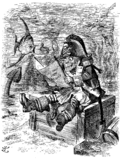
Sir John Tenniel—illustrator of Alice's Adventures in Wonderland—joined Punch in 1850, and over 50 years contributed over two thousand cartoons.[4]


Selected article -

"North by North Quahog" is the first episode of season four of Family Guy, following the revival of the series three years after its cancellation in 2002. Directed by Peter Shin and written by series creator Seth MacFarlane (pictured), the episode was first broadcast on May 1, 2005, on FOX. In "North by North Quahog", the show's main characters Peter and Lois Griffin go on a second honeymoon to spice up their marriage, but are eventually chased by Mel Gibson after Peter steals the sequel to The Passion of the Christ from Gibson's private hotel room. Meanwhile, their anthropomorphic dog Brian and their infant son Stewie take care of their teenage kids Chris and Meg. Family Guy had been canceled in 2002 due to low ratings, but was revived by FOX after reruns on Adult Swim became the network's most watched program, and more than three million DVDs of the show were sold. Much of the plot and many of the technical aspects of the episode, as well as the title, are direct parodies of the 1959 Alfred Hitchcock movie North by Northwest. The episode was watched by 12 million viewers and received a Primetime Emmy Award nomination for Outstanding Animated Program (for Programming Less Than One Hour).
Selected character -

Homer Simpson is a fictional main character in the animated television series The Simpsons. Homer is the boorish father of the Simpson family and as the family's provider, he works at the Springfield Nuclear Power Plant. With his wife, Marge, he has three children: Bart, Lisa, and Maggie. Homer embodies several American working class stereotypes: he is crude, overweight, incompetent, clumsy, lazy and ignorant; however, he is also fiercely devoted to his family. Homer was created and designed by cartoonist Matt Groening. He is voiced by Dan Castellaneta and first appeared on television, along with the rest of his family, in The Tracey Ullman Show short "Good Night" on April 19, 1987. After appearing on The Tracey Ullman Show for three years, the Simpson family got their own series on Fox, which debuted December 17, 1989. Homer is one of the most influential fictional characters on television and has inspired an entire line of merchandise. His catchphrase, the annoyed grunt "d'oh!", has been included in several dictionaries. Castellaneta has won four Primetime Emmy Awards for Outstanding Voice-Over Performance and a special achievement Annie Award for voicing Homer.
Did you know... -

- ...that the film Green Lantern starring Ryan Reynolds has been in development since the 1990s and once included a comedic incarnation with Jack Black set to star?
- ...that the Fire Nation, from the Universe of Avatar: The Last Airbender, was inspired by photos of volcanic islands of Iceland and the Pacific Ocean?
- ...that the Sam Sheepdog and Ralph Wolf cartoons Sheep Ahoy, A Sheep in the Deep, and Don't Give Up the Sheep were censored by ABC to remove a dynamite stick, a smoke break scene, and a spanking scene respectively?
Selected list -

There have been 131 episodes of Ed, Edd n Eddy, an animated comedy television series created by Danny Antonucci and produced by Canada-based a.k.a. Cartoon. The series debuted on Cartoon Network in the United States on January 4, 1999, and ended on November 8, 2009, with the premiere of the series finale film Ed, Edd n Eddy's Big Picture Show. The series was originally planned to air for four seasons; however, Cartoon Network ordered two additional seasons and three holiday-themed specials as a result of its popularity. Reruns continue to air on Cartoon Network, including airing as part of the revived block Cartoon Planet. The series revolves around three adolescent boys collectively known as "the Eds", who live in a suburban cul-de-sac. Unofficially led by Eddy, the Eds constantly try to scam the fellow cul-de-sac children in order to purchase jawbreakers. The Eds' plans usually fail and leave them in various predicaments. The award-winning series garnered generally positive reviews, and remains the longest running original Cartoon Network series and Canadian-made animated series to date.
General images -
-
 James Gillray's The Plumb-pudding in Danger (1805). The world being carved up into spheres of influence between Pitt and Napoleon. According to Martin Rowson, it is "probably the most famous political cartoon of all time—it has been stolen over and over and over again by cartoonists ever since." (from Political cartoon)
 -
 Stop-motion animated character from 20 Million Miles to Earth (1957) (from Animator)
 -
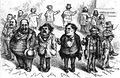 Thomas Nast depicts the Tweed Ring: "Who stole the people's money?" / "'Twas him." (from Political cartoon)
 -
 John Leech, Substance and Shadow (1843), published as Cartoon, No. 1 in Punch, the first use of the word cartoon to refer to a satirical drawing (from Cartoon)
 -

-
 Benjamin Franklin's Join, or Die (May 9, 1754), credited as the first cartoon published in an American newspaper (from Cartoonist)
 -
 Example of a modern cartoon. The text was excerpted by cartoonist Greg Williams from the Wikipedia article on Dr. Seuss.
 -
-
 An editorial cartoon of Andrew Johnson and Abraham Lincoln, 1865, entitled The Rail Splitter at Work Repairing the Union. The caption reads: (Johnson): "Take it quietly Uncle Abe and I will draw it closer than ever!!" (Lincoln): "A few more stitches Andy and the good old Union will be mended!" (from Political cartoon)
 -
 1903 political cartoon. The U.S.'s intentions to influence the area (especially the Panama Canal construction and control) led to the separation of Panama from Colombia. (from Political cartoon)
 -
 Sir John Tenniel, chief cartoonist for Punch (from 1864) and the illustrator of Alice in Wonderland, was the first cartoonist to be knighted (from Cartoonist)
 -
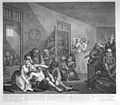 A Rake's Progress, Plate 8, 1735, and retouched by William Hogarth in 1763 by adding the Britannia emblem (from Political cartoon)
 -
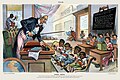 1899 cartoon showing Uncle Sam lecturing four children labeled Philippines, Hawaii, Puerto Rico, and Cuba. The caption reads: "School Begins. Uncle Sam (to his new class in Civilization)!" (from Political cartoon)
 -
 1942 political cartoon by Dr. Seuss. This cartoon depicts Japanese Americans as a "fifth column," lending support to Japan during its war against the United States. Bigotry against Japanese people was common among Americans at this time. (from Political cartoon)
 -
Nast depicts the Tweed Ring: "Who stole the people's money?" / "'Twas him."
-
 U.S. President Theodore Roosevelt introduces Taft as his crown prince: Puck magazine cover, 1906. (from Political cartoon)

_Ymir_2.png)


,_Artist_and_Cartoonist,_Lived_here.jpg)

.jpg)


Selected biography -

Ralph Bakshi (born October 29, 1938) is an American director of animated and, occasionally, live-action films. As the American animation industry fell into decline during the 1960s and 1970s, Bakshi tried to bring a change in the industry by establishing an alternative to mainstream animation in independent and adult-oriented productions. From 1972 until 1994, he directed nine theatrically-released feature films, writing five of them, and oversaw ten television projects as a director, producer and animator. Beginning his career at the Terrytoons television cartoon studio as a cel polisher, Bakshi was eventually promoted to director. He moved to the animation division of Paramount Pictures in 1967 and started his own studio, Bakshi Productions, in 1968. Through producer Steve Krantz, Bakshi made his debut feature film, Fritz the Cat, released in 1972. It was the first animated film to receive an X rating from the Motion Picture Association of America, and the most successful independent animated feature of all time.
Subcategories

WikiProjects
- Main projects
- Arts • Animation • Comics • Entertainment • Visual arts

- Related Projects
- Anime and manga • Biography • Film • Fictional characters • Media franchises • Music • Television • Video games
Selected quote -
Topics
- Comic book
- Comic strip
- Digital comics
- Graphic novel
- Mobile comic
- Motion comics
- Trade paperback
- Webcomic
- Animator
- Animation director
- Animation studios
- Animation film festivals
- Feature-length films
- Short films
- Television series
- Computer-animated films
- Stop-motion films
- Traditional animation
- Limited animation
- Rotoscoping
- Stop Motion
- Clay
- Cutout
- Graphic
- Model
- Object
- Pixilation
- Puppetoon
- Computer animation
- Flash animation
- PowerPoint animation
- SVG animation
- Cel-shaded animation
- Crowd simulation
- Morph target animation
- Motion capture
- Non-photorealistic rendering
- Skeletal animation
Things you can do

- Requested articles: Fenwick (comics), Khimaera (comics), Mutant Underground Support Engine, Bruce J. Hawker, Marc Dacier, Hultrasson, Frankenstein Comics, Dave Johnson (comics), Paco Medina, Dappere Dodo, New Adventures of the Space Explorers, Habatales, Musical Box, Foo-Foo (TV series), Bonne nuit les petits, The Adventures of Lariat Sam, More...
- Images and photos needed: Request images that are needed from Wikipedia requested images of comics and animation to included in each articles.
- Stubs: Work on stubs in articles in Comics and Animation stubs.
- Infobox: Add infobox that are needed from Category:Comics articles without infoboxes and Category:Animation articles needing infoboxes in articles.
- Deletion sorting: Please see the collection of discussions on the deletion of articles related to comics and animation - compiled by WikiProject Deletion sorting
Related portals


Associated Wikimedia
The following Wikimedia Foundation sister projects provide more on this subject:
-
 Commons
Free media repository -
 Wikibooks
Free textbooks and manuals -
 Wikidata
Free knowledge base -
 Wikinews
Free-content news -
 Wikiquote
Collection of quotations -
 Wikisource
Free-content library -
 Wikiversity
Free learning tools -
 Wiktionary
Dictionary and thesaurus


More portals


Sources
- ^ Punch.co.uk. "History of the Cartoon". Archived from the original on 2007-11-11. Retrieved 2007-11-01.
- ^ Adler & Hill 2008, p. 30.
- ^ "Substance and Shadow: Original Editorial Accompanying "Cartoon, No. I"". Victorian web.org. Retrieved 29 October 2023.
- ^ "Sir John Tenniel". National Portrait Gallery. Retrieved 26 August 2022.