Wiki Article
Portal:Energy
Nguồn dữ liệu từ Wikipedia, hiển thị bởi DefZone.Net

| Main page | New articles & Tasks |
 The Energy Portal Welcome to Wikipedia's Energy portal, your gateway to energy. This portal is aimed at giving you access to all energy related topics in all of its forms.
|
Page contents: Selected article • Selected image • Selected biography • Did you know? • General images • Quotations • Related portals • Wikiprojects • Major topics • Categories • Help • Associated Wikimedia |
Introduction

Energy (from Ancient Greek ἐνέργεια (enérgeia) 'activity') is the quantitative property that is transferred to a body or to a physical system, recognizable in the capacity to do work and in the form of heat and light. Energy is a conserved quantity—the law of conservation of energy states that energy can be converted in form, but not created or destroyed. The unit of measurement for energy in the International System of Units (SI) is the joule (J).
Forms of energy include the kinetic energy of a moving object, the potential energy stored by an object (for instance due to its position in a field), the elastic energy stored in a solid object, chemical energy associated with chemical reactions, the radiant energy carried by electromagnetic radiation, the internal energy contained within a thermodynamic system, and rest energy associated with an object's rest mass. These are not mutually exclusive.
All living organisms constantly take in and release energy. The Earth's climate and ecosystems processes are driven primarily by radiant energy from the Sun. (Full article...)
Selected article

To avoid dangerous climate change, the energy policy of the European Union has set a 2°C [3.6°F] limit to the temperature rise, compared to pre-industrial levels. Of this, 0.8°C has already taken place and another 0.5°C is already committed. The 2°C rise is associated with a carbon dioxide concentration of 400–500 ppm by volume; as of January 2007 it was 383 ppm by volume, and rising at 2 ppm annually. Unless significant action is taken soon the 2°C limit is likely to be exceeded.
Strategies for moving to a low-carbon economy include development of new technologies, particularly renewable energy; electric and hybrid vehicles; fuel cells; public transportion; zero-energy buildings; Zero-Net-Energy USA Federal Buildings; energy conservation; carbon taxes; enhancing natural carbon dioxide sinks; population control; and carbon capture and storage. Environmental groups also encourage individual-lifestyle and political action, as well as action by business.
The Kyoto Protocol, covering more than 160 countries and over 55% of global emissions provides an international mitigation framework. The United States, the world's largest greenhouse gas emitter; and Kazakhstan have refused to ratify the treaty. China and India, two other large emitters, have ratified the treaty but are exempt from cutting emissions. International talks on a successor to the treaty, which ends in 2012, have begun.
Selected image

Photo credit: Senior Airman Joshua Strang, United States Air Force
An aurora, caused by the release of energy as charged particles collide with atoms in the Earth's upper atmosphere.
Did you know?

- Buildings constructed to the German Passivhaus standard use 75% to 95% less energy for space heating and cooling than current new buildings in the United States?
- Crossing 4,000 km (2,500 miles), the Druzhba pipeline is the world's longest oil pipeline?
- Coal is ground to a powder before being burnt in fossil fuel power plants?
- Compact fluorescent lamps (pictured) use about 1/4 of the energy of normal incandescent light bulbs, and pay for themselves after about 500 hours of use?
- Nuclear power in France produces 78% of all the country's electricity - more than in any other nation?
- Positive lightning bolts are typically six to ten times more powerful than normal lightning — and aircraft are not designed to withstand them?
- Dark energy is a hypothetical form of energy which permeates all of space?
Selected biography

Born in Ireland, Thomson studied at the University of Glasgow, Scotland. On graduating, he became a mathematics teacher at the Royal Belfast Academical Institution. During his life Thomson published more than 600 scientific papers and filed over 70 patents.
As early as 1845 Thomson pointed out that the experimental results of William Snow Harris were in accordance with the laws of Coulomb. Over the period 1855 to 1867, Thomson collaborated with Peter Guthrie Tait the Treatise on Natural Philosophy that unified the various branches of physical science under the common principle of energy. His inventions included the current balance for the precise specification of the ampere, the standard unit of electric current.
In 1893, Thomson headed an international commission to decide on the design of the Niagara Falls power station. Despite his previous belief in the superiority of direct current electric power transmission, he agreed to use alternating current after seeing a Westinghouse demonstration at the Chicago World's Fair.
In the news
- 9 June 2026 – Economic impact of the 2026 Iran war
- The United States Energy Information Administration reports that Middle Eastern oil producers have reduced output by more than 11 million barrels per day, due to the Strait of Hormuz closure. (Al Jazeera)
- 5 June 2026 –
- The United States Department of Energy announces that a nuclear microreactor developed by a private company has reached "criticality" for the first time under a program to develop the U.S. nuclear industry by the second Trump administration. (PBS)
- 4 June 2026 –
- The Indonesian rupiah falls to its lowest recorded level against the United States dollar, reaching Rp 18,028 per $1 amid rising energy costs and increased demand for foreign currency despite central bank intervention. (AFP via France 24)
- 31 May 2026 – Economic impact of the 2026 Iran war
- Sri Lanka increases fuel prices by up to six percent as part of economic reforms linked to its International Monetary Fund assistance program, which includes plans to phase out fuel subsidies and achieve cost recovery in the energy sector. (AFP via The Hindu)
- 29 May 2026 – Iran and weapons of mass destruction
- International Atomic Energy Agency director Rafael Grossi says that Kazakhstan is open to taking custody of Iran's enriched uranium if a deal is reached on their nuclear program. (Middle East Eye)
General images
-
 Olkiluoto 3 under construction in 2009. It was the first EPR, a modernized PWR design, to start construction. (from Nuclear power)
 -
 A comparison of levelized cost of energy (LCOE) over time for nuclear power and other sources. While wind turbines and solar panels can be mass-produced and thus enjoy learning curve effects, nuclear are almost always one-of-a-kind projects due to the limited number of reactors being built. The source of this chart, Our World in Data notes that the costs presented here is the global average, and these costs were driven up by 2 projects in the United States. The organization recognises that the median cost of the most exported and produced nuclear energy facility in the 2010s the South Korean APR1400, remained "constant", including in export. (from Nuclear power)
 -
 The Warwick Castle water-powered generator house, used for the generation of electricity for the castle from 1894 until 1940 (from Hydroelectricity)
 -
 Passive cooling features, such as these windcatcher towers in Iran, bring cool air into buildings without any use of energy. (from Sustainable energy)
 -
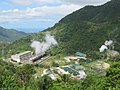
-
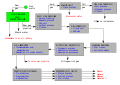 Schematic flow diagram of a typical natural gas processing plant (from Natural gas)
 -
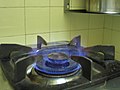 Natural gas burning on a gas stove (from Natural gas)
 -
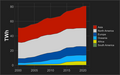 Yearly geothermal generation by continent (from Geothermal power)
 -
 The Ikata Nuclear Power Plant, a pressurized water reactor that cools by using a secondary coolant heat exchanger with a large body of water, an alternative cooling approach to large cooling towers (from Nuclear power)
 -

-
 Museum Hydroelectric power plant "Under the Town" in Užice, Serbia, built in 1900 (from Hydroelectricity)
 -
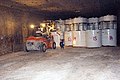 Nuclear waste flasks generated by the United States during the Cold War are stored underground at the Waste Isolation Pilot Plant (WIPP) in New Mexico. The facility is seen as a potential demonstration for storing spent fuel from civilian reactors. (from Nuclear power)
 -
 The Three Gorges Dam in Central China is the world's largest power-producing facility of any kind. (from Hydroelectricity)
 -
 Yearly solar generation by continent (from Solar power)
 -
 The US has been counting on private industry to lead in fusion power, while more recently China's government has made fusion a national priority. In 2025, $2.1 billion was poured into a single Chinese state-owned fusion company, an amount two and a half times the U.S. Energy Department's annual fusion budget. (from Nuclear power)
 -
 Crude oil is separated into fractions by fractional distillation. The fractions at the top of the fractionating column have lower boiling points than the fractions at the bottom. The heavy bottom fractions are often cracked into lighter, more useful products. All of the fractions are processed further in other refining units. (from Oil refinery)
 -
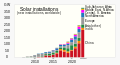 Benefitting from favorable policies and declining costs of modules, photovoltaic solar installation has grown consistently. In 2023, China added 60% of the world's new capacity. (from Solar power)
 -

-
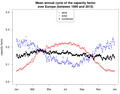 Seasonal cycle of capacity factors for wind and photovoltaics in Europe shown under idealized assumptions. The figure illustrates the balancing effects of wind and solar energy at the seasonal scale (Kaspar et al., 2019). (from Solar power)
 -
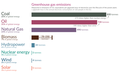 Greenhouse gas emissions per energy source. Solar power is one of the sources with the least greenhouse gas emissions. (from Solar power)
 -
 Life-cycle greenhouse gas emissions of electricity supply technologies, median values calculated by IPCC (from Nuclear power)
 -

-
 Sample of crude oil (petroleum) (from Oil refinery)
 -
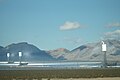 Ivanpah Solar Electric Generating System with all three towers under load (from Solar power)
 -
 Following the 2011 Fukushima Daiichi nuclear disaster, the world's worst nuclear accident since 1986, 50,000 households were displaced after radiation leaked into the air, soil and sea. Radiation checks led to bans of some shipments of vegetables and fish. (from Nuclear power)
 -

-
 Buildings in the Solar Settlement at Schlierberg, Germany, produce more energy than they consume. They incorporate rooftop solar panels and are built for maximum energy efficiency. (from Sustainable energy)
 -
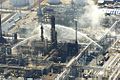 Fire-extinguishing operations after the Texas City refinery explosion (from Oil refinery)
 -
 Countries' proven natural gas reserves (2014), based on data from The World Factbook (from Natural gas)
 -
-
 Death rates per unit of electricity production for different energy sources (from Nuclear power)
 -
 Natural gas drilling rig in Texas, US (from Natural gas)
 -
 The outdoor section of a heat pump. In contrast to oil and gas boilers, they use electricity and are highly efficient. As such, electrification of heating can significantly reduce emissions. (from Sustainable energy)
 -

-
 A gas bill from Baltimore, Maryland, 1834, for manufactured coal gas, before the introduction of ground-extracted methane gas. (from Natural gas)
 -
 For cooking, electric induction stoves are one of the most energy-efficient and safest options. (from Sustainable energy)
 -
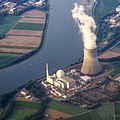 The Leibstadt Nuclear Power Plant in Switzerland (from Nuclear power)
 -
 A micro-hydro facility in Vietnam (from Hydroelectricity)
 -
 Production of technology such as renewable energy sources starts a positive feedback loop to form what has been called a virtuous cycle—the opposite of a vicious cycle. For example, as more and more solar modules are deployed, prices fall because of the economies of scale, allowing the technology to become cost-competitive in new applications that in turn increase demand for more deployment. (from Sustainable energy)
 -
 China's count of multi-country patent filings has surged since the mid-2010s, leading in batteries and solar, though Europe still dominates in wind energy and smart grids. China also leads in highly cited publications in global peer-reviewed journals. (from Sustainable energy)
 -

-
 Sample of kerosene (from Oil refinery)
 -
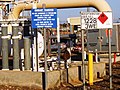 A pipeline odorant injection station (from Natural gas)
 -
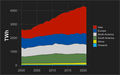 Yearly hydro generation by continent (from Hydroelectricity)
 -
 Electrified transport and renewable energy are key areas of investment for the renewable energy transition. (from Sustainable energy)
 -
 Motor oil (from Oil refinery)
 -
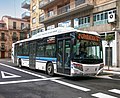 Natural gas bus in Salamanca, Spain (from Natural gas)
 -
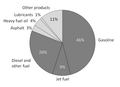 A breakdown of the products made from a typical barrel of US oil (from Oil refinery)
 -
 Electrification rates of different countries compared to OECD Europe (from Sustainable energy)
 -
 Proportions of the isotopes uranium-238 (blue) and uranium-235 (red) found in natural uranium and in enriched uranium for different applications. Light water reactors use 3–5% enriched uranium, while CANDU reactors work with natural uranium. (from Nuclear power)
 -
 The first light bulbs ever lit by electricity generated by nuclear power at EBR-1 at Argonne National Laboratory-West (now the Idaho National Laboratory), December 20, 1951. (from Nuclear power)
 -
 Global geothermal electric capacity. Upper red line is installed capacity; lower green line is realized production. (from Geothermal power)
 -
 Enhanced geothermal system 1: Reservoir 2: Pump house 3: Heat exchanger 4: Turbine hall 5: Production well 6: Injection well 7: Hot water to district heating 8: Porous sediments 9: Observation well 10: Crystalline bedrock (from Geothermal power)
 -
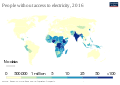 World map showing where people without access to electricity lived in 2016—mainly in sub-Saharan Africa and the Indian subcontinent (from Sustainable energy)
 -
 The Ffestiniog Power Station can generate 360 MW of electricity within 60 seconds of the demand arising. (from Hydroelectricity)
 -
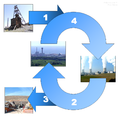 The nuclear fuel cycle begins when uranium is mined, enriched, and manufactured into nuclear fuel (1), which is delivered to a nuclear power plant. After use, the spent fuel is delivered to a reprocessing plant (2) or to a final repository (3). In nuclear reprocessing, 95% of spent fuel can potentially be recycled to be returned to use in a power plant (4). (from Nuclear power)
 -
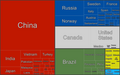 Hydro generation by country, 2021 (from Hydroelectricity)
 -
 Storage tanks and towers at Shell Puget Sound Refinery (Shell Oil Company), Anacortes, Washington (from Oil refinery)
 -
 Kenyan dairy farmer lighting a biogas lamp. Biogas produced from biomass is a renewable energy source that can be burned for cooking or light. (from Sustainable energy)
 -
 Natural gas processing plant in Aderklaa, Lower Austria (from Natural gas)
 -
 Cooling towers at a geothermal power plant in Larderello, Italy
 -
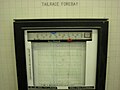 Measurement of the tailrace and forebay rates at the Limestone Generating Station in Manitoba, Canada (from Hydroelectricity)
 -
 Refinery, Bayport Industrial Complex, Harris County, Texas (from Oil refinery)
 -
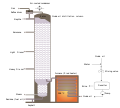 Schematic flow diagram of a typical crude oil distillation unit as used in petroleum crude oil refineries (from Oil refinery)
 -
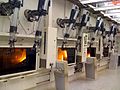 Most waste packaging, small-scale experimental fuel recycling chemistry and radiopharmaceutical refinement is conducted within remote-handled hot cells. (from Nuclear power)
 -
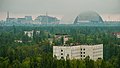 The town of Pripyat abandoned since 1986, with the Chernobyl plant and the Chernobyl New Safe Confinement arch in the distance (from Nuclear power)
 -
 Typical composition of uranium dioxide fuel before and after approximately three years in the once-through nuclear fuel cycle of a LWR (from Nuclear power)
 -
 Sample of gasoline (from Oil refinery)
 -
 Natural gas extraction by countries in cubic meters per year around 2013 (from Natural gas)
 -
 Wind turbines in Xinjiang, China
 -
 A woman in rural Rajasthan, India, collects firewood. The use of wood and other polluting fuels for cooking causes millions of deaths each year from indoor and outdoor air pollution. (from Sustainable energy)
 -
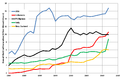 Trends in the top five geothermal electricity-generating countries, 1980–2012 (US EIA) (from Geothermal power)
 -
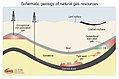 The location of shale gas compared to other types of gas deposits (from Natural gas)
 -
 The growth of solar PV on a semi-log scale since 1996 (from Solar power)
 -
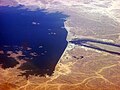 Merowe Dam in Sudan. Hydroelectric power stations that use dams submerge large areas of land due to the requirement of a reservoir. These changes to land color or albedo, alongside certain projects that concurrently submerge rainforests, can in these specific cases result in the global warming impact, or equivalent life-cycle greenhouse gases of hydroelectricity projects, to potentially exceed that of coal power stations. (from Hydroelectricity)
 -
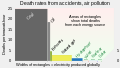 Deaths caused as a result of fossil fuel use (areas of rectangles in chart) greatly exceed those resulting from production of sustainable energy (rectangles barely visible in chart). (from Sustainable energy)
 -

-
 Construction close to high-pressure gas-transmission pipelines is discouraged, often with standing warning signs. (from Natural gas)
 -
 Thomas Young - the first to use the term "energy" to refer to kinetic energy in its modern sense, in 1802. (from History of energy)
 -
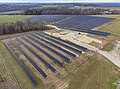
 Part of the Senftenberg Solarpark, a solar photovoltaic power plant located on former open-pit mining areas close to the city of Senftenberg, in Eastern Germany. The 78 MW Phase 1 of the plant was completed within three months. (from Solar power)
 -
 Nuclear fuel assemblies being inspected before entering a pressurized water reactor in the United States (from Nuclear power)
 -
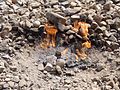 Burning of natural gas coming out of the ground (from Natural gas)
 -
 The U.S. and Russia have been the predominant producers of natural gas. (from Natural gas)
 -
 Cracks at the historic Town Hall of Staufen im Breisgau presumed due to damage from geothermal drilling (from Geothermal power)
 -
 The Hoover Dam in the United States is a large conventional dammed-hydro facility, with an installed capacity of 2,080 MW. (from Hydroelectricity)
 -
 Map of solar resources from World bank (from Solar power)
 -
 Acceptance of wind and solar facilities in one's community is stronger among U.S. Democrats (blue), while acceptance of nuclear power plants is stronger among U.S. Republicans (red). (from Solar power)
 -
 Anti-nuclear protest near nuclear waste disposal centre at Gorleben in northern Germany (from Nuclear power)
 -
 Manhole for domestic gas supply, London, UK (from Natural gas)
 -
 Part of the 354 MW Solar Energy Generating Systems (SEGS) parabolic trough solar complex in northern San Bernardino County, California (from Solar power)
 -
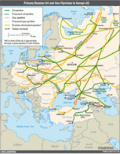 Russia was a key oil and gas supplier to Europe (map from 2013). This changed with the Russian invasion of Ukraine in 2022. (from Energy policy)
 -
 Sulphur (from Oil refinery)
 -
 Utility cycling infrastructure, such as this bike lane in Vancouver, encourages sustainable transport. (from Sustainable energy)
 -
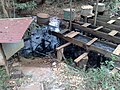
-
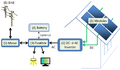 Schematics of a grid-connected residential PV power system (from Solar power)
 -
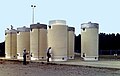 Dry cask storage vessels storing spent nuclear fuel assemblies (from Nuclear power)
 -

-
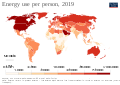 Global energy usage is highly unequal. High income countries such as the United States and Canada use 100 times as much energy per capita as some of the least developed countries in Africa. (from Sustainable energy)
 -
 Electricity production by source (from Solar power)
 -
 Since 1985, the proportion of electricity generated from low-carbon sources has increased only slightly. Advances in deploying renewables have been mostly offset by declining shares of nuclear power. (from Sustainable energy)
 -
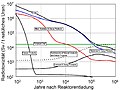 Activity of spent UOx fuel in comparison to the activity of natural uranium ore over time (from Nuclear power)
 -
 Geothermal generation by country, 2021 (from Geothermal power)
 -
 The map shows the commercial nuclear power plants in the world. Research reactors are not considered nuclear power plants.Operating reactors, building new reactorsOperating reactors, planning new buildNo reactors, building new reactorsNo reactors, new in planningOperating reactors, stableOperating reactors, decided on phase-outCivil nuclear power is illegalNo reactors(from Nuclear power)
 -
 The multi-mission radioisotope thermoelectric generator (MMRTG), used in several space missions such as the Curiosity Mars rover (from Nuclear power)
 -
 Example of energy policy decisions: The goal of the Southern Gas Corridor, which connects the giant Shah Deniz gas field in Azerbaijan to Europe, is to reduce Europe's dependency on Russian gas. (from Energy policy)
 -
 A photovoltaic power station in California, United States
 -
 The Calder Hall nuclear power station in the United Kingdom, the world's first commercial nuclear power station (from Nuclear power)
 -
 Several countries and the European Union have committed to dates for all new cars to be zero-emissions vehicles. (from Sustainable energy)
 -
 The warming influence (called radiative forcing) of long-lived greenhouse gases has increased substantially in the last 40 years, with carbon dioxide and methane being the dominant drivers of global warming. (from Natural gas)
 -
 Actual annual deployments of solar PV vs predictions by the IEA for the period 2002–2016. Predictions have largely and consistently underestimated actual growth. (from Solar power)
 -
 Peoples Gas Manlove Field natural gas storage area in Newcomb Township, Champaign County, Illinois. In the foreground (left) is one of the numerous wells for the underground storage area, with an LNG plant, and above-ground storage tanks are in the background (right). (from Natural gas)
 -
 Sample of diesel fuel (from Oil refinery)
 -
 A parabolic collector concentrates sunlight onto a tube in its focal point. (from Solar power)
 -
 Reactor decay heat as a fraction of full power after the reactor shutdown, using two different correlations. To remove the decay heat, reactors need cooling after the shutdown of the fission reactions. A loss of the ability to remove decay heat caused the Fukushima accident. (from Nuclear power)
 -
Deaths caused by use of fossil fuels such as natural gas (areas of rectangles in chart) greatly exceed those resulting from production of wind energy, nuclear energy or solar energy (rectangles barely visible in chart). (from Natural gas)
-
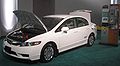 Honda Civic GX, a natural gas-powered automobile sold in North America from 1998 to 2015 (from Natural gas)
 -
 The launching ceremony of USS Nautilus January 1954. In 1958 it would become the first vessel to reach the North Pole. (from Nuclear power)
 -
 Oil refinery in Iran (from Oil refinery)
 -

-


.svg)


.svg)


.jpg)


.jpg)

Quotations
- "We must not waste time and energy disputing the IPCC's report or debating the right machinery for making progress. The International Panel's work should be taken as our sign post: and the United Nations Environment Programme and the World Meteorological Organisation as the principal vehicles for reaching our destination." – Margaret Thatcher, 1990
- "The Kyoto treaty would have wrecked our economy, if I can be blunt." – George W. Bush, 2005
- "We strongly believe that the efforts needed to combat climate change do not have to be regarded as constraints on the economy. Instead, they can be used as a lever for new, green technology." – Maud Olofsson, 2007
Related portals


WikiProjects
WikiProjects connected with energy:
Other WikiProjects that may be of interest:
Major topics


.svg)


Major categories
National energy supply, use & conservation
National electricity sector
Politics, economics, environment
- Climate change
- Energy conservation
- Energy economics
- Energy crises
- Energy development
- Energy policy
- Peak oil
Energy sources
- Fuels
- Biofuels
- Fossil fuels
- Fusion power
- Nuclear technology
- Renewable energy
- Energy conversion
- Electric power
- Energy storage
Energy-related design
Scientific usage
Category browser

Help

Puzzled by energy?
Can't answer your question?
Don't understand the answer?
- Ask at the reference desk
- Read the Wikipedia help pages
For further ideas, to leave a comment, or to learn how you can help improve and update this portal, see the talk page.
Associated Wikimedia
The following Wikimedia Foundation sister projects provide more on this subject:
-
 Commons
Free media repository -
 Wikidata
Free knowledge base -
 Wikiquote
Collection of quotations -
 Wikisource
Free-content library -
 Wikiversity
Free learning tools -
 Wiktionary
Dictionary and thesaurus


