Wiki Article
Portal:Germany
Nguồn dữ liệu từ Wikipedia, hiển thị bởi DefZone.Net

Welcome to the Germany Portal!
Willkommen im Deutschland-Portal!
.svg)
|

|

| |
Germany (German: Deutschland), officially the Federal Republic of Germany (German: Bundesrepublik Deutschland), is a country in Central and Western Europe, lying between the Baltic Sea and the North Sea to the north with the Alps to the south. It borders Denmark to the north, Poland and the Czech Republic to the east, Austria and Switzerland to the south, France to the southwest, and Luxembourg, Belgium and the Netherlands to the west.
Germany includes 16 constituent states, covers an area of 357,596 square kilometres (138,069 sq mi) and has a largely temperate seasonal climate. With over 83 million inhabitants, it is the second most populous state of Europe after Russia, the most populous state lying entirely in Europe, as well as the most populous member state of the European Union. Germany is a very decentralized country. Its capital and most populous city is Berlin, while Frankfurt serves as its financial capital and has the country's busiest airport.
In 1871, Germany became a nation-state when most of the German states unified into the Prussian-dominated German Empire. After World War I and the Revolution of 1918–19, the Empire was replaced by the parliamentary Weimar Republic. The Nazi seizure of power in 1933 led to World War II and the Holocaust. After the end of World War II in Europe and a period of Allied occupation, two new German states were founded: West Germany, formed from the American, British, and French occupation zones, and East Germany, formed from the western part of the Soviet occupation zone, reduced by the newly established Oder-Neisse line. Following the Revolutions of 1989 that ended communist rule in Central and Eastern Europe, the country was reunified on 3 October 1990.
Germany is a federal parliamentary republic led by a chancellor. It is a great power with a strong economy. As a global leader in several industrial, scientific and technological sectors, it is a major trading nation. The Federal Republic of Germany was a founding member of the European Economic Community in 1957 and the European Union in 1993. Read more...
Selected article

The Göttingen Seven (German: Göttinger Sieben) were a group of seven liberal professors at University of Göttingen. In 1837, they protested against the annulment of the constitution of the Kingdom of Hanover by its new ruler, King Ernest Augustus, and refused to swear an oath to the king. The company of seven was led by historian Friedrich Christoph Dahlmann, who himself was one of the key advocates of the previous constitution. The other six were the Germanist brothers Wilhelm and Jacob Grimm, famed collectors and publishers of folklore, known collectively as the Brothers Grimm; jurist Wilhelm Eduard Albrecht; historian Georg Gottfried Gervinus; physicist Wilhelm Eduard Weber; and theologian and orientalist Heinrich Georg August Ewald. (Full article...)
Selected picture
-

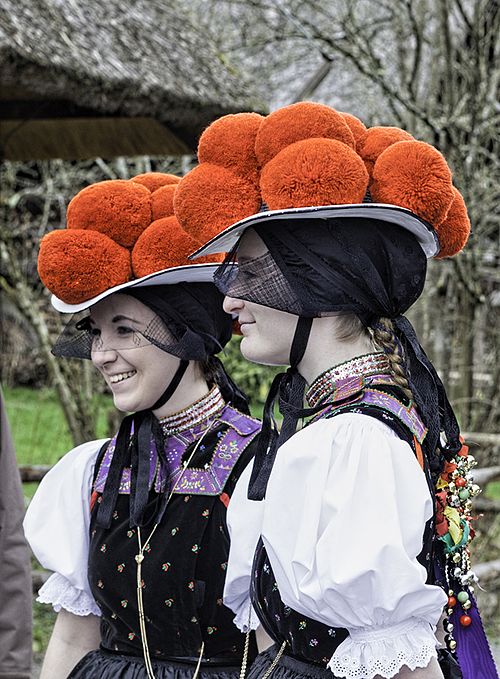
Women in the wearing Bollenhut Credit: Michel Lefranc aka Tournachon -
-
 Photograph: Taxiarchos228Bellevue Palace is a palace (schloss) in Berlin's Tiergarten district, along the northern edge of the Großer Tiergarten park. Designed by architect Michael Philipp Boumann, Schloss Bellevue was erected in 1786 as a summer residence for Prince Augustus Ferdinand of Prussia. Variously used as a residence, museum, and guest house in subsequent decades, Bellevue was damaged heavily in World War II. Following substantial refurbishments, it has served as the secondary residence of the President of West Germany and official residence of the President of Germany.
 -
 Photograph: Henry W. LaurischKadavar are a rock band from Berlin, Germany, founded in 2010. Their retro sound, incorporating psychedelic rock and stoner rock, has been compared to bands of the 1970s hard rock/heavy metal era. Kadavar currently consists of three members: guitarist and lead vocalist Christoph "Lupus" Lindemann, drummer Christoph "Tiger" Bartelt, and bassist Simon "Dragon" Bouteloup.
 -

Town hall of Hildesheim Town hall of HildesheimCredit: old postcard, public domain -
 Painting: Hans BaluschekCity of Workers is an oil painting on canvas completed by the Berlin Secessionist painter Hans Baluschek in 1920. It depicts a dark and dirty working class sector of the German capital, Berlin, in which industrial smoke dominates the skyline and the few lights of windows are drowned in the gloom. The 48.44 × 36.25 in (123 × 92.1 cm) work is held at the Milwaukee Art Museum.
 -
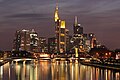 The night skyline of Frankfurt, showing the Commerzbank Tower (centre) and the Maintower (right of centre). Frankfurt is the fifth-largest city in Germany, and the surrounding Frankfurt Rhein-Main Region is Germany's second-largest metropolitan area.
 -

Shaft 12 of Zollverein Coal Mine Industrial Complex, Essen Shaft 12 of Zeche Zollverein, a coal mine in Essen -
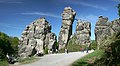 Photo credit: Daniel SchwenThe Externsteine, a distinctive rock formation located in the Teutoburger Wald region of northwestern Germany, are a popular tourist attraction. Stairs and a small bridge connecting two of the rocks lead to the top.
 -
-
 Photo credit: Daniel SchwenA portrait of a senior police officer in Hamburg, wearing the new blue uniform in accordance with the policy of using the same colour for police uniforms and vehicles throughout the European Union. Law enforcement in Germany is divided into two groups: the federal police and the state police.
 -
 Photo credit: Karsten DörreA twilight panorama of Regensburg, Bavaria, Germany with the 12th century bridge Steinerne Brücke and Regensburg Cathedral on the left and the river Danube in the foreground. Located at the confluence of the Danube and Regen rivers, the first settlements in the area date to the Stone Age. A Roman fort was constructed in 179. In contrast to almost all other major German cities, Regensburg had little damage from Allied air raids in World War II and thus has an almost intact medieval city center, which is listed as a UNESCO World Heritage Site.
 -
-
 Photograph: Michael KranewitterThomas Müller (b. 1989) is a German professional footballer who has played for Bayern Munich since 2009; he is also the team's vice-captain. A versatile player, Müller plays as a midfielder or forward but has also been deployed in attacking roles such as attacking midfielder, second striker, centre forward and on either wing. He has represented Germany on its national team since 2010.
 -
 Image credit: Wilhelm Ernst & SohnAn 1896 engraving of the interior of the New Synagogue, Berlin. The synagogue was noted for its Moorish style and resemblance to the Alhambra. During the Kristallnacht pogrom of 1938, the Synagogue was set ablaze. Today the synagogue serves as an exhibit for various aspects of the Holocaust, particularly Kristallnacht.
 -
 Painting credit: Adolf MosengelAdolf Mosengel (1837–1885) was a landscape painter from Hamburg, Germany, who built a reputation painting Alpine scenes, later turning to scenes from Westphalia. From 1854 to 1857, he studied at the Kunstakademie Düsseldorf under Hans Gude, and from 1858 to 1859 in Paris, after which he moved to Geneva to study under Alexandre Calame. He spent most of his life working in Hamburg, but travelled in 1879 to the lakes of Northern Italy, where he painted en plein air. This oil-on-canvas painting by Mosengel shows a village in the Bernese Alps.
 -
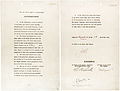 The German Instrument of Surrender, the main portion of which was signed at Reims, France, at 02:41 on 7 May 1945, was the legal instrument that established the armistice ending World War II in Europe. It was signed by representatives of the Oberkommando der Wehrmacht, the Allied Expeditionary Force and Soviet High Command. Another act of military surrender was signed, shortly before midnight, on 8 May in the outskirts of Berlin, Germany, at the insistence of the Soviets.
 -
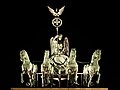 Close-up of the quadriga (four-horse chariot) on top of the Brandenburg Gate in Berlin (Germany) at night. The sculpture was produced by Johann Gottfried Schadow in 1793. The word quadriga may refer to the chariot alone, the four horses without it, or the combination. All modern quadrigas are based on the Horses of Saint Mark, a Roman or Greek sculpture which is the only surviving ancient quadriga.
 -
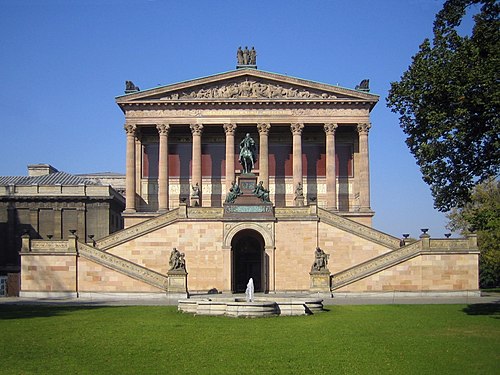
The Alte Nationalgalerie in Berlin Credit: Manfred Brückels -
 Painting credit: Karl Friedrich SchinkelKarl Friedrich Schinkel (1781–1841) was a Prussian architect and city planner. He was one of the most prominent architects in Germany and designed both Neoclassical and Neo-Gothic buildings, the most famous of which are found in and around Berlin. He was also a painter and a designer of furniture and stage sets.
This oil-on-canvas painting, entitled Castle by the River, was created by Schinkel in 1820. As an artist, his architectural talent shone through, and his buildings and landscapes are carefully drafted and meticulously executed. The painting is in the collection of the Alte Nationalgalerie in Berlin. -
 Wanderer above the Sea of Fog is an 1818 painting by Caspar David Friedrich, a German Romantic. It has been read as a metaphor for the uncertainty of the future.
 -
 German war bond posterPoster: Lucian Bernhard; restoration: BellhallaA 1917 poster by Lucian Bernhard intended to sell war bonds in Germany. The caption, roughly translated, is "This is how your money helps you fight! Turned into submarines, it keeps enemy shells away! That's why you should subscribe to war bonds!" Mostly excluded from international financial markets during World War I, Germany was largely limited to domestic borrowing. The bond drives proved extremely successful, raising approximately 100 billion marks in funds.


.jpg)


.jpg)


Related portals
- Parent portals
.svg)

- Regional


- History
 Holy Roman Empire (900–1806)
 East Germany (1949–1990)


- Neighbouring countries


Anniversaries for April 9

- 1794 - Birth of Theobald Boehm, inventor of the modern flute
- 1886 - Death of poet Joseph Viktor von Scheffel
- 1936 - Death of sociologist Ferdinand Tönnies
- 1945 - Lutheran pastor Dietrich Bonhoeffer is hanged at Flossenbürg concentration camp
- 1945 - Georg Elser, who had attempted to kill Adolf Hitler, is executed at Dachau concentration camp
Did you know...

- ... that the pianist Alide Topp (pictured) once responded to claims that women lacked the "biceps of a man" for great music by stating she broke her pianos as well as any man?
- ... that Karl Marx made an arrangement of a Christmas carol?
- ... that Bernhard Waldenfels discussed "black holes of everyday life" in a book subtitled Challenges of Phenomenology?
- ... that Agostino Steffani missed the 1709 premiere of his opera Amor vien dal destino because he was in Rome mediating between the pope and the emperor?
- ... that Ruth Wagner, the minister of culture in Hesse from 1999 to 2003, was nicknamed Mother Courage of Hesse?
- ... that mathematician Grete Hermann wrote political philosophy articles for Der Funke and Sozialistische Warte under various pseudonyms during the German resistance to Nazism?
- ... that there were more than a thousand Nazi concentration camps?
- ... that three members of the Hamburg Parliament—Mehria Ashuftah, Hila Latifi, and Zohra Mojadeddi—are Afghan refugees?
Selected cuisines, dishes and foods

Westphalian ham (German: Westfälischer Schinken) is a ham that was originally produced from acorn-fed pigs raised in the forests of Westphalia, Germany. The resulting meat is dry cured and then smoked over a mixture of beechwood and juniper branches.
The hams are prepared for consumption solely by the process of smoking, which preserves them, and are typically eaten thinly sliced in their preserved state without additional cooking. (Full article...)Topics
Categories

Things you can do

A list of articles needing cleanup associated with this project is available. See also the tool's wiki page and the index of WikiProjects.
Here are some tasks you can do. Please remove completed tasks from the list.
- Requests: German Archaeological Institute at Rome, Deutsche Familienversicherung, Hermann Bachmann (Journalist), Dietlof von Arnim-Boitzenburg, Rolf von Bargen, Hennes Bender, Eduard Georg von Bethusy-Huc, Rolf Brandt (1886–1953), Jan Philipp Burgard, Rudolf Epp, Lisa Feller, Georg Gafron, Ferdinand Heribert von Galen, Gundula Gause, Wolfgang von Geldern, Karl-Heinz Hagen, Herbert Helmrich, Nils von der Heyde, Monty Jacobs (1875–1945), Siegfried Kauder, Klimbim Matze Knop, Wolfgang Kryszohn, Claus Larass, Isidor Levy (1852–1929), Richard Lewinsohn (1894-1968), Markus Löning, Tobias Mann, Julius Meyer (Kunsthistoriker), Mathias Müller von Blumencron ,Günther Nonnenmacher, Nord bei Nordwest, Günter von Nordenskjöld, Anke Plättner, Hans Heinrich X. Fürst von Pless, Günter Prinz, Ulrich Reitz, Hans Sauer (inventor), Franz August Schenk von Stauffenberg, Paul Schlesinger (1878-1928), Hajo Schumacher, Der Seewolf (1971), Otto Theodor von Seydewitz, Christoph Sieber (comedian), Dorothea Siems, Werner Sonne, Udo zu Stolberg-Wernigerode, Christoph Strässer, Karl Trimborn, Joseph von Utzschneider, Hedda von Wedel, Jürgen Wieshoff, Hans Wilhelmi, Dietmar Wischmeyer, Doris Wittner (1880-1937), Alexandra Würzbach
- Unreferenced: especially Unreferenced BLPs
- Cleanup: 53541 issues in total as of 2024-03-03
- Translate: Articles needing translation from German Wikipedia
- Stubs: the largest stub category is Category:German history stubs; see also 109 articles in Category:German MEP stubs
- Update: Deutsches Wörterbuch
- Portal maintenance: Update News, Did you know, announcements and the todo list
- Orphans:
Orphaned articles in Germany

- Photo: Take/Add requested photographs
- Expression error: Unrecognized punctuation character ",".

Associated Wikimedia
The following Wikimedia Foundation sister projects provide more on this subject:
-
 Commons
Free media repository -
 Wikibooks
Free textbooks and manuals -
 Wikidata
Free knowledge base -
 Wikinews
Free-content news -
 Wikiquote
Collection of quotations -
 Wikisource
Free-content library -
 Wikiversity
Free learning tools -
 Wikivoyage
Free travel guide -
 Wiktionary
Dictionary and thesaurus


