Michigan consists of two peninsulas: the heavily forested Upper Peninsula (commonly called "the U.P."), which juts eastward from northern Wisconsin, and the more populated Lower Peninsula, stretching north from Ohio and Indiana. The peninsulas are separated by the Straits of Mackinac, which connects Lake Michigan and Lake Huron, and are linked by the 5-mile-long Mackinac Bridge along Interstate 75. Bordering four of the five Great Lakes and Lake St. Clair, Michigan has the longest freshwater coastline of any U.S. political subdivision, measuring 3,288 miles. The state ranks second behind Alaska in water coverage by square miles and first in percentage, with approximately 42%, and it also contains 64,980 inland lakes and ponds.
The Great Lakes region has largely been inhabited for thousands of years by Indigenous peoples such as the Ojibwe, Odawa, Potawatomi, and Wyandot.
Some people contend that the region's name is derived from the Ojibwe word ᒥᓯᑲᒥ (mishigami), meaning "large water" or "large lake". Others say that it comes from the Mishiiken Tribe of Mackinac Island, also called Michinemackinawgo by Ottawa historian Andrew Blackbird, whose surrounding lands were referred to as Mishiiken-imakinakom, later shortened to Michilimackinac.
In the 17th century, French explorers claimed the area for New France. French settlers and Métis established forts and settlements.
After France's defeat in the French and Indian War in 1762, the area came under British control and later the U.S. following the Treaty of Paris (1783), though control remained disputed with Indigenous tribes until treaties between 1795 and 1842. The area was part of the larger Northwest Territory; the Michigan Territory was organized in 1805. (Full article...)
Entries here consist of Good and Featured articles, which meet a core set of high editorial standards.
Heritage Festival Parade, 1984
YpsiFest (formerly Ypsilanti Heritage Festival) is a festival in Ypsilanti, Michigan. Held each year on the fourth weekend of August, the festival sprawls across Frog Island Park, Riverside Park, and historic Depot Town. The festival features a variety of activities and entertainment including helicopter rides, acrobats and theater performances by Ring of Steel, evening concerts, gambling and bingo, and a huge kids zone full of children specific activities and rides. Additionally there are featured evens like Illumination@YpsiFest where local business compete for prizes by creating illuminated sculptures for an evening display, and an illumination parade. (Full article...)
The team had no coach, and its captain was William C. Malley. George P. Codd, who later served as the Mayor of Detroit and in the United States Congress, was the team's manager. George Jewett, who played at the fullback and halfback positions, was the team's leading scorer with 50 points on 11 touchdowns (four points each) and three kicks for goal from touchdown (two points each). Jewett was also the first African American to play football at Michigan. (Full article...)
Image 3A map of Michigan by Henry Schenck Tanner, published in 1842, showing such county names as "Negwegon County," "Okkuddo County," and "Unwattin County," prior to an 1843 legislative action renaming sixteen counties in northern Michigan (from History of Michigan)
Image 12The Detroit–Windsor area is North America's largest cross-border conurbation, with a combined population of approximately six million people (from Michigan)
Image 14Treaty of Paris, by Benjamin West (1783), an unfinished painting of the American diplomatic negotiators of the Treaty of Paris which brought official conclusion to the Revolutionary War and gave possession of Michigan and other territory to the new United States (from Michigan)
Image 18The Detroit-Windsor border crossing is the busiest international border crossing in North America by trade volume, with approximately one-third of all Canada–U.S. trade passing through this link. Pictured in the background is the under-construction Gordie Howe International Bridge, which will complement the existing Ambassador Bridge, shown in the foreground. (from Michigan)
Image 20Union members occupying a General Motors body factory during the Flint Sit-Down Strike of 1937 which spurred the organization of militant CIO unions in auto industry (from History of Michigan)
Image 27Detroit in the mid-twentieth century. At the time, the city was the fourth-largest U.S. metropolis by population, and held about one-third of the state's population. (from Michigan)


.svg)


.jpg)


.jpg)


.jpg)


.jpg)
.png)


.jpg)


.jpg)


.jpg)


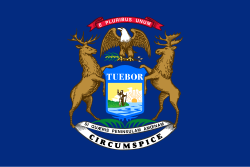 The Flag of Michigan
 The Seal of Michigan
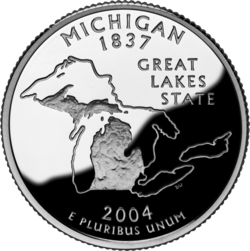 State Quarter – Released in 2004


 Commons
 Wikidata
 Wikiquote
 Wikisource
 Wikiversity
 Wikivoyage
 Wiktionary


