Wiki Article
Semitone
Nguồn dữ liệu từ Wikipedia, hiển thị bởi DefZone.Net
Semitones (also called half steps or half tones)[1] are the smallest class of interval commonly used in Western music,[2] and are among the most dissonant[3] when sounded harmonically. The term refers to the interval between two adjacent notes in a 12-tone scale (or half of a whole step), visually seen on a keyboard as the distance between two adjacent keys. For example, C is adjacent to D♭; the interval between them is a semitone.[4]

In a 12-note approximately equally divided scale, an appropriate number of semitones can realize a certain interval (e.g. a whole tone or major second is 2 semitones wide, a major third 4 semitones, and a perfect fifth 7 semitones).
In music theory, a distinction is made[5] between a diatonic semitone, or minor second (an interval encompassing two different staff positions, e.g. from C to D♭) and a chromatic semitone or augmented unison (an interval between two notes at the same staff position, e.g. from C to C♯). These are enharmonically equivalent only if twelve-tone equal temperament is used; for example, they are not the same size in Pythagorean tuning, where the diatonic semitone is distinguished from the larger chromatic semitone (augmented unison), or in quarter-comma meantone temperament, where the diatonic semitone is larger instead. See Interval (music) § Number for more details about this terminology.
In twelve-tone equal temperament, all semitones are equal in size (100 cents). In other tuning systems, "semitone" refers to a family of intervals that may vary both in size and name. For further details, see below.
The condition of having semitones is called hemitonia; that of having no semitones is anhemitonia. A musical scale or chord containing semitones is called hemitonic; one without semitones is anhemitonic.
Minor second
[edit]| Inverse | major seventh |
|---|---|
| Name | |
| Abbreviation | m2 |
| Size | |
| Semitones | 1 |
| Interval class | 1 |
| Just interval | 256:243, 16:15,[6] 27:25 |
| Cents | |
| 12-Tone equal temperament | 100.0 |
| Just intonation | 90.2, 111.7, 133.2 |
The minor second occurs in the major scale, between the third and fourth degree, (mi (E) and fa (F) in C major), and between the seventh and eighth degree (ti (B) and do (C) in C major). It is also called the diatonic semitone because it occurs between steps in the diatonic scale. The minor second is abbreviated m2 (or −2). Its inversion is the major seventh (M7 or Ma7).
ⓘ. Here, middle C is followed by D♭, which is a tone 100 cents sharper than C, and then by both tones together.
Melodically, this interval is very frequently used, and is of particular importance in cadences. In the perfect and deceptive cadences it appears as a resolution of the leading-tone to the tonic. In the plagal cadence, it appears as the falling of the subdominant to the mediant. It also occurs in many forms of the imperfect cadence, wherever the tonic falls to the leading-tone.
Harmonically, the interval usually occurs as some form of dissonance or a nonchord tone that is not part of the functional harmony. It may also appear in inversions of a major seventh chord, and in many added tone chords.


In unusual situations, the minor second can add a great deal of character to the music. For instance, Frédéric Chopin's Étude Op. 25, No. 5 opens with a melody accompanied by a line that plays fleeting minor seconds. These are used to humorous and whimsical effect, which contrasts with its more lyrical middle section. This eccentric dissonance has earned the piece its nickname: the "wrong note" étude. This kind of usage of the minor second appears in many other works of the Romantic period, such as Modest Mussorgsky's "Ballet of the Unhatched Chicks" from Pictures at an Exhibition. More recently, the music to the movie Jaws exemplifies the minor second.
Augmented unison
[edit]| Inverse | Diminished octave |
|---|---|
| Name | |
| Other names | Chromatic semitone, minor semitone |
| Abbreviation | A1 |
| Size | |
| Semitones | 1 |
| Interval class | 1 |
| Just interval | 2187:2048, 25:24 |
| Cents | |
| 12-Tone equal temperament | 100 |
| Just intonation | 114, 71 |
The augmented unison, augmented prime[7], or chromatic semitone[8] is the interval between two notes on the same staff position (same letter name) that differ by one chromatic alteration. For example, the interval between B♭ and B♮, or between C♮ and C♯, is an augmented unison.

In 12-tone equal temperament and well temperaments, the augmented unison is realized as a semitone, making it enharmonically equivalent to the minor second.[9] In other systems such as Pythagorean tuning and quarter-comma meantone, the intervals are acoustically distinct.
The term, in its French form unisson superflu, appears to have been coined by Jean-Philippe Rameau in 1722, who also called this interval a minor semitone (semiton mineur).[10] Historically, this interval, like the tritone, is described as being "mi contra fa" and was associated with the "diabolus in musica" (Latin for 'the Devil in music').[11]
Definition
[edit]In terms of regular temperament theory, the augmented unison can be derived by ascending 7 perfect fifths and descending 4 octaves (e.g. C–G–D–A–E–B–F♯–C♯, compensating for range).
Occurrence
[edit]
Melodically, an augmented unison very frequently occurs when proceeding to a chromatic chord, such as a secondary dominant, a diminished seventh chord, or an augmented sixth chord. Its use is also often the consequence of a melody proceeding in semitones, regardless of harmonic underpinning, e.g. D, D♯, E, F, F♯. (Restricting the notation to only minor seconds is impractical, as the same example would have a rapidly increasing number of accidentals, written enharmonically as D, E♭, F♭, G , A
, A ).
).

Harmonically, augmented unisons are quite rare in tonal repertoire. In the example to the right, Liszt had written an E♭ against an E♮ in the bass. Here E♭ was preferred to a D♯ to make the tone's function clear as part of an F dominant seventh chord, and the augmented unison is the result of superimposing this harmony upon an E pedal point.
In addition to this kind of usage, harmonic augmented unisons are frequently written in modern works involving tone clusters, such as Iannis Xenakis' Evryali for solo piano.
Diminished unison
[edit]The term diminished unison or diminished prime is also found occasionally. It is found once in Rameau's writings, for example,[10] as well as subsequent French, German, and English sources.[diminished 1] Other sources reject the possibility or utility of the diminished unison on the grounds that any alteration to the unison increases its size, thus augmenting rather than diminishing it.[augmented 1] The term is sometimes justified as a negative-numbered interval,[12][13] and also in terms of violin double-stopping technique on analogy to parallel intervals found on other strings.[14] Some theoreticians make a distinction for this diminished form of the unison, stating it is only valid as a melodic interval, not a harmonic one.[melodic 1]
History
[edit]The semitone appeared in the music theory of Greek antiquity as part of a diatonic or chromatic tetrachord, and it has always had a place in the diatonic scales of Western music since. The various modal scales of medieval music theory were all based upon this diatonic pattern of tones and semitones.
Though it would later become an integral part of the musical cadence, in the early polyphony of the 11th century this was not the case. Guido of Arezzo suggested instead in his Micrologus other alternatives: either proceeding by whole tone from a major second to a unison, or an occursus having two notes at a major third move by contrary motion toward a unison, each having moved a whole tone.
"As late as the 13th century the half step was experienced as a problematic interval not easily understood, as the irrational [sic] remainder between the perfect fourth and the ditone ." In a melodic half step, no "tendency was perceived of the lower tone toward the upper, or of the upper toward the lower. The second tone was not taken to be the 'goal' of the first. Instead, the half step was avoided in clausulae because it lacked clarity as an interval."[15]

However, beginning in the 13th century cadences begin to require motion in one voice by half step and the other a whole step in contrary motion.[15] These cadences would become a fundamental part of the musical language, even to the point where the usual accidental accompanying the minor second in a cadence was often omitted from the written score (a practice known as musica ficta). By the 16th century, the semitone had become a more versatile interval, sometimes even appearing as an augmented unison in very chromatic passages. Semantically, in the 16th century the repeated melodic semitone became associated with weeping, see: passus duriusculus, lament bass, and pianto.
By the Baroque era (1600 to 1750), the tonal harmonic framework was fully formed, and the various musical functions of the semitone were rigorously understood. Later in this period the adoption of well temperaments for instrumental tuning and the more frequent use of enharmonic equivalences increased the ease with which a semitone could be applied. Its function remained similar through the Classical period, and though it was used more frequently as the language of tonality became more chromatic in the Romantic period, the musical function of the semitone did not change.
In the 20th century, however, composers such as Arnold Schoenberg, Béla Bartók, and Igor Stravinsky sought alternatives or extensions of tonal harmony, and found other uses for the semitone. Often the semitone was exploited harmonically as a caustic dissonance, having no resolution. Some composers would even use large collections of harmonic semitones (tone clusters) as a source of cacophony in their music (e.g. the early piano works of Henry Cowell). By now, enharmonic equivalence was a commonplace property of equal temperament, and instrumental use of the semitone was not at all problematic for the performer. The composer was free to write semitones wherever he wished.
Semitones in different tunings
[edit]The exact size of a semitone depends on the tuning system used. Pythagorean tuning has two distinct types of semitones. Meantone temperaments have two distinct types of semitones, but in the exceptional case of 12-tone equal temperament, there is only one. The unevenly distributed well temperaments contain many different semitones. In systems of just intonation, several types of semitones are encountered.

Pythagorean tuning
[edit]


Pythagorean tuning, or 3-limit just intonation, is generated by a sequence of perfect fifths, which creates two distinct semitones.
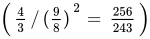
The Pythagorean diatonic semitone has a ratio of 256/243 (ⓘ), and is often called the Pythagorean limma. It is also sometimes called the Pythagorean minor semitone. It is about 90.2 cents.

It can be thought of as the difference between three octaves and five just fifths, and functions as a diatonic semitone in a Pythagorean tuning.
The Pythagorean chromatic semitone has a ratio of 2187/2048 (ⓘ). It is about 113.7 cents. It may also be called the Pythagorean apotome[16][17][18] or the Pythagorean major semitone. (See Pythagorean interval.)
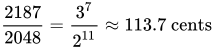
It can be thought of as the difference between four perfect octaves and seven just fifths, and functions as a chromatic semitone in a Pythagorean tuning.
The Pythagorean limma and Pythagorean apotome are only a Pythagorean comma apart, and may be considered enharmonic equivalents, in contrast to the diatonic and chromatic semitones in meantone temperament and 5-limit just intonation, which are farther apart.
Meantone temperament
[edit]In meantone systems, the diatonic and chromatic semitones are typically of different sizes. This results because of the break in the circle of fifths that occurs in the tuning system: diatonic semitones derive from a chain of five fifths that does not cross the break, and chromatic semitones come from one that does.[further explanation needed]
Unlike in Pythagorean tuning, the chromatic semitone is usually smaller than the diatonic. In the common quarter-comma meantone, the chromatic and diatonic semitones are 76.0 and 117.1 cents wide respectively. They differ by the lesser diesis of ratio 128:125 or 41.1 cents.
This table shows quarter-comma meantone used to create a 12-tone tuning via a sequence of tempered fifths from E♭ to G♯.
| Chromatic semitone | 76.0 | 76.0 | 76.0 | 76.0 | 76.0 | |||||||||||||||||||||
| Pitch | C | C♯ | D | E♭ | E | F | F♯ | G | G♯ | A | B♭ | B | C | |||||||||||||
| Cents | 0.0 | 76.0 | 193.2 | 310.3 | 386.3 | 503.4 | 579.5 | 696.6 | 772.6 | 889.7 | 1006.8 | 1082.9 | 1200.0 | |||||||||||||
| Diatonic semitone | 117.1 | 117.1 | 117.1 | 117.1 | 117.1 | 117.1 | 117.1 | |||||||||||||||||||
Extended tunings with more than 12 notes still retain the same two semitone sizes, but there is more flexibility for the musician about whether to use an augmented unison or minor second. 31-tone equal temperament is the most flexible of these, which makes an unbroken circle of 31 fifths, allowing the choice of semitone to be made for any pitch.
Equal temperament
[edit]12-tone equal temperament is a form of meantone tuning in which the diatonic and chromatic semitones are exactly the same. Each semitone is equal to one twelfth of an octave. This is a ratio of 21/12 (approximately 1.05946), or 100 cents, and is 11.7 cents narrower than the 16:15 ratio (its most common form in just intonation, discussed below).
All diatonic intervals can be expressed with an appropriate number of semitones. For instance, nine semitones represents a major sixth.
There are many approximations, rational or otherwise, to the equal-tempered semitone. To cite a few:
suggested by Vincenzo Galilei and used by luthiers of the Renaissance,

suggested by Marin Mersenne as a constructible and more accurate alternative,
![{\displaystyle {\sqrt[{4}]{\frac {2}{3-{\sqrt {2}}}}}\approx 100.4{\text{ cents,}}}](https://wikimedia.org/api/rest_v1/media/math/render/svg/237847316a3aea533ae093273132eda8e4d25250)
used by Julián Carrillo as part of a sixteenth-tone system.

For more examples, see Pythagorean and Just systems of tuning below.
Well temperament
[edit]There are many forms of well temperament, but the characteristic they all share is that their semitones are of an uneven size. Every semitone in a well temperament has its own interval (usually close to the equal-tempered version of 100 cents), and there is no clear distinction between a diatonic and chromatic semitone in the tuning. Well temperament was constructed so that enharmonic equivalence could be assumed between all of these semitones, and whether they were written as a minor second or augmented unison did not effect a different sound. Instead, in these systems, each key had a slightly different sonic color or character, beyond the limitations of conventional notation.
Just 5-limit intonation
[edit]


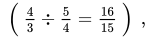
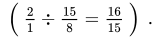
A minor second in just intonation typically corresponds to a pitch ratio of 16:15 (ⓘ) or 1.0666... (approximately 111.7 cents), called the just diatonic semitone.[19] This is a practical just semitone, since it is the interval that occurs twice within the diatonic scale between a:
- major third (5:4) and perfect fourth (4:3) and a
- major seventh (15:8) and the perfect octave (2:1)
The 16:15 just minor second arises in the C major scale between B & C and E & F, and is, "the sharpest dissonance found in the scale".[20] ⓘ
An "augmented unison" (sharp) in just intonation is a different, smaller semitone, with frequency ratio 25:24 (ⓘ) or 1.0416... (approximately 70.7 cents). It is the interval between a major third (5:4) and a minor third (6:5). In fact, it is the spacing between the minor and major thirds, sixths, and sevenths (but not necessarily the major and minor second). Composer Ben Johnston used a sharp (♯) to indicate a note is raised 70.7 cents, or a flat (♭) to indicate a note is lowered 70.7 cents.[21] (This is the standard practice for just intonation, but not for all other microtunings.)
Two other kinds of semitones are produced by 5 limit tuning. A chromatic scale defines 12 semitones as the 12 intervals between the 13 adjacent notes, spanning a full octave (e.g. from C4 to C5). The 12 semitones produced by a commonly used version of 5 limit tuning have four different sizes, and can be classified as follows:
- Just chromatic semitone
- chromatic semitone, or smaller, or minor chromatic semitone between harmonically related flats and sharps e.g. between E♭ and E (6:5 and 5:4):
- Larger chromatic semitone
- or major chromatic semitone, or larger limma, or major chroma,[21] e.g. between C and an accute C♯ (C♯ raised by a syntonic comma) (1:1 and 135:128):
- Just diatonic semitone
- or smaller, or minor diatonic semitone, e.g. between E and F (5:4 to 4:3):
- Larger diatonic semitone
- or greater or major diatonic semitone, e.g. between A and B♭ (5:3 to 9:5), or C and chromatic D♭ (27:25), or F♯ and G (25:18 and 3:2):




The most frequently occurring semitones are the just ones (S3, 16:15, and S1, 25:24): S3 occurs at 6 short intervals out of 12, S1 3 times, S2 twice, and S4 at only one interval (if diatonic D♭ replaces chromatic D♭ and sharp notes are not used).
The smaller chromatic and diatonic semitones differ from the larger by the syntonic comma (81:80 or 21.5 cents). The smaller and larger chromatic semitones differ from the respective diatonic semitones by the same 128:125 diesis as the above meantone semitones. Finally, while the inner semitones differ by the diaschisma (2048:2025 or 19.6 cents), the outer differ by the greater diesis (648:625 or 62.6 cents).
Extended just intonations
[edit]In 7 limit tuning there is the septimal diatonic semitone of 15:14 (ⓘ) available in between the 5 limit major seventh (15:8) and the 7 limit minor seventh / harmonic seventh (7:4). There is also a smaller septimal chromatic semitone of 21:20 (ⓘ) between a septimal minor seventh and a fifth (21:8) and an octave and a major third (5:2). Both are more rarely used than their 5 limit neighbours, although the former was often implemented by theorist Cowell, while Partch used the latter as part of his 43 tone scale.
Under 11 limit tuning, there is a fairly common undecimal neutral second (12:11) (ⓘ), but it lies on the boundary between the minor and major second (150.6 cents). In just intonation there are infinitely many possibilities for intervals that fall within the range of the semitone (e.g. the Pythagorean semitones mentioned above), but most of them are impractical.
In 13 limit tuning, there is a tridecimal 2/3 tone (13:12 or 138.57 cents) and tridecimal 1/3 tone (27:26 or 65.34 cents).
In 17 limit just intonation, the major diatonic semitone is 15:14 or 119.4 cents (ⓘ), and the minor diatonic semitone is 17:16 or 105.0 cents,[22][23] and septendecimal limma is 18:17 or 98.95 cents.
Though the names diatonic and chromatic are often used for these intervals, their musical function is not the same as the meantone semitones. For instance, 15:14 would usually be written as an augmented unison, functioning as the chromatic counterpart to a diatonic 16:15. These distinctions are highly dependent on the musical context, and just intonation is not particularly well suited to chromatic use (diatonic semitone function is more prevalent).
Other equal temperaments
[edit]19-tone equal temperament distinguishes between the chromatic and diatonic semitones; in this tuning, the chromatic semitone is one step of the scale (ⓘ), and the diatonic semitone is two (ⓘ). 31-tone equal temperament also distinguishes between these two intervals, which become 2 and 3 steps of the scale, respectively. 53-ET has an even closer match to the two semitones with 3 and 5 steps of its scale while 72-ET uses 4 (ⓘ) and 7 (ⓘ) steps of its scale.
In general, because the smaller semitone can be viewed as the difference between a minor third and a major third, and the larger as the difference between a major third and a perfect fourth, tuning systems that closely match those just intervals (6/5, 5/4, and 4/3) will also distinguish between the two types of semitones and closely match their just intervals (25/24 and 16/15).
See also
[edit]- 12-tone equal temperament
- List of meantone intervals
- List of musical intervals
- List of pitch intervals
- Approach chord
- Major second
- Neutral second
- Pythagorean interval
- Regular temperament
Notes
[edit]- ^ Sources for diminished unison
- Johann Georg Albrechtsberger, Methods of Harmony, Figured Base, and Composition: Adapted for Self-Instruction, Volume 1, edited by Ignaz Seyfried (Ritter von), and Alexandre Choron (London: R. Cocks & Co., 1834): 4 [Translated from Méthodes d'harmonie et de composition: à l'aide desquelles on peut apprendre soi-même à accompagner la basse chiffrée et à composer toute espèce de musique, par J.-Georges Albrechtsberger. Nouvelle éd., mise en ordre et considérablement augmentée d'après l'enseignement de l'auteur, et formant la collection complète de ses OEuvres de théorie musicale, par le chevalier de Seyfried, son élève. Traduite de l'allemand, avec des notes, par M. Choron. Paris: Bachelier, 1830.]
- Henry Charles Banister, A Text-book of Music (London: George Bell and Sons, 1872): 34.
- Alexandre Choron, Principes de Composition des Ecoles d'Italie: Adoptés par le Gouvernement Français pour servir à l'instruction des Elèves des Maîtrises de Cathédrales: ouvrage classique formé de la réunion des modèles les plus parfaits en tout genre, enrichi d'un texte méthodique rédigé selon l'enseignement des Ecoles les plus célèbres et des Ecrivains didactiques les plus estimés, Tome premier, Contenant la préface & les Trois premiers Livres (Paris, 1808): 2
- Castil-Blaze [François-Henri-Joseph Blaze], Dictionnaire de musique moderne (Brussels: L'Academie de musique, 1828): 269.
- Anton Gräffer, Systematische Guitarre-Schule, Erster Theil (Vienna: Anton Strauß, 1811): 38.
- Oskar Kolbe, Kurzgefasste Generalbasslehre, second, enlarged and corrected edition (Leipzig: Breitkopf und Härtel, 1872): 12.
- Alexander Lehr, Campanology Textbook: The Musical and Technical Aspect of Swinging Bells and Carillons, constituting Bulletin of the Guild of Carillonneurs in North America Volume 54 (2005): 51. The Guild of Carillonneurs in North America.
- Horst Leuchtmann, Dictionary of Terms in Music / Wörterbuch Musik: English–German, German–English, fourth, revised and enlarged edition (Munich, London, New York, and Paris: K. G. Saur; Berlin: Walter De Gruyter, 1992): 324. ISBN 978-3-598-10913-3 (cloth); ISBN 978-3-11-190694-2 (print/ebook); ISBN 978-3-11-150573-2 (ebook).
- Frederic Allison Lyman, The Normal Music Course in the Schoolroom: Being a Practical Exposition of the Normal Music Course, Together with Its Complemental Series, The Cecilian Series of Study and Song, by John W. Tufts, Designed to Aid Those who Teach Vocal Music (Boston, New York, Chicago: Silver, Burdett, and Company, 1896): 47–48.
- Robert Middleton, Harmony in Modern Counterpoint (Boston: Allyn and Bacon, 1967): 20.
- Cesar-Auguste Monti-Punti, Les secrets de la musique ou théorie musicale, edited by Pierre Rigaud (Paris: Leduc, 1846): 63, 72, 77.
- Robert Nelson and Carl J. Christensen, Foundations of Music, seventh edition (Boston: Schirmer Cengage Learning, 2008): 169. ISBN 978-0-495-56593-2.
- Gustav Schilling, Musikalische Didaktik; oder, Die Kunst des Unterrichts in der Musik: Ein nothwendiges Hand- und Hülfsbuch für alle lehrer und lernende der Musik, Erzieher, Schulvorsteher, Organisten, Volkschullehrer &c. (Eisleben: Ferdinand Kuhnt. 1851): 315.
- Daniel Gottlob Türk, Anweisung zum Generalbaßspielen, second edition (Halle: Hemmerde und Schwetschte; Leipzig: Schwickert, 1800): 16.
- William Alfred White (1907). Harmony and Ear-Training (New York, Boston [etc.]: Silver, Burdett & Company): 35.
- ^ Sources for augmented unison
- Friedrich Wilhelm Marpurg, Anfangsgründe der theoretischen Musik (Leipzig: Johann Gottlieb Immanuel Breitkopf, 1757): 34.
- Friedrich Wilhelm Marpurg, Handbuch bey dem Generalbasse und der Composition: mit zwo- drey- vier- fünf- sechs- sieben- acht und mehreren Stimmen für Anfänger und Geübtere, second, expanded and corrected edition (Berlin: Gottlieb August Lange. 1762): 14.
- Stefan Kostka and Dorothy Payne (2004). Tonal Harmony (Boston: McGraw-Hill): 21. ISBN 978-0-07-285260-8. "There is no such thing as a diminished unison."
- Michael Pilhofer and Holly Day (2006). Music Theory for Dummies (Hoboken, NJ: John Wiley & Sons, Inc.): 113. ISBN 978-0-7645-7838-0. "There is no such thing as a diminished unison, because no matter how you change the unisons with accidentals, you are adding half steps to the total interval."
- Andrew Surmani, Karen Farnum Surmani, and Morton Manus (2009). Alfred's Essentials of Music Theory: A Complete Self-Study Course for All Musicians ([s.l.]: Alfred Music Publishing): 135. ISBN 0-7390-3635-1. "Since lowering either note of a perfect unison would actually increase its size, the perfect unison cannot be diminished, only augmented."
- W. S. B. Mathews (1909). "Editorial: Prof. White's Harmony and Ear-Training", The Journal of School Music 1, no. 9 (June): 260–63. Citation on 263: "What he [Prof. White in Harmony and Ear Training] calls the 'diminished prime or unison' cannot possibly occur. It is simply an augmented unison. Because unison is 'the relation of two tones at the same pitch,' and when one of these is chromatically distanced, it creates the contradiction in terms known as 'augmented' unison; but the other term, 'diminished unison' is impossible on the face of it, because the 'same pitch' cannot be made less."
- Smith, Uselma Clarke (1916). Keyboard Harmony, p. 15. The Boston Music Company. "Note that the diminished unison and octave are not commonly used."
- Jim Aikin (2004). A Player's Guide to Chords & Harmony (San Francisco: Backbeat Books): 32. ISBN 978-0-87930-798-1. "In case you were wondering, there's no such thing as a diminished unison."
- Arthur Foote and Walter Raymond Spalding (1905). Modern Harmony in Its Theory and Practice, p. 5. Arthur P. Schmidt. "a diminished unison is unthinkable, and the diminished 2d and 9th are of no practical use:..."
- ^ Source for melodic interval:
- Nicolas Etienne Framery, Pierre Louis Ginguené, and Jérôme-Joseph Momigny. Encyclopédie méthodique: musique, 2 vols. (Paris: Mme. Veuve Agasse,1818): 2:19.
- Carl Edward Gardner, Essentials of Music Theory: Elementary (New York: Carl Fischer, Inc. 1912): 34.
- Johann Adam Hiller (ed.) "Fortsetzung zu dem musikalischen Wörterbuche", Wöchentliche Nachrichten und Anmerkungen, die Musik betreffend 3, no. 41 (10 April 1769): 315–22, citation on 318.
- E. Friedrich Richter, Traité de l'harmonie: théorique et pratique, translated from the German by Gustave Sandré (Leipzig and Brussels: Breitkopf & Härtel, Éditeurs, 1891): 3.
References
[edit]- ^ Semitone, half step, half tone, halftone, and half-tone are all variously used in sources.[1][2][3][4][5]
Aaron Copland, Leonard Bernstein, and others use "half tone".[6] [7][8][9]
One source says that step is "chiefly US",[10] and that half-tone is "chiefly N. Amer."[11] - ^ Miller, Michael. The Complete Idiot's Guide to Music Theory, 2nd ed. [Indianapolis, Indiana]: Alpha, 2005. ISBN 1-59257-437-8. p. 19.
- ^ Capstick, John Walton (1913). Sound: An Elementary Text-book for Schools and Colleges. Cambridge University Press.
- ^ "musictheory.net". www.musictheory.net. Retrieved 2024-01-04.
- ^ Wharram, Barbara (2010). Elementary Rudiments of Music (2nd ed.). Mississauga, Ontario: Frederick Harris Music. p. 17. ISBN 978-1-55440-283-0.
- ^ Duffin, Ross W. (2008). How equal temperament ruined harmony : (and why you should care) (First published as a Norton paperback. ed.). New York: W. W. Norton. p. 163. ISBN 978-0-393-33420-3. Retrieved 28 June 2017.
- ^ Blood, Brian (12 September 2014). "Intervals". Music theory online. Dolmetsch Musical Instruments. Retrieved 30 August 2015.
- ^ Rushton, Julian. "Unison (prime)". Grove Music Online. Oxford Music Online. Retrieved 17 August 2011. (subscription needed)
- ^ Porter, Steven (1986). Music, A Comprehensive Introduction, p. 66. ISBN 978-0-935016-81-9.
- ^ a b Gene Henry Anderson, "Musical Terminology in J.-P. Rameau's Traité de l'harmonie: A Study and Glossary Based on an Index". PhD diss. (Iowa City: University of Iowa, 1981): 196.
- ^ Andreas Werckmeister, Harmonologia musica, oder kurze Anleitung zur musicalischen Composition (Frankfurt and Leipzig: Theodor Philipp Calvisius, 1702): 6, and Musicalische Paradoxal-Discourse, oder allgemeine Vorstellungen (Quedlinburg: Theodor Philipp Calvisius, 1707): 75–76.
- ^ Eytan Agmon, The Languages of Western Tonality, Computational Music Science (Berlin, Heidelberg, New York, Dordrecht, London: Springer-Verlag, 2013): 64, 151. ISBN 978-3-642-39586-4 (cloth); ISBN 978-3-642-39587-1 (ebook)
- ^ Steven Porter, Music: A Comprehensive Introduction: Workbook No. 1: Music Theory (New York: Excelsior Music Publishing, 1986): 8. ISBN 0-935016-83-X.
- ^ Karl Courvoisier, Die Violin-Technik (Cologne: Pet. Jos. Tonger, 1878): 26. English edition, as The Technics of Violin Playing, the Strad Library 1 (London: The Strad; New York: Charles Scribner's Sons, 1908): 49.
- ^ a b Dahlhaus, Carl, trans. Gjerdingen, Robert O. Studies in the Origin of Harmonic Tonality. Princeton University Press: Princeton, 1990. ISBN 0-691-09135-8.
- ^ Rashed, Roshdi (ed.) (1996). Encyclopedia of the History of Arabic Science, Volume 2, pp. 588, 608. Routledge. ISBN 0-415-12411-5.
- ^ Hermann von Helmholtz (1885). On the Sensations of Tone as a Physiological Basis for the Theory of Music, p. 454.
- ^ Benson, Dave (2006). Music: A Mathematical Offering, p. 369. ISBN 0-521-85387-7.
- ^ "[no title cited]". Proceedings of the Royal Society of London. 30. Great Britain: Royal Society: 531. 1880.
digitized 26 Feb 2008; Harvard University
- ^ Paul, Oscar (1885). A manual of harmony for use in music-schools and seminaries and for self-instruction, p. 165. Theodore Baker, trans. G. Schirmer.
- ^ a b Fonville, J. (Summer 1991). "Ben Johnston's extended just intonation – a guide for interpreters". Perspectives of New Music. 29 (2): 106–137. doi:10.2307/833435. JSTOR 833435.
... the 25/24 ratio is the sharp (♯) ratio ... this raises a note approximately 70.6 cents.(p109)
- ^ Haluska, Jan (2003). The Mathematical Theory of Tone Systems, p. xxiv. ISBN 0-8247-4714-3. Overtone semitone.
- ^ Prout, E. (2004). Harmony. University Press of the Pacific. p. 325. ISBN 1-4102-1920-8.
Further reading
[edit]- Grout, Donald Jay, and Claude V. Palisca. A History of Western Music, 6th ed. New York: Norton, 2001. ISBN 0-393-97527-4.
- Hoppin, Richard H. Medieval Music. New York: W. W. Norton, 1978. ISBN 0-393-09090-6.
| Twelve- semitone (post-Bach Western) |
| ||||||||||||||
|---|---|---|---|---|---|---|---|---|---|---|---|---|---|---|---|
| Other tuning systems |
| ||||||||||||||
| Other intervals |
| ||||||||||||||

| Fundamentals |  | |
|---|---|---|
| Permutations | ||
| Notable composers | ||
| Related articles | ||