Wiki Article
Solinas prime
Nguồn dữ liệu từ Wikipedia, hiển thị bởi DefZone.Net
In mathematics, a Solinas prime, or generalized Mersenne prime, is a prime number that has the form , where is a low-degree polynomial with small integer coefficients.[1][2] These primes allow fast modular reduction algorithms and are widely used in cryptography. They are named after Jerome Solinas.


This class of numbers encompasses a few other categories of prime numbers:
- Mersenne primes, which have the form ,
- Crandall or pseudo-Mersenne primes, which have the form for small odd ,[3] including 3 (sequence A050414 in the OEIS), 5 (sequence A059608 in the OEIS), 7 (sequence A059609 in the OEIS), 9 (sequence A059610 in the OEIS), etc.


Modular reduction algorithm
[edit]Let be a monic polynomial of degree with coefficients in and suppose that is a Solinas prime. Given a number with up to bits, we want to find a number congruent to mod with only as many bits as – that is, with at most bits.


First, represent in base :

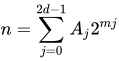
Next, generate a -by- matrix by stepping times the linear-feedback shift register defined over by the polynomial : starting with the -integer register , shift right one position, injecting on the left and adding (component-wise) the output value times the vector at each step (see [1] for details). Let be the integer in the th register on the th step and note that the first row of is given by . Then if we denote by the integer vector given by:


![{\displaystyle [0|0|...|0|1]}](https://wikimedia.org/api/rest_v1/media/math/render/svg/eac3fe6294947dbd2821efc9db82330a4e9638a0)

![{\displaystyle [c_{0},...,c_{d-1}]}](https://wikimedia.org/api/rest_v1/media/math/render/svg/1754d2f8b6497258748c5c7a2e62926f0291adac)


![{\displaystyle (X_{0,j})=[c_{0},...,c_{d-1}]}](https://wikimedia.org/api/rest_v1/media/math/render/svg/fe41f9cc9785f8fec59e1e12c66ec53127776e41)

- ,

it can be easily checked that:
- .
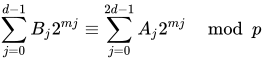
Thus represents an -bit integer congruent to .

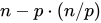
For judicious choices of (again, see [1]), this algorithm involves only a relatively small number of additions and subtractions (and no divisions!), so it can be much more efficient than the naive modular reduction algorithm ().
Examples
[edit]In 1999, NIST recommended four Solinas primes as moduli for elliptic curve cryptography:[4]
- curve p-192 uses modulus
- curve p-224 uses modulus
- curve p-256 uses modulus
- curve p-384 uses modulus .
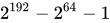
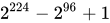


A newer Curve448 uses modulus .

A Solinas prime that fits into a typical 64-bit unsigned integer is , it is where is the cyclotomic polynomial, thus it is a unique prime in base 2 (with period length 192). This size is too small for cryptography, but finds use in implementing a number-theoretic transform for efficient multiplication of large numbers.[5]


A complete list of with , a small modular reduction weight , and (i.e. multiples of a computer word size) was produced by José de Jesús Angel Angel and Guillermo Morales-Luna in 2010.[6]


The Curve25519 uses , which has also been called pseudo-Mersenne.[7]

See also
[edit]- Proth prime: several examples on this page are also Proth primes
References
[edit]- ^ Solinas, Jerome A. (1999). Generalized Mersenne Numbers (PDF) (Technical report). Center for Applied Cryptographic Research, University of Waterloo. CORR-99-39.
- ^ Solinas, Jerome A. (2011). "Generalized Mersenne Prime". In Tilborg, Henk C. A. van; Jajodia, Sushil (eds.). Encyclopedia of Cryptography and Security. Springer US. pp. 509–510. doi:10.1007/978-1-4419-5906-5_32. ISBN 978-1-4419-5905-8.
- ^ US patent 5159632, Richard E. Crandall, "Method and apparatus for public key exchange in a cryptographic system", issued 1992-10-27, assigned to NeXT Computer, Inc.
- ^ Recommended Elliptic Curves for Federal Government Use (PDF) (Technical report). NIST. 1999.
- ^ Craig-Wood, Nick. "Integer DWTs mod 2^64-2^32+1". www.craig-wood.com.
- ^ de Jesús Angel Angel, José; Morales-Luna, Guillermo (2010). "Solinas primes of small weight for fixed sizes". Cryptology ePrint Archive, Paper 2010/058.
- ^ Nath, Kaushik; Sarkar, Palash (2018), Efficient Arithmetic In (Pseudo-)Mersenne Prime Order Fields, 2018/985, retrieved 2025-05-10