Wiki Article
Trifacial Trinity
Nguồn dữ liệu từ Wikipedia, hiển thị bởi DefZone.Net
.jpg)
Trifacial Trinity (also known as the tricephalous Trinity or vultus trifrons; in Russian: смесоипостасная Троица, "mixed-hypostasis Trinity") is a distinct iconography in Christian art depicting the Holy Trinity. It typically presents God as a single body with three heads or, more commonly, a single head with three fused faces sharing four eyes.[1] Emerging in the 12th century, this imagery attempted to visually represent the Christian dogma of one God in three persons (Father, Son, and Holy Spirit) but was eventually condemned by the Catholic Church for being "monstrous" and prone to pagan or diabolical misinterpretation.[2][3] In the Russian Orthodox tradition, such images appeared later, primarily in the 18th century, where they were also met with hostility by ecclesiastical authorities.[4]
Origins
[edit]The visual concept of a three-headed deity has roots in pre-Christian and pagan traditions across Europe and Asia.[1] The number three in ancient religious iconography often signified an intensification of power and the "all-seeing" nature of the divine.[5]
- Celtic and Gallic cultures: Three-faced stone heads, such as the Corleck Head found in Ireland (ca. 2nd century BCE), indicate that such imagery held a significant position among the Celts of Gaul and the Danube region.[6]
- Slavic religion: The god Triglav (meaning "three-headed") was depicted as a man with three goat heads or faces, symbolizing rule over the sky, earth, and underworld.[7]
- Classical antiquity: Greco-Roman deities such as Hecate and Hermes were sometimes depicted with three heads.[5] The Roman god Janus was typically a bifrons (two-faced) looking forward and backward, a motif that influenced later medieval allegory.[8]
- Hinduism: The iconography may share distant links with polycephalous Hindu deities, such as the three-headed Shiva or four-headed Brahma.[5]
Scholars suggest that the Christian adoption of this form was a "sublimated fulfilment" of the pagan vision, attempting to resolve the artistic difficulty of representing the Triune God.[9] However, the motif also overlaps with the iconography of the Devil depicted with three faces on one head, as well as depictions of "monstrous peoples" and demonized heretics, which utilized a similar principle of fused visages.[10]
History and development
[edit]In the early church, the visual depiction of the Trinity was often sidestepped to avoid confusion. Artists relied on "Trinitarian Images"—scriptural narratives deemed to relate to the mystery, such as the Three Visitors to Abraham in Genesis 18—or aniconic symbols like the triangle, though the latter was criticized by Saint Augustine.[3]
By the 12th century, direct representations of the Trinity began to flourish, leading to radical iconographical solutions. These included the "triandric" Trinity (three identical human figures) and the "trifacial" or "tricephalous" Trinity (a single body with three fused faces).[3] The earliest examples of the tricephalous type appeared in 12th-century French manuscripts.[1] The iconography spread throughout Europe, becoming particularly popular in Florence, Italy, during the 14th century and the Renaissance.[9] An Italian antiphonary from the 15th century depicts a three-faced Trinity with four eyes.[11]
The motif was also present in the Balkans; frescoes in the narthex of the Church of St. Clement in Ohrid (1295) and the Church of the Dormition in Matejce (c. 1360) feature the tricephalous Trinity.[11] In the 18th century, an example of this imagery, unusual for Orthodox iconography, could be found in the Church of St. George on Mount Athos.[11]
Major Renaissance artists, including Andrea del Sarto, Fra Filippo Lippi, and Donatello, utilized this iconography to explore the mystery of the Trinity.[9] In these depictions, the three faces often look in different directions, symbolizing God's omniscience over space and time.[12]
Theological controversy and prohibition
[edit]Despite its use by prominent artists, the trifacial Trinity was controversial. Scholastic theologians and humanists criticized the imagery as a "monster" (monstrum in natura rerum) and an aberration of nature.[13] Archbishop Antoninus of Florence (1389–1459) was among the early voices arguing that three-headedness was disorderly and inappropriate for the divine.[13] However, the imagery did find defenders; Saint Teresa of Avila wrote that for the ignorant, the three-faced depiction could be helpful in visualizing the three persons present in one being.[3]
In the wake of the Reformation and the Council of Trent (1563), the Catholic Church sought to standardize religious imagery.[13] This led to explicit papal bans:
- Pope Urban VIII (1628): On August 11, 1628, the Pope issued a prohibition against representations of the Trinity as "a figure with one body, three mouths, three noses, and four eyes," ordering such examples to be burned.[14][3]
- Pope Benedict XIV (1745): In his brief Sollicitudini Nostrae, Benedict XIV categorized the three-headed Trinity as a prohibited "monster," distinguishing it from "tolerated" images (such as three identical men) and "approved" images (such as the Gnadenstuhl or "Mercy Seat").[14]
In the Russian Empire
[edit]
In Russia, isolated examples of the three-faced Trinity appeared only in the 18th century, influenced by Catholic art brought by migrants from Ukraine and exiles from Poland.[15][4] This influence is evident in a 1729 "mixed-hypostasis" icon formerly held at the Novo-Tikhvinsky Convent[which?] near Tobolsk (now in the Sverdlovsk Regional Museum of Local Lore).[15]
Russian authorities reacted with hostility, condemning the images as obscene.[4] In 1767, Catherine the Great reported to the chief procurator of the Holy Synod that a merchant in Kazan had presented her with an icon of the Trinity with three faces and four eyes.[4] The Empress wrote: "I fear that this might give occasion to senseless icon painters to add to this even more hands and legs, which would be very seductive and similar to Chinese images."[4]
Consequently, the Holy Synod condemned the three-faced image and decreed stricter control over icon painters, sending commissions to inspect workshops and markets.[4] A Synod decree from June 11, 1764, had already ordered that "strange and absurd indecencies" in iconography—specifically citing the three-faced, four-eyed Trinity presented to the Empress as resembling "Hellenic gods"—be suppressed.[16] Existing icons of this type were to be removed or repainted.[16] The Synod also attempted to ban the import of foreign prints featuring the "four-eyed Trinity," such as one found in the possession of a merchant who had purchased it in Pskov, though this measure was not implemented.[17]
Survival in folk and colonial art
[edit]
Following the papal bans, the trifacial Trinity largely disappeared from high art but survived in popular devotion and folk art, particularly in Austria, Bavaria, and Switzerland, into the 19th century.[9]
The iconography also flourished in Latin America, specifically within the Cusco school of Peru (16th–18th centuries).[18] In the Spanish American colonies, clergy relied heavily on images for "material pedagogy" to transmit religious knowledge across linguistic barriers.[3] There was a specific anxiety regarding the standard depiction of the Holy Spirit as a dove; officials feared this would reignite idolatrous practices rooted in nature worship among Indigenous viewers.[3] Consequently, the "triandric" Trinity (three identical human figures) was officially endorsed by the Mexican Inquisition in the 18th century as a safer alternative.[3] Although the trifacial Trinity did not receive this official endorsement, it nevertheless permeated the region and survives in numerous paintings from New Spain and Peru.[3]
Some colonial examples were later censored; a trifacial painting attributed to the Colombian artist Gregorio Vásquez de Arce y Ceballos (1638–1711) was only identified as such after overpainting was removed to reveal the original "offending" iconography.[3]
Notable examples
[edit]- Abraham and the Trinity (c. 1270–1280): An illumination in the St John's Psalter (Cambridge) depicts a blue-robed figure with three heads on a single neck visiting Abraham, emphasizing the link between the Old Testament patriarch and the Christian revelation.[19][20]
- Vision of St. Augustine (c. 1438): A predella piece by Fra Filippo Lippi shows Saint Augustine gazing at a small, sun-like trifacial Trinity with three noses and four eyes appearing in the sky.[21]
- Allegory of Prudence (c. 1550–1565): A painting by Titian uses a secularized form of the tricephalous image to represent the three ages of man (youth, maturity, and old age) associated with a three-headed beast (dog, lion, and wolf).[22]
-
 Abraham and the Trinity
 -
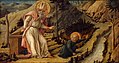 Vision of St. Augustine
 -
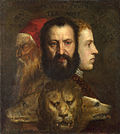 Allegory of Prudence


References
[edit]- ^ a b c Thiessen 2018, p. 400.
- ^ Thiessen 2018, pp. 400–407.
- ^ a b c d e f g h i j McMahon 2025.
- ^ a b c d e f Antonov & Maizuls 2011, p. 156.
- ^ a b c Thiessen 2018, p. 402.
- ^ Thiessen 2018, pp. 401–403.
- ^ Thiessen 2018, p. 401.
- ^ Thiessen 2018, p. 403.
- ^ a b c d Thiessen 2018, p. 406.
- ^ Antonov & Maizuls 2011, pp. 155–156.
- ^ a b c Antonov & Maizuls 2011, p. 155.
- ^ Thiessen 2018, p. 420.
- ^ a b c Thiessen 2018, p. 407.
- ^ a b Thiessen 2018, p. 410.
- ^ a b Sofronova 2004.
- ^ a b Molodykh 1924.
- ^ Antonov & Maizuls 2011, pp. 156–157.
- ^ Thiessen 2018, p. 423.
- ^ Thiessen 2018, pp. 412–413.
- ^ Judova.
- ^ Thiessen 2018, pp. 416–418.
- ^ Thiessen 2018, p. 421.
Sources
[edit]- Antonov, Dmitriy I.; Maizuls, Mikhail R. (2011). Демоны и грешники в древнерусской иконографии: Семиотика образа [Demons and Sinners in Old Russian Iconography: Semiotics of the Image] (in Russian). Moscow: Indrik. ISBN 978-5-91674-149-0.
- Judova, Jenny. "Threeheaded Trinity in St. John's Psalter MS K26". Academia.edu.
- McMahon, Brendan C. (2025). "Material Pedagogy. Religious Images and the Iridescent Divine". Iridescence & the Image: Material Thinking in the Early Modern Spanish World. University Park, PA: The Pennsylvania State University Press. ISBN 978-0-271-09969-9. LCCN 2025007912.
- Molodykh, V. G. (1924). "Материалы к истории иконописания и живописи в Западной Сибири" [Materials for the History of Icon Painting and Painting in Western Siberia]. Notes of the Tyumen Society for Scientific Study of the Local Region (in Russian) (1). Tyumen: 151–165.
- Sofronova, M. N. (2004). Становление и развитие живописи в Западной Сибири в XVII — начале XIX века [Formation and Development of Painting in Western Siberia in the XVII – Early XIX Centuries] (PhD Art History thesis) (in Russian). Barnaul.
- Thiessen, Gesa Elsbeth (2018). "Not So Unorthodox: A Reevaluation of Tricephalous Images of the Trinity" (PDF). Theological Studies. 79 (2): 399–426. doi:10.1177/0040563918766704.
External links
[edit]