Wiki Article
Draft:Stately home
Nguồn dữ liệu từ Wikipedia, hiển thị bởi DefZone.Net
| Submission declined on 14 December 2025 by Theroadislong (talk). This submission reads more like an essay than an encyclopedia article. Submissions should summarise information in secondary, reliable sources and not contain opinions or original research. Please write about the topic from a neutral point of view in an encyclopedic manner.
Where to get help
How to improve a draft
You can also browse Wikipedia:Featured articles and Wikipedia:Good articles to find examples of Wikipedia's best writing on topics similar to your proposed article. Improving your odds of a speedy review To improve your odds of a faster review, tag your draft with relevant WikiProject tags using the button below. This will let reviewers know a new draft has been submitted in their area of interest. For instance, if you wrote about a female astronomer, you would want to add the Biography, Astronomy, and Women scientists tags. Editor resources
|  |
| Submission declined on 4 December 2025 by Royiswariii (talk). This submission is not adequately supported by reliable sources. Reliable sources are required so that information can be verified. If you need help with referencing, please see Referencing for beginners and Citing sources. This draft's references do not show that the subject qualifies for a Wikipedia article. In summary, the draft needs multiple published sources that are: Declined by Royiswariii 34 days ago.
| |

The stately home, more commonly known as a manor house.[1] in the Middle Ages from the late 11th century to the mid-15th century, was a large building usually located in the keep and reserved for the use of the lord and his family.
In a broader sense, the terms stately home, manor house[2] or large house subsequently referred to the residence of the owner of a fortified (sometimes isolated) farm, such as the 12th-century dwellings that can still be found today, particularly in Germany, England, France, and Spain.
Nowadays, an old manor house may have been destroyed, modified for comfort, or used as an agricultural building.

Definition
[edit]
The owner of the manor house—whether a knight, baron, count, duke, or king (in this specific case, we refer to a '"royal logis", a secondary residence used as a base during trips related to the control of the kingdom (inspection) or leisure (rest, hunting))—used it as:
- A place of residence (for himself, his family, and his comrades-in-arms) in times of peace. In the event of a threat or conflict, they would take refuge in the upper courtyard or the keep, if there was one. The smallest manor houses had only buttresses, double-thickness door frames, surrounding walls, and moats that could be filled with water as their only fortifications. For this reason, the manor house was often built near a river (or a spring for simple everyday needs).
- A meeting room, intended to receive his vassals and other distinguished guests, with all decisions being made in the Great Hall or aula (Latin for hall)in Latin (declaration of war, preparation for battle, economic management of possessions, etc.). In the Great Hall of Caen (the "Salle de l'Échiquier"), Richard the Lionheart, King of England and Duke of Normandy, gathered his barons before leaving on the Crusades[3]
- A court of justice, if there were disputes on his lands, concerning commoners or men of high rank. These disputes could only be settled through the mediator, namely “the lord”, who alone had the power to pass judgment.
- A reception hall where all ceremonies took place (knighting, marriage, religious festivals, etc.). Robert de Torigni, abbot of Mont-Saint-Michel, recorded that in 1182 more than a thousand knights were present to celebrate Christmas in the Salle de l'Échiquier, the great hall of Château de Caen.
- A place of worship; every significant "stately home" had an adjoining room fitted out as a chapel.
- A treasury room where various feudal taxes were collected.
Layout and function of rooms
[edit]The stately home generally has two levels:
- The ground floor housed a large pantry and the kitchen with a monumental fireplace; the kitchen could sometimes be on the first floor.
- the first floor was divided into two rooms: the larger of which was the antechamber or, in smaller residences, the Great Hall (a vast public room used for a reception hall), where large meals or official ceremonies—weddings, knighting ceremonies, etc.—were held. It was also the place where court decisions were made. The smaller room was the lord’s bedchamber. Access to this floor was via an external staircase known as the grand degré (great stair).
In the largest stately homes, there was often a Great Hall (aula in Latin), located in another type of building associated with the stately home.
Cellar
[edit]Located on the ground floor of the house or semi-basement, the cellar and pantry have the advantage of preventing natural moisture from the ground from invading the upper floor of the dwelling and provide a place with a constant, cool temperature, ideal for storing food supplies that would ferment if exposed to changes in outside temperature, hence the minimum number of windows. There was also a vaulted kitchen (pantry at Bricquebecor a joist-ceilinged kitchen
Kitchen
[edit]
A rack with rings hangs from the chimney hood, allowing a cauldron to be suspended closer to or further from the flames, depending on the desired cooking method. Andirons support the logs.
In the illustration shown here of the Notre-Dame des Fontaines sanctuary, the object hanging from the rack is a “calen,” a metal oil lamp with a hook-shaped stem that can be hooked onto various places.
In the kitchen of a stately home, highly refined dishes could be prepared, a privilege of the ruling class, the common people naturally having no access to such delicacies.
Great hall
[edit]In Old French, the term Grant sale or simply Sale was used to refer to it, an expression that was adopted in modern times as Grand-Salle; in Latin texts, it was aula. This state room, also known as the banquet or reception hall, was usually on the first floor and accessed by the grand external staircase. It contained a large fireplace used for both cooking, with cooking accessories, and heating. Not far from the fireplace, wall cabinets provided storage for crockery. There was also a washbasin, as hygiene was very strict in the Middle Ages; otherwise, an aquamanile, a gemellion (container)
The room also contained trestle tables (hence the expression "dressing the table") and benches. It was often decorated with murals and tapestries.
Initially, the great hall was often a separate building (e.g., at Oakham,(Rutland County, England), Caen, Douvres-la-Délivrande (initially, the Domaine de la Baronnie had a large hall separate from the stately home), Bricquebec, or Beaumont-le-Richard).
Later, it became integrated into the same structure as the stately home (e.g., at Crépy-en-Valois (or the Great Hall and the living stately homes are in the same building), Creully, (“see Evolution of the building”), Lillebonne, or Penshurst Place (Baron's Hall))[4].
Royal or princely stately homes also had their own Great Halls, which were much more imposing and luxurious than those of lesser homes. Some of them remain famous for their size and beauty. This is the case of the Grand Hall of the Palais de la Cité in Paris, which, at 1,800 square meters, was the largest hall in Europe at the time. It was destroyed by fire in 1618, but the lower hall, now known as the Salle des Gens-d'Armes, can still be seen in the Palais de Justice in Paris.
Examples of large princely halls in France:
- Chinon, the Great Hall of the castle, partially destroyed, where Charles VII received Joan of Arc;
- Loches, the Great Hall of the royal residence;
- Poitiers, the Great Hall, known as the Salle des Pas-Perdus (Hall of Lost Steps) in the Palace of Justice.
Examples of large princely halls in Europe:
- England, London, the Great Hall of the Palace of Westminster, Westminster Hall;
- The Czech Republic, the Great Hall of Prague Castle, known as Vladislav Hall.

Bedchamber
[edit]The bedchamber[5] adjoined the Great Hall, separated by a simple partition. It was accessed either through the hall or via a turret equipped with a spiral staircase marked “private access.” It contained a fireplace for heating and, obviously, a bed and medieval furniture. There was also a washbasin and a bucket for washing.
Architectural features
[edit]Fireplaces
[edit]There is no evidence of fireplaces in the interiors of Roman palaces or houses. Fireplaces or hearths only appeared in interiors in the 12th century, and there are many examples from this period. The primitive fireplace consisted of a niche carved out of the thickness of the wall, supported on each side by two uprights and topped by a mantelpiece and a hood, under which the smoke was drawn. The fireplace was used both for heating and cooking, depending on the room in which it was installed.[6]
In primitive 11th-century stately homes, there would have been a central open hearth (instead of a wall-mounted fireplace).
Fireplace pipes and caps
- The flues of 13th-century fireplaces are usually cylindrical inside and end above the gables or valleys in the form of a large column crowned by a mitre. Built with great care using layers of hollowed-out stones, these pipes often take on a monumental form that gracefully surmounts the roofline of buildings[6].
Conveniences
[edit]Wall cupboards
[edit]A wall cupboard is a closed compartment built into the wall, designed to store valuable items or food supplies. Some are ventilated and divided by stone or wooden shelves. This type of cupboard was usually found either near the fireplace in the kitchen or in the bedroom.
Washbasin
[edit]It is usually placed in a niche, and a drain pipe runs through the wall, ending in a gargoyle. Examples of civilian washbasins are very rare. In France, the oldest known washbasin is in Châtillon-Coligny, in the large tower of the keep, dating from around 1180.
These washbasins had a pump that was used to supply water to the basin.
Latrines
[edit]The best equipped and most comfortable stately homes had latrines built into the outer wall (“corbelled latrines” and later “sloping-duct latrines,” latrines built into the thickness of the wall with a conduit leading directly to the wall facing, causing olfactory and visual pollution) or into the thickness of the wall itself (“pit latrines”), at the foot of which excrement was disposed of and returned to nature, falling among trees or into the water of the protective moat surrounding the building[6].
-
 Lavabo at the manor of Amblie (13th–14th centuries)
 -
 Annunciation by Robert Campin – latrine visible at rear left
 -
 Latrines from various angles
 -
 Interior view of latrines


Windows
[edit]There are different types of windows, all of which are chamfered (a slanted surface obtained by cutting down the edge of a stone)[7]:
-
 Romanesque twin window
 -
 Later twin window
 -
 Twin windows and blocked arrow-slits
 -
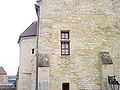 Simple mullioned window


# twin: arranged in pairs, grouped, from the Latin geminare, to double
- single or double watch window: small chamfered window used for watching, as its name suggests.
- mullioned: fixed upright dividing a window into compartments, particularly in medieval and Renaissance architecture (it may be intersected by one or more crossbars).
- clerestory: a series of juxtaposed windows, “relatively rare in Anglo-Norman dwellings.”
Doors
[edit]The doors were chamfered. Doors of civil buildings, exterior and interior. In medieval towns, only castles and palaces had carriage gates, which were usually fortified. As for the doors of the houses themselves, even if they had courtyards, they were always what we call alley doors, i.e., designed only for pedestrians, with a width of 1 m to 1.50 m and a height of 2.50 to 3 m at most.
There are no known doors from 11th-century civil buildings in France that have any distinctive features. The entranceways from this period, which are very rare, consist of only two jambs with a small semicircular arch and are no different from the small church doors that can still be seen on the sides of some religious monuments in Beauvaisis, Berry, Touraine, and Poitou.
Staircase with large steps, removable, or spiral staircase in a tower
[edit]- To reach the upper floor of the stately home, long straight ramps with a parapet at the top were built as early as the 12th century. The steps rested on arches and always protruded outward, which made the staircase wider and created a striking effect, indicating the purpose of these very long ramps.
- Pivoting stairs
This type of staircase could be installed in stately homes, manors, and keeps, whose occupants wanted to ensure greater security against possible intrusions. Installed in a round tower, in a masonry cylinder pierced with doors at the height of the floors to be served, the staircase was independent of the masonry and consisted of a pivot shaft supporting the entire framework system. A landing in the masonry was provided for each floor to be served.
It is necessary to assume that all doors are located above door D on the ground floor. The first step is at E; from E to F, the steps are fixed and independent of the wooden core mounted on a lower iron pivot G and held at the top of the screw in a circle formed by two horizontal pieces of wood. The first step assembled in the core is H; it is strongly supported, as are the next three, by brackets I.
From this relief step H, a spiral staircase begins, assembled at the ends of the steps and supporting a cylindrical wooden partition pierced by doors aligned with the masonry bays D. Above the third step (starting from step H), the other steps up to the top of the spiral staircase are only supported by small ties K, which are shorter than the brackets I, to facilitate clearance. Thus, all the steps, the stringer, and the cylindrical partition rest on the pivoting shaft O. To close all the doors on the upper floors at once, it was sufficient to turn the cylinder a quarter of a circle by rotating the core on its axis.
These doors were thus concealed; there was a gap between steps F and H, and anyone who crossed it to enter the apartments would find a wall opposite the openings in the cylinder and would be unable to guess the location of the real doors corresponding to these openings when the staircase was put back in place. A simple stop placed by the inhabitants on one of the landings, C, prevented this screw from being turned. This was a sure way of avoiding intruders[6]. See removable staircase.
- Spiral staircases
They connected two rooms, one above the other, and were not always hidden by the thickness of the walls; they were partly visible, placed in a corner or along the walls of the lower room, and open onto that room. Regarding this, it is important to understand the principles that medieval architects followed in the construction of staircases. Such architects never viewed a staircase as anything other than an essential appendage to any building with multiple floors, an appendage that had to be placed in the most convenient location for practical purposes, just as a ladder is placed along a building under construction, wherever it is needed[6]. See spiral staircase.
-
 Pivoting staircase
 -
 12th-century spiral stair in a turret
 -
 Turret containing a spiral stair at Amblie
 -
 Spiral stair at Amblie, view from the chamber
 -
 Spiral stair at Amblie, ground-floor view


Decorative elements
[edit]Wall paintings
The findings of archaeologists, which are well known today, lead us to focus here only on painting as applied to French architecture in the Middle Ages. As in Antiquity, painting and architecture were not separate disciplines at that time. These two arts lent each other mutual support, and the “painting” as such (a decorative wall object) did not exist, or at least was of very secondary importance[6], as evidenced by 14th-century murals at Vinzelles (Auvergne, France).
-
 Example of a very common 12th- and 13th-century wall painting
 -
 Example of a wall painting (Commandery of the Temple, Metz)
 -
 Example of a wall painting
 -
 Example of a ceiling painting (black-and-white photograph)


The first example of this device is very simple, as shown in the 12th- and 13th-century mural above[6], white on an ochre yellow background, or, more frequently, reddish brown on a white or pale yellow background; the lines, painted with a brush over large areas, simple, doubled, tripled or accompanied by certain ornaments, present a very economical decoration, perfectly highlighting the moldings, bands, columns, and borders covered with more complicated ornamentation and bright colors.
- Flooring
- Assembly of stone or terracotta tiles
- Tiles Decorated floor tiles There are no known examples of terracotta tiles dating from before the 12th century, which is hardly surprising given how quickly the glaze used to coat this material wears away. Terracotta tiles wore out quickly and had to be replaced frequently[6].
- Stone paving - Roman opus
Limestone, granite, schist, etc., depending on the geographical area and geological resources. Throughout history and across all countries, flat, hard, polished stones have been used to cover ground floors in private homes, either randomly or symmetrically. Most limestone quarries have thin upper layers with a compact texture, suitable for this type of paving. Most stately homes were paved with large slabs of hard stone. Often, in castles, these pavements were decorated with inlays of colored stones or mastics, or the slabs alternated with painted stucco. In an account of the construction of Bellver Castle (Spain) on the island of Majorca, there is mention of the paving in this stately home, made of stucco composed of quicklime, plaster, and large mixed colored stones; all so well polished that one might have thought these areas were made of marble and porphyry[6].
-
 Example of tomettes
 -
 Example of 13th- to 15th-century tomettes
 -
 Example of “opus roman” stone flooring


Ceilings
[edit]In the Middle Ages, ceilings were simply floors viewed from below. The structure of the floor determined the shape and appearance of the ceiling, which was never covered with arches, compartments, or wooden or plaster coffers—decorative elements unrelated to the primary function of simply dividing the space into two levels.

The beams, often with little span in the walls and supported by more or less protruding stone corbels, could be decorated (on their edges) with profiles beyond the span on the corbels. Sometimes the joists themselves were also very delicately molded. The joists of the oldest floors rested at one end only on these beams and at the other end in a groove cut into the wall, in holes, or on a joist itself resting on corbels or a continuous profile. To compensate for the torsion of these joists (held in place by neither tenons nor pegs), struts forming keys were pegged diagonally between their spans, on the beams and joists.
The joist spaces (solid or empty) were coated with wood shingles or lined with staves laid crosswise. The joints between these staves formed small boxes between the joists. Plaster or mortar was spread over these staves, and the whole surface was covered with tiles.
On ceilings, where wood was rarely exposed, a distemper paint was applied that could be easily renewed. Many of these 13th- and 14th-century ceilings can still be seen under more modern lathwork in old houses[6].
Roof structures
[edit]The roof structure of buildings in Anglo-Norman regions, for example, is characterized by its similarity to the naval roof structure[6]. The Normans, a seafaring people, seem to have contributed significantly to the art of carpentry, as evidenced by the vast buildings from the 11th century onwards, entirely covered by large exposed roof structures. The roof structure built later in England, during the 13th and 14th centuries, appears to be more original and to have incorporated older traditions.
The roof structure could be highly ornate and carved, usually made of oak or elm.

Roof
[edit]- Gable slope (Rampant)
The rampant is the sloping part of the gable of a roof.

- Ridge and ridgepole
These are the elements covering the upper part of a roof. These elements could be ornate[8],[9].
- Finials[10]
-
 Ridge ornaments (épis de faîtage) on one of the residential buildings at the manor of Amblie « De Bonvouloir », late 15th–early 16th century
 -
 Ridge ornaments on a barn at Amblie
 -
 Terracotta ridge ornament (épi de faîtage)


- Roofing
Roofing can be made of tiles, flagstones, slate, thatch, etc., depending on geological resources.[11],[12]
Buttresses
[edit]A mass of masonry built to project out from a wall or other supporting structure. Buttresses serve more of a reinforcing function than an aesthetic one[13]
-
 Buttresses at the stately home of Amblie, Normandy
 -
 Buttresses at the Domaine de la Baronnie, Bretteville-sur-Odon


Some stately homes in France
[edit]Alsace
[edit]Maine
[edit]- Château de la Cour, Vezot
- Convoise, Saint-Cosme-en-Vairais
- Mirebeau, Vivoin
Maine-et-Loire
[edit]- Le Grand Boust, Longué-Jumelles
Normandy
[edit]- Bricquebec(c. 1190)
- Ardevon (1220)
- Domain of the Barony at Bretteville-sur-Odon
- Domfront (1100)
- Château de Beaumont-le-Richard, Englesqueville-la-Percée[14] (c. 1150)
- Damigny at Saint-Martin-des-Entrées (1250)
- Creully (c. 1160)
- Salle de l'Échiquier, Caen (c. 1125)
- Le Mesnil-sous-Jumièges (c. 1200)
- Villiers-sur-Port[15] at Port-en-Bessin-Huppain
- Amblie (13th–14th centuries)
- Crèvecœur-en-Auge
- Domaine de la Baronnie, Douvres-la-Délivrande (13th–15th centuries)
- Château de Fontaine-Henry (c. 1220, much altered in the Renaissance)
- Rumesnil (1260)
- Manoir des Vallées at Barneville-la-Bertran[16] (1220)
- Loisail[17] (1180)
- Glos-sur-Risle (1220)
- Honguemare-Guenouville (1240)
- Vatteville-la-Rue[18] (1100)
- Martin-Église (1220)
Picardy
[edit]- Château Saint-Aubin, Crépy-en-Valois, today: Archery Museum
- Manoir de Saint-Paterne, Pontpoint
Examples elsewhere in Europe
[edit]Germany
[edit]England
[edit]- Boothby Pagnell Manor House, Lincolnshire (c. 1180)[19]
- Constable's House, Christchurch, Dorset (c. 1160)
-
 Logis at Christchurch, England (c. 1160)
 -
 Temple Manor, Strood, England


References
[edit]- ^ Pounds 1990, pp. 125–127
- ^ Dictionnaire raisonné de l'architecture française du|XI|au|XVI - Tome 6, Manoir|Manoir on the medieval encyclopedia
- ^ Liddiard 2005, p. 162
- ^ Baron's Hall.
- ^ Viollet-le-Duc, Eugène (1875). "Chamber". Dictionary of French Architecture from 11th to 16th Century (in French). Vol. 2 (English translation ed.).
- ^ a b c d e f g h i j k according to the Encyclopédie of Viollet-le-Duc, Volume I: Architecture
- ^ Eugène Viollet-le-Duc, Dictionnaire raisonné de l’architecture française du XIe au XVIe siècle, article “Window” (Fenêtre)
- ^ Viollet-le-Duc, Dictionnaire raisonné de l’architecture française du XIe au XVIe siècle, vol. 4, "Crête" (in French).
- ^ Viollet-le-Duc, Dictionnaire raisonné de l’architecture française du XIe au XVIe siècle, vol. 5, "Faîtière" (in French).
- ^ Viollet-le-Duc, Dictionnaire raisonné de l’architecture française du XIe au XVIe siècle, vol. 5, "Épi" (in French),
- ^ Viollet-le-Duc, Dictionnaire raisonné de l’architecture française du XIe au XVIe siècle, vol. 9, "Tuile" (in French)
- ^ Viollet-le-Duc, Dictionnaire raisonné de l’architecture française du XIe au XVIe siècle, vol. 1, "Ardoise" (in French)
- ^ Viollet-le-Duc, Dictionnaire raisonné de l’architecture française du XIe au XVIe siècle, vol. 4, "Contre-fort" (in French)
- ^ Seigneurial residence of Beaumont-le-Richard Archived 2006-11-27 at the Wayback Machine on Mondes normands (in French), Centre Michel de Boüard – Université de Caen Normandie.
- ^ Villiers-sur-Port in Base Mérimée (in French), French Ministry of Culture.
- ^ Manor of the Vallées in Base Mérimée (in French), French Ministry of Culture.
- ^ Loisail Archived 2006-11-29 at the Wayback Machine on Mondes normands (in French), Centre Michel de Boüard – Université de Caen Normandie.
- ^ Vatteville-la-Rue Archived 2007-09-26 at the Wayback Machine on Mondes normands (in French), Centre Michel de Boüard – Université de Caen Normandie.
- ^ Manor house of Boothby Pagnell Archived 2006-11-27 at the Wayback Machine on Mondes normands (in French), Centre Michel de Boüard – Université de Caen Normandie.
- ^ Burton Agnes Old Hall Archived 2007-01-29 at the Wayback Machine on Mondes normands (in French), Centre Michel de Boüard – Université de Caen Normandie.
- ^ Burton Agnes Manor House Archived 2007-02-22 at the Wayback Machine on the official Burton Agnes Hall website.