Wiki Article
Portal:Chess
Nguồn dữ liệu từ Wikipedia, hiển thị bởi DefZone.Net


Introduction

Chess is a board game for two players, played on a square board consisting of 64 squares arranged in an 8×8 grid. The players, referred to as "White" and "Black", each control sixteen pieces: one king, one queen, two rooks, two bishops, two knights, and eight pawns, with each piece type having a different pattern of movement. An enemy piece may be captured (removed from the board) by moving one's own piece onto the square it occupies. The object of the game is to "checkmate" (threaten with inescapable capture) the enemy king. There are also several ways a game can end in a draw.
The recorded history of chess dates back to the emergence of chaturanga in 7th-century India. Chaturanga is also thought to be an ancestor of similar games like janggi, xiangqi, and shogi. After its introduction to Persia, it spread to the Arab world and then to Europe. The modern rules of chess emerged in Europe at the end of the 15th century, becoming standardized and gaining universal acceptance by the end of the 19th century. Today, chess is one of the world's most popular games, with millions of players worldwide.
Organized chess arose in the 19th century. International chess competitions today are governed by the International Chess Federation FIDE (Fédération Internationale des Échecs). The first universally recognized World Chess Champion, Wilhelm Steinitz, claimed his title in 1886; Gukesh Dommaraju is the current World Champion, having won the title in 2024. (Full article...)
Selected article -

In graph theory, a rook's graph is an undirected graph that represents all legal moves of the rook chess piece on a chessboard. Each vertex of a rook's graph represents a square on a chessboard, and there is an edge between any two squares sharing a row (rank) or column (file), the squares that a rook can move between. These graphs can be constructed for chessboards of any rectangular shape. Although rook's graphs have only minor significance in chess lore, they are more important in the abstract mathematics of graphs through their alternative constructions: rook's graphs are the Cartesian product of two complete graphs, and are the line graphs of complete bipartite graphs. The square rook's graphs constitute the two-dimensional Hamming graphs.
Rook's graphs are highly symmetric, having symmetries taking every vertex to every other vertex. In rook's graphs defined from square chessboards, more strongly, every two edges are symmetric, and every pair of vertices is symmetric to every other pair at the same distance in moves (making the graph distance-transitive). For rectangular chessboards whose width and height are relatively prime, the rook's graphs are circulant graphs. With one exception, the rook's graphs can be distinguished from all other graphs using only two properties: the numbers of triangles each edge belongs to, and the existence of a unique 4-cycle connecting each nonadjacent pair of vertices. (Full article...)
General images
-
 Two Georgian writers, Ilia Chavchavadze and Ivane Machabeli, playing chess in Saint Petersburg, 1873 (from Chess in the arts)
 -
 The 12th-century Lewis chessmen in the collection of the National Museum of Scotland (from History of chess)
 -
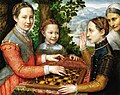 Sofonisba Anguissola, The Chess Game, 1555, National Museum, Poznań, Poland (from Chess in the arts)
 -
 Stamp of the USSR devoted to the accomplished Estonian player and analyst Paul Keres, 1991 (from History of chess)
 -
 Liberale da Verona, The Chess Players, c. 1475 (The Metropolitan Museum of Art) (from Chess in the arts)
 -
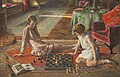 John Lavery, 1929, The Chess Players (from Chess in the arts)
 -

-
 A Chess Dispute (1903) (from Chess in the arts)
 -

-
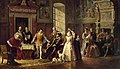 Final match of the 1575 tournament in El Escorial. Painting by Luigi Mussini. (from History of chess)
 -

-
 Book of the customs of men and the duties of nobles or the Book of Chess (1473) (from Chess in the arts)
 -
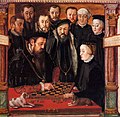 Hans Muelich, 1552, Duke Albrecht V. of Bavaria and his wife Anna of Austria playing chess (from Chess in the arts)
 -
 Iranian shatranj set, glazed fritware, 12th century, New York Metropolitan Museum of Art (from History of chess)
 -
 RZA at a Hip Hop Chess Federation Tournament (from Chess in the arts)
 -

-
 Animation of the Immortal Game, in which Adolf Anderssen, playing White, beat Lionel Kieseritzky in June 1851 (from History of chess)
 -
 Honoré Daumier, 1863, The Chess Players (from Chess in the arts)
 -

-

-
 Persian manuscript from the 14th century describing how an ambassador from India brought chess to the Persian court (from History of chess)
 -
 Lucas van Leyden, c. 1508, The Game of Chess, oil on oak, 27 x 35 cm, Gemäldegalerie, Berlin (from Chess in the arts)
 -
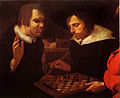 Karel van Mander, 1600 (attributed to), Les joueurs d'échecs (from Chess in the arts)
 -

-
 Paris Bordone, c. 1545, Chess players, oil on canvas, Mailand, Wohnhaus (from Chess in the arts)
 -

-
-
 Chess Set by Man Ray (from Chess in the arts)
 -
 In 1975, former President of Pakistan Zulfi Bhutto gifted a carved ivory set of chess to the former United States President Gerald Ford. (from Chess in the arts)
 -
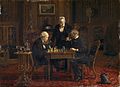
-

-
 An illustration from a Persian manuscript "A treatise on chess". The Ambassadors from India present the Chatrang to Khosrow I Anushirwan, "Immortal Soul", King of Persia. (from History of chess)
 -

-
 These seven ivory chess pieces are the oldest known, dating to about 700 CE. The ivory came from India. They were excavated in 1977 by archaeologist Yuriy Buryakov, at Afrasiyab in Samarkand, Uzbekistan. They are housed today at the Samarkand State Museum. Photographed during a loan of the pieces to the Silk Roads Exhibition at the British Museum. (from History of chess)
 -
 The Chess Players by Henry Fox Talbot, 1847 (from History of chess)
 -
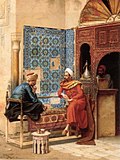
-
 Shams-i Tabrīzī as portrayed in a 1500 painting in a page of a copy of Rumi's poem dedicated to Shams (from History of chess)
 -
 Gustaf Lundberg, 1775, Portrait of Gustav Badin, pastel, 74 x 57 cm, Nationalmuseum, Sweden (from Chess in the arts)
 -
 Niccolò di Pietro, 1413–15, The Conversion of Saint Augustin, Musée des Beaux-Arts, Lyon (from Chess in the arts)
 -
 Some of the earliest examples of chess-related art are medieval illustrations accompanying books or manuscripts, such as this chess problem from the 1283 Libro de los juegos. (from Chess in the arts)
 -
 Current world champion Gukesh Dommaraju (from History of chess)
 -
 Wilhelm Steinitz, the first official World Chess Champion (from History of chess)


_1555_(4096x3236px).jpg)


.jpg)


.jpg)


_gegen_Fischer_(USA).jpg)


.jpg)


.jpg)
.jpg)
Selected image
-
 Click to enlarge and view description
 -
 Click to enlarge and view description
 -
 Click to enlarge and view description


.jpg)
FIDE world ranking
| Rank | Player | Rating |
|---|---|---|
| 1 |  Magnus Carlsen Magnus Carlsen
|
2840 |
| 2 |  Hikaru Nakamura Hikaru Nakamura
|
2810 |
| 3 | Fabiano Caruana
|
2795 |
| 4 |  Vincent Keymer Vincent Keymer
|
2776 |
| 5 |  Arjun Erigaisi Arjun Erigaisi
|
2775 |
| 6 |  Anish Giri Anish Giri
|
2760 |
| 7 |  Alireza Firouzja Alireza Firouzja
|
2759 |
| 8 | R Praggnanandhaa
|
2758 |
| 9 | Gukesh Dommaraju
|
2754 |
| 10 |  Wei Yi Wei Yi
|
2754 |
| 11 | Wesley So
|
2753 |
| 12 |  Nodirbek Abdusattorov Nodirbek Abdusattorov
|
2751 |
| 13 | Viswanathan Anand
|
2743 |
| 14 |  Richárd Rapport Richárd Rapport
|
2741 |
| 15 | Leinier Domínguez
|
2738 |
| 16 | Maxime Vachier-Lagrave
|
2734 |
| 17 |  Jan-Krzysztof Duda Jan-Krzysztof Duda
|
2731 |
| 18 |  Lê Quang Liêm Lê Quang Liêm
|
2731 |
| 19 |  Shakhriyar Mamedyarov Shakhriyar Mamedyarov
|
2730 |
| 20 | Levon Aronian
|
2729 |
Top 10 WikiProject Chess Popular articles of the month
-

Stanley Kubrick (/ˈkuːbrɪk/ KOO-brick; July 26, 1928 – March 7, 1999) was an American filmmaker and photographer. A major figure of the post-war film industry, Kubrick is widely regarded as one of the greatest and most influential filmmakers in the history of cinema. His films were nearly all adaptations of novels or short stories, spanning a number of genres and gaining recognition for their intense attention to detail, innovative cinematography, extensive set design, and dark humor. (Full article...) -
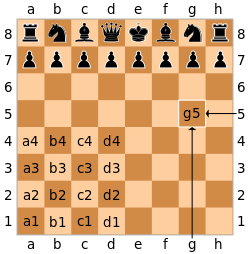
Algebraic notation
Algebraic notation is the standard method of chess notation, used for recording and describing moves. It is based on a system of coordinates to identify each square on the board uniquely. It is now almost universally used by books, magazines, newspapers and software, and is the only form of notation recognized by FIDE, the international chess governing body. (Full article...) -
Benjamin Franklin (January 17, 1706 [O.S. January 6, 1705] – April 17, 1790) was an American polymath: a writer, scientist, inventor, statesman, diplomat, printer, publisher and political philosopher. Among the most influential intellectuals of his time, Franklin was one of the Founding Fathers of the United States; a drafter and signer of the Declaration of Independence; and the first postmaster general. (Full article...) -
Sven Magnus Øen Carlsen (born 30 November 1990) is a Norwegian chess grandmaster. Carlsen is a five-time World Chess Champion, reigning six-time World Rapid Chess Champion and the reigning nine-time World Blitz Chess Champion. He has held the No. 1 position in the FIDE rankings since 1 July 2011, the longest consecutive period, and trails only Garry Kasparov in time spent as the highest-rated player in the world. His peak rating of 2882 is the highest in history. He also holds the record for the longest unbeaten streak at the elite level in classical chess at 125 games. (Full article...) -
Humphrey DeForest Bogart (/ˈboʊɡɑːrt/ BOH-gart; December 25, 1899 – January 14, 1957), nicknamed Bogie, was an American actor. His performances in classic Hollywood cinema made him an American cultural icon. In 1999, the American Film Institute selected Bogart as the greatest male star of classic American cinema. (Full article...) -
Sir Demis Hassabis (born 27 July 1976) is a British artificial intelligence (AI) researcher and entrepreneur. He is the chief executive officer and co-founder of Google DeepMind and Isomorphic Labs, and a UK Government AI Adviser. In 2024, Hassabis and John M. Jumper were jointly awarded the Nobel Prize in Chemistry for their AI research contributions for protein structure prediction. (Full article...) -
Robert James Fischer (March 9, 1943 – January 17, 2008) was an American chess grandmaster and the eleventh World Chess Champion. A chess prodigy, he won his first of a record eight US Championships at the age of 14. In 1964, he won with an 11–0 score, the only perfect score in the history of the tournament. Qualifying for the 1972 World Championship, Fischer swept matches with Mark Taimanov and Bent Larsen by 6–0 scores. After winning another qualifying match against Tigran Petrosian, Fischer won the title match against Boris Spassky of the USSR, in Reykjavík, Iceland. Publicized as a Cold War confrontation between the US and USSR, the match attracted more worldwide interest than any chess championship before or since. (Full article...) -
Chess is a board game for two players, played on a square board consisting of 64 squares arranged in an 8×8 grid. The players, referred to as "White" and "Black", each control sixteen pieces: one king, one queen, two rooks, two bishops, two knights, and eight pawns, with each piece type having a different pattern of movement. An enemy piece may be captured (removed from the board) by moving one's own piece onto the square it occupies. The object of the game is to "checkmate" (threaten with inescapable capture) the enemy king. There are also several ways a game can end in a draw. (Full article...) -
Daniel Aaron "Danya" Naroditsky (November 9, 1995 – October 19, 2025) was an American chess grandmaster (GM), commentator, and content creator. During his career, he was widely considered one of the best speed chess players in the world and was consistently ranked among the top 25 players. His major tournament wins include the 2007 World Youth Championship, the 2013 U.S. Junior Championship, and the 2025 U.S. Blitz Championship. Naroditsky was highly regarded for his educational content and commentary. (Full article...) -
Chess is a musical with music by Benny Andersson and Björn Ulvaeus of the pop group ABBA, lyrics by Ulvaeus and Tim Rice, and book by Rice. The story involves a politically charged, Cold War-era chess tournament between two grandmasters, one American and the other Soviet, and their fight over a woman who manages one and falls in love with the other. Although the protagonists were not intended to represent any real individuals, the character of the American grandmaster was loosely based on Bobby Fischer, while elements of the story may have been inspired by the chess careers of Russian grandmasters Viktor Korchnoi and Anatoly Karpov. (Full article...)

_crop.jpg)


.jpg)

.jpg)
Did you know...
- ... that there have been attempts to make chess an Olympic sport since at least 1924?
Reviewed articles


_(cropped).jpg)

Chess from A to Z
| Index: | A B C D E F G H I J K L M N O P Q R S T U V W X Y Z (0–9) |
| Glossary: | A B C D E F G H I J K L M N O P Q R S T U V W X Y Z |
Topics
| Outline | |||||||||
|---|---|---|---|---|---|---|---|---|---|
| Equipment | |||||||||
| History |
| ||||||||
| Rules | |||||||||
| Terms | |||||||||
| Tactics | |||||||||
| Strategy | |||||||||
| Openings |
| ||||||||
| Endgames | |||||||||
| Tournaments |
| ||||||||
| Art and media | |||||||||
| Related | |||||||||

Subcategories

Related portals


Related WikiProjects
Associated Wikimedia
The following Wikimedia Foundation sister projects provide more on this subject:
-
 Commons
Free media repository -
 Wikibooks
Free textbooks and manuals -
 Wikidata
Free knowledge base -
 Wikinews
Free-content news -
 Wikiquote
Collection of quotations -
 Wikisource
Free-content library -
 Wikiversity
Free learning tools -
 Wiktionary
Dictionary and thesaurus


