Wiki Article
Portal:Baseball
Nguồn dữ liệu từ Wikipedia, hiển thị bởi DefZone.Net

| Main page | Content, Categories & Topics | WikiProjects & Things you can do |
The Baseball Portal
.jpg)

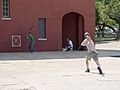
Baseball is a bat-and-ball sport played between two teams of nine players each, taking turns batting and fielding. The game occurs over the course of several plays, with each play beginning when a player on the fielding team, called the pitcher, throws a ball that a player on the batting team, called the batter, tries to hit with a bat. The objective of the offensive team (batting team) is to hit the ball into the field of play, away from the other team's players, allowing its players to run the bases, having them advance counter-clockwise around four bases to score what are called "runs". The objective of the defensive team (referred to as the fielding team) is to prevent batters from becoming runners, and to prevent runners advancing around the bases. A run is scored when a runner legally advances around the bases in order and touches home plate (the place where the player started as a batter).
The opposing teams switch back and forth between batting and fielding; the batting team's turn to bat is over once the fielding team records three outs. One turn batting for each team constitutes an inning. A game is usually composed of nine innings, and the team with the greater number of runs at the end of the game wins. Most games end after the ninth inning, but if scores are tied at that point, extra innings are usually played. Baseball has no game clock, though some competitions feature pace-of-play regulations such as a pitch clock to shorten game time.
Baseball evolved from older bat-and-ball games already being played in England by the mid-18th century. This game was brought by immigrants to North America, where the modern version developed. Baseball's American origins, as well as its reputation as a source of escapism during troubled points in American history such as the American Civil War and the Great Depression, have led the sport to receive the moniker of "America's Pastime"; since the late 19th century, it has been unofficially recognized as the national sport of the United States, though in modern times is considered less popular than other sports, such as American football. In addition to North America, baseball spread throughout the rest of the Americas and the Asia–Pacific in the 19th and 20th centuries, and is now considered the most popular sport in parts of Central and South America, the Caribbean, and East Asia, particularly in Japan, South Korea, and Taiwan. (Full article...)
 Featured articles -

-
 Wii Sports is a 2006 sports simulation video game developed and published by Nintendo for the Wii video game console. The game was released in North America along with the Wii on 19 November 2006, and in Japan, Australia, and Europe the following month. It was included as a pack-in game with the console in all territories except Japan and Korea, making it the first sports game included with the launch of a Nintendo system since Mario's Tennis for the Virtual Boy in 1995. The game was later released on its own as part of the Nintendo Selects collection of games.
Wii Sports is a collection of five sports simulations designed to demonstrate the motion-sensing capabilities of the Wii Remote. The five sports included are tennis, baseball, bowling, golf, and boxing. Players use the Wii Remote to mimic actions performed in real-life sports, such as swinging a tennis racket or rolling a bowling ball. The rules for each game are simplified to make them more accessible to new players. The game also features training and fitness modes that monitor players' progress in the sports. (Full article...) -
Harmon Clayton Killebrew Jr. (/ˈkɪlɪbruː/; June 29, 1936 – May 17, 2011), nicknamed "the Killer" and "Hammerin' Harmon", was an American professional baseball player as a first baseman, third baseman, and left fielder. He spent most of his 22-year career in Major League Baseball (MLB) with the Minnesota Twins. A prolific power hitter, Killebrew had the fifth-most home runs in major league history at the time of his retirement. He was second only to Babe Ruth in American League (AL) home runs, and was the AL career leader in home runs by a right-handed batter. Killebrew was inducted into the National Baseball Hall of Fame in 1984.
Killebrew was 5 feet 11 inches (180 cm) and 213 pounds (97 kg). His compact swing generated tremendous power and made him one of the most feared power hitters of the 1960s, when he hit at least 40 home runs per season eight times. In total Killebrew led the league six times in home runs and three times in RBIs, and was named to 13 All-Star teams. In 1965, he played in the World Series with the Twins, who lost to the Los Angeles Dodgers. His finest season was 1969, when he hit 49 home runs, recorded 140 RBIs and won the AL Most Valuable Player Award while helping lead the Twins to the AL West pennant. (Full article...) -

On July 10, 1932, the Philadelphia Athletics beat the Cleveland Indians 18–17 in 18 innings in a Major League Baseball game played at League Park in Cleveland. Several major-league records were set during the game; for example, Johnny Burnett of the Indians became the only player to hit safely nine (or even eight) times in a game, while Cleveland's 33 hits and the teams' combined 58 hits are also single-game records. Pitcher Eddie Rommel secured the win for the Athletics, pitching an American League-record 17 innings in relief after Philadelphia's Lew Krausse gave up three runs in the first inning. The 29 hits Rommel allowed are a major-league record; the 14 runs against him are the most given up by a winning pitcher.
Coming into the game, the Athletics, who were the three-time defending American League champions, trailed the New York Yankees in the standings by 71⁄2 games. Sunday baseball was still illegal in Philadelphia, forcing the Athletics to make one-game road trips on some Sundays, including July 10. With his pitching staff exhausted by six games in the previous three days, the owner and manager of the Athletics, Connie Mack, took only two pitchers on the train trip to Cleveland, giving the rest of the staff the day off. With no chance of being relieved except by a position player, Rommel pitched with mixed effectiveness, giving up six runs in the seventh inning but only two runs in the final nine innings of the game. He aided his own cause by getting three hits in seven at bats. Cleveland's Wes Ferrell took the loss after Jimmie Foxx got his sixth hit of the game and then scored. Foxx had already batted in eight runs, having hit three home runs and accumulated sixteen total bases, tying a record that has since been broken. (Full article...) -
James Howard Thome (/ˈtoʊmi/; TOH-mee; born August 27, 1970) is an American former professional baseball player—a first baseman, third baseman and designated hitter—who played in Major League Baseball (MLB) for 22 seasons (1991–2012). A prolific power hitter, Thome hit 612 home runs during his career—the eighth-most all time. He amassed a total of 2,328 hits and 1,699 runs batted in (RBIs). His career batting average was .276. He was a member of five All-Star teams and won a Silver Slugger Award in 1996.
Thome grew up in Peoria, Illinois, as part of a large blue-collar family of athletes. After attending Illinois Central College, he was drafted by the Indians in the 1989 draft, and made his big league debut in 1991. With the Indians, he was part of a core of players that led the franchise to five consecutive playoff appearances in the 1990s, including World Series appearances in 1995 and 1997. Thome spent over a decade with Cleveland, before leaving via free agency after the 2002 season, to join the Philadelphia Phillies, with whom he spent the following three seasons. Traded to the Chicago White Sox before the 2006 season, he won the American League (AL) Comeback Player of the Year Award that year and joined the 500 home run club during his three-season tenure with the White Sox. By this point in his career, back pain limited Thome to being a designated hitter. After stints with the Los Angeles Dodgers and Minnesota Twins, he made brief returns to Cleveland and Philadelphia, before ending his career with the Baltimore Orioles. Upon retiring, Thome accepted an executive position with the White Sox. (Full article...) -
How Brown Saw the Baseball Game is an American short silent comedy film produced in 1907 and distributed by the Lubin Manufacturing Company. The film follows a baseball fan named Mr. Brown who overdrinks before a game and becomes so intoxicated that the game appears to him in reverse motion. During production, trick photography was used to achieve this effect. The film was released in November 1907. It received a positive review in a 1908 issue of The Courier-Journal that reported the film was successful and "truly funny". As of 2021[update], it is unclear whether a print of the film has survived. The identities of the film's cast and production crew are unknown. Film historians have noted similarities between the plot of How Brown Saw the Baseball Game and How the Office Boy Saw the Ball Game, a comedy film directed by Edwin S. Porter that was released a year earlier. (Full article...) -
Lee Arthur Smith (born December 4, 1957) is an American former professional baseball player who was a pitcher for 18 years in Major League Baseball (MLB) for eight teams. Serving mostly as a relief pitcher during his career, he was a dominant closer, was the first pitcher to reach 400 saves, and held the major league record for career saves from 1993 until 2006, when Trevor Hoffman passed his total of 478. He was elected to the National Baseball Hall of Fame as part of the class of 2019 by the Today's Game Era Committee.
A native of Jamestown in Bienville Parish in north Louisiana, Smith was scouted by Buck O'Neil and was selected by the Chicago Cubs in the 1975 MLB draft. Smith was an intimidating figure on the pitcher's mound at 6 feet 6 inches (1.98 m) and 265 pounds (120 kg) with a 95-mile-per-hour (150 km/h) fastball. In 1991, he set a National League (NL) record with 47 saves for the St. Louis Cardinals, and was runner-up for the league's Cy Young Award; it was the second of three times Smith led the NL in saves, and he later led the American League (AL) in saves once. When he retired, he held the major league record for career games finished (802) and was third in games pitched (1,022). He holds the Cubs' team record for career saves (180), and held the same record for the Cardinals (160) until 2006. Smith became known for taking his time to reach the mound when called upon, which Smith attributed to a fact he learned that the groundskeepers at Wrigley Field would receive time and a half for games that went past 4:30 p.m. (Full article...) -
The Nashville Sounds Minor League Baseball team was established in Nashville, Tennessee, in 1978, after Larry Schmittou and a group of investors purchased the rights to operate an expansion franchise of the Double-A Southern League. The Sounds played their home games at Herschel Greer Stadium from its opening in 1978 until the end of the 2014 season. In 2015, the Sounds left Greer for First Tennessee Park, now known as First Horizon Park, a new facility located on the site of the historic Sulphur Dell ballpark, home to Nashville's minor league teams from 1885 to 1963.
The Sounds led all of Minor League Baseball in attendance in their inaugural season and continued to draw the Southern League's largest crowds in each of their seven years as members of the league. On the field, the team won six consecutive second-half division titles from 1979 to 1984 and won the Southern League championship twice: in 1979 as the Double-A affiliate of the Cincinnati Reds and again in 1982 as the Double-A affiliate of the New York Yankees. (Full article...) -
Baseball is a bat-and-ball sport played between two teams of nine players each, taking turns batting and fielding. The game occurs over the course of several plays, with each play beginning when a player on the fielding team, called the pitcher, throws a ball that a player on the batting team, called the batter, tries to hit with a bat. The objective of the offensive team (batting team) is to hit the ball into the field of play, away from the other team's players, allowing its players to run the bases, having them advance counter-clockwise around four bases to score what are called "runs". The objective of the defensive team (referred to as the fielding team) is to prevent batters from becoming runners, and to prevent runners advancing around the bases. A run is scored when a runner legally advances around the bases in order and touches home plate (the place where the player started as a batter).
The initial objective of the batting team is to have a player reach first base safely; this occurs either when the batter hits the ball and reaches first base before an opponent retrieves the ball and touches the base, or when the pitcher persists in throwing the ball out of the batter's reach. Players on the batting team who reach first base without being called "out" can attempt to advance to subsequent bases as a runner, either immediately or during teammates' turns batting. The fielding team tries to prevent runs by using the ball to get batters or runners "out", which forces them out of the field of play. The pitcher can get the batter out by throwing three pitches which result in strikes, while fielders can get the batter out by catching a batted ball before it touches the ground, and can get a runner out by tagging them with the ball while the runner is not touching a base. (Full article...) -
Tyler Wayne Skaggs (July 13, 1991 – July 1, 2019) was an American professional baseball player. A starting pitcher, he played seven seasons in Major League Baseball (MLB) for the Arizona Diamondbacks and Los Angeles Angels between 2012 and 2019.
A native of Woodland Hills, California, and a graduate of Santa Monica High School, Skaggs was a supplemental first-round selection for the Angels in the 2009 Major League Baseball draft. He was traded to the Diamondbacks the following year as part of an exchange for pitcher Dan Haren and rose through Arizona's farm system. After two consecutive appearances at the All-Star Futures Game in 2011 and 2012, Skaggs made his major league debut on August 22, 2012, against the Miami Marlins. He remained with the Diamondbacks through the end of the season, but was optioned to the minor leagues in 2013. (Full article...) -
The 2009 World Series was the championship series of Major League Baseball's (MLB) 2009 season. As the 105th edition of the World Series, it was a best-of-seven playoff contested between the Philadelphia Phillies, champions of the National League (NL) and defending World Series champions, and the New York Yankees, champions of the American League (AL). The Yankees defeated the Phillies, 4 games to 2, winning their 27th World Series championship and their first since 2000.
The series was played between October 28 and November 4, broadcast on Fox, and watched by an average of roughly 19 million viewers. Home field advantage for the Series went to the AL for the eighth straight year as a result of its 4–3 win in the All-Star Game. The Phillies earned their berth into the playoffs by winning the National League East. The Yankees won the American League East to earn their berth, posting the best record in the Major Leagues. The Phillies reached the World Series by defeating the Colorado Rockies in the best-of-five National League Division Series and the Los Angeles Dodgers in the best-of-seven NL Championship Series (NLCS). The Yankees defeated the Minnesota Twins in the American League Division Series and the Los Angeles Angels of Anaheim in the AL Championship Series (ALCS) to advance to their first World Series since 2003. As a result of their loss, the Phillies became the first team since the 2001 Yankees to lose the World Series after winning it the previous year. The Phillies were also the last defending champions to make the World Series until the 2025 Dodgers. (Full article...) -
Benjamin Edwin Paschal (October 13, 1895 – November 10, 1974) was an American baseball outfielder who played eight seasons in Major League Baseball from 1915 to 1929, mostly for the New York Yankees. After two "cup of coffee" stints with the Cleveland Indians in 1915 and the Boston Red Sox in 1920, Paschal spent most of his career as the fourth outfielder and right-handed pinch hitter of the Yankees' Murderers' Row championship teams of the late 1920s. Paschal is best known for hitting .360 in the 1925 season while standing in for Babe Ruth, who missed the first 40 games with a stomach ailment.
During his time in baseball, Paschal was described as a five-tool player who excelled at running, throwing, fielding, hitting for average, and power. However, his playing time with the Yankees was limited because they already had future Baseball Hall of Famers Ruth and Earle Combs, and star Bob Meusel, in the outfield. Paschal was considered one of the best bench players in baseball during his time with the Yankees, and sportswriters wrote how he would have started for most other teams in the American League. He was one of the best pinch hitters in the game during the period, at a time when the term was still relatively new to baseball. (Full article...) -

Lawrence Winchester Wetherby (January 2, 1908 – March 27, 1994) was an American politician who served as 40th lieutenant governor and the 48th governor of Kentucky. He was the first of only two Kentucky governors born in Jefferson County, despite the fact that Louisville (the county seat) is the state's most populous city. The second governor born in Jefferson County is the incumbent governor, Democrat Andy Beshear, who grew up in the Lexington area. Two other governors have been elected when residents of Jefferson: Republicans Augustus Willson, 1907–11, and Matt Bevin, 2015–19.
After graduating from the University of Louisville, Wetherby held several offices in the Jefferson County judicial system before being elected lieutenant governor in 1947 as the quiet choice of 2nd District U.S. Rep. Earle C. Clements, D-Morganfield, who won the primary for the top job. Wetherby was called Kentucky's first "working" lieutenant governor because Clements had him carry out duties beyond his constitutional responsibility to preside over the state Senate, such as preparing the state budget and attending the Southern Governors Conference. In 1950, Clements was elected to the U.S. Senate, elevating Wetherby to governor on Nov. 27. Wetherby won immediate acclaim by calling a special legislative session to increase funding for education and government benefits from the state's budget surplus, which had been boosted by the Korean War. In 1951, campaigning as a "Middletown farmer" in a largely rural state, he won a full four-year term, during which he continued and expanded many of Clements' programs, including increased road construction and industrial diversification. He endorsed the Supreme Court's 1954 desegregation order in the case of Brown v. Board of Education and appointed a biracial commission to oversee the successful integration of the state's schools. As chairman of the Southern Governors Conference in 1954 and 1955, he encouraged other Southern governors to accept and implement desegregation. (Full article...) -
William Derrick Bates (born December 7, 1963) is an American former professional baseball second baseman and pinch runner who played in Major League Baseball (MLB) for the Milwaukee Brewers and the Cincinnati Reds. In 29 career games, Bates had a batting average of .125 with six hits, two runs batted in (RBI), 11 runs, and eight stolen bases. Though his defensive position was at second base, the Reds primarily used Bates as a pinch runner. After he scored the winning run in Game 2 of the 1990 World Series, Bates never played in MLB again.
Born in Houston, Bates attended the University of Texas and, in his freshman season, won the 1983 College World Series as a part of the Texas Longhorns baseball team. For the next two seasons, Bates was named to the College Baseball All-America Team, a team composed of the best collegiate baseball athletes in America. Drafted by Milwaukee in the fourth round of the 1985 MLB draft, he rose through the Brewers' farm system helping several of his minor league teams win their respective league titles. He made his MLB debut in 1989, after Milwaukee's starting second baseman Jim Gantner was injured. A trade in 1990 sent Bates to Cincinnati, where the Reds used him primarily as a pinch runner at the end of the regular season and into the postseason. Facing the Oakland Athletics in the World Series, Bates reached base on a pinch hit single against Dennis Eckersley and later scored the winning run in Game 2 as the Reds swept the Athletics four games to none. Following the World Series championship, the Reds re-signed Bates on a one-year contract, and he played for their Triple-A team. He spent the next year with the Chicago Cubs Triple-A affiliate, and last played exhibition baseball in 1995. After retiring, he worked as an equipment supplier in the oil and gas industry in Houston. (Full article...) -
Herschel Greer Stadium was a Minor League Baseball park in Nashville, Tennessee, United States. Located on the grounds of Fort Negley, an American Civil War fortification, it was approximately two mi (3.2 km) south of the city's downtown district. The facility closed at the end of the 2014 baseball season and remained deserted for over four years until its demolition in 2019. Following an archaeological survey, the land is expected to be reincorporated into Fort Negley Park.
Greer was opened in 1978 for the Nashville Sounds, an expansion franchise of the Double-A Southern League who moved to the Triple-A American Association in 1985 and to the Triple-A Pacific Coast League in 1998. The stadium played host to the team until 2014. The subject of numerous upgrades and repairs to maintain its functionality, Greer became one of the oldest stadiums used by a Triple-A team and had fallen well below professional baseball's standards for a stadium at that class level by the end of its use. For over a decade, the Sounds attempted to secure agreements with the Metropolitan Government of Nashville and Davidson County for a new ballpark to replace Greer, eventually resulting in the construction of First Tennessee Park, which became the Sounds' new home in 2015. (Full article...) -

KARE (channel 11) is a television station licensed to Minneapolis, Minnesota, United States, serving as the NBC affiliate for the Twin Cities area. Owned by the Tegna subsidiary of Nexstar Media Group, the station maintains studios on Olson Memorial Highway (MN 55) in Golden Valley and a transmitter at the Telefarm Towers in Shoreview, Minnesota.
Channel 11 began broadcasting on September 1, 1953. It was originally shared by WMIN-TV in St. Paul and WTCN-TV in Minneapolis; the two stations shared an affiliation with ABC and alternated presenting local programs. In 1955, Consolidated Television and Radio bought both stations and merged them as WTCN-TV from the Minneapolis studios in the Calhoun Beach Hotel. The station presented several regionally and nationally notable children's shows in its early years as well as local cooking, news, and sports programs. Time Inc. purchased the station in 1957. Under its ownership, ABC switched its affiliation to KMSP-TV (channel 9), leaving channel 11 to become an independent station that broadcast games of the Minnesota Twins baseball team, movies, and syndicated programs. This continued under two successive owners: Chris-Craft Industries and Metromedia. By the late 1970s, WTCN was one of the nation's most financially successful independent stations. (Full article...)


.jpg)


_(cropped).jpg)

.png)


General images -
-

-
 Alexander Cartwright, father of modern baseball (from History of baseball)
 -
 Two players on the baseball team of Tokyo, Japan's Waseda University in 1921 (from Baseball)
 -
 An Afghan girl playing baseball in August 2002 (from Baseball)
 -
 1906 World Series, infielders playing "in" for the expected bunt and the possible play at the plate with the bases loaded (from Rules of baseball)
 -
 Baseball games sometimes end in a walk-off home run, with the batting team usually gathering at home plate to celebrate the scoring of the winning run(s). (from Rules of baseball)
 -
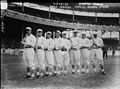 The NL champion New York Giants baseball team, 1913. Fred Merkle, sixth in line, had committed a baserunning gaffe in a crucial 1908 game that became famous as Merkle's Boner. (from History of baseball)
 -

-
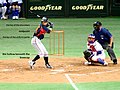 The strike zone determines the result of most pitches, and varies in vertical length for each batter. (from Baseball)
 -
 President George W. Bush taking advice before throwing the first pitch of World Series game 3, weeks after 9/11 (from Baseball)
 -
 The typical motion of a right-handed pitcher (from Rules of baseball)
 -

-
 Diagram of a baseball diamond (from Rules of baseball)
 -
 Pesäpallo, a Finnish variation of baseball, was invented by Lauri "Tahko" Pihkala in the 1920s, and after that, it has changed with the times and grown in popularity. Picture of Pesäpallo match in 1958 in Jyväskylä, Finland. (from Baseball)
 -

-
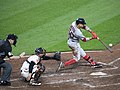
-
Diagram of a baseball field. Diamond may refer to the square area defined by the four bases or to the entire playing field. The dimensions given are for professional and professional-style games. Children often play on smaller fields. (from Baseball)
-

-
 The standard fielding positions (from Rules of baseball)
 -
By the 1860s Civil War, baseball (bottom) had overtaken its fellow bat-and-ball sport cricket (top) in popularity within the United States. (from History of baseball)
-
 A batter follows through after swinging at a pitched ball. (from Rules of baseball)
 -
 The American Tobacco Company's line of baseball cards featured shortstop Honus Wagner of the Pittsburgh Pirates from 1909 to 1911. In 2007, the card shown here sold for $2.8 million. (from Baseball)
 -
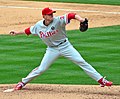 In May 2010, the Philadelphia Phillies' Roy Halladay pitched the 20th major league perfect game. That October, he pitched only the second no-hitter in MLB postseason history. (from History of baseball)
 -
-
 Sadaharu Oh managing the Japan national team in the 2006 World Baseball Classic. Playing for the Central League's Yomiuri Giants (1959–80), Oh set the professional world record for home runs. (from Baseball)
 -
 Pick-off attempt on runner (in red) at first base (from Rules of baseball)
 -
-
 A runner sliding into home plate and scoring. (from Baseball)
 -
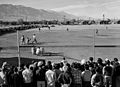 Japanese-Americans spectating a World War II-era game while in an internment camp. America's ties to immigrants and to Japan have been deeply shaped by a shared baseball heritage. (from History of baseball)
 -
 Rickey Henderson—the major leagues' all-time leader in runs and stolen bases—stealing third base in a 1988 game (from Baseball)
 -
-
 Pitchers are generally substituted during mound visits (team gatherings at the pitcher's mound). (from Rules of baseball)
 -
 David Ortiz, the batter, awaiting a pitch, with the catcher and umpire (from Baseball)
 -
 Jackie Robinson in 1945, with the era's Kansas City Royals, a barnstorming squad associated with the Negro American League's Kansas City Monarchs (from History of baseball)
 -
Sadaharu Oh managing the Japan national team in the 2006 World Baseball Classic. Playing for the Central League's Yomiuri Giants (1959–80), Oh set the professional world record for home runs with 868. (from History of baseball)
-
 2013 World Baseball Classic championship match between the Dominican Republic and Puerto Rico, March 20, 2013 (from Baseball)
 -
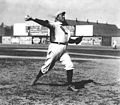 Cy Young—the holder of many major league career marks, including wins and innings pitched, as well as losses—in 1908. MLB's annual awards for the best pitcher in each league are named for Young. (from Baseball)
 -
 A well-worn baseball (from Baseball)
 -
 A pitcher handing off the ball after being taken out of the game during a mound meeting. (from Baseball)
 -
 Fenway Park, home of the Boston Red Sox. The Green Monster is visible beyond the playing field. (from Baseball)
 -
 Cover of Official Base Ball Rules, 1921 edition, used by the American League and National League (from Rules of baseball)
 -
 Baserunners generally stand a short distance away from their base between pitches, preparing themselves to either go back or steal the next base. (from Rules of baseball)
 -
 Diagram indicating the standard layout of positions (from Baseball)
 -
 A New York Yankees batter (Andruw Jones) and a Boston Red Sox catcher at Fenway Park (from Baseball)
 -
The strike zone, which determines the outcome of most pitches, varies in vertical length depending on the batter's typical height while swinging. (from Rules of baseball)

.jpg)


.jpg)
_(LOC).jpg)


.jpg)


.jpg)


.jpg)


.jpg)

.jpg)


 Good articles -

-
Lyman Gilbert Linde (September 30, 1920 – October 24, 1995) was an American right-handed pitcher in Major League Baseball who played for the Cleveland Indians in the American League for two seasons. In four career games, Linde pitched 10+2⁄3 innings and had a 6.75 earned run average (ERA).
Born and raised in Wisconsin, Linde first played professionally with the Green Bay Bluejays. After a season with them, he enlisted in the armed forces for World War II, and joined the Greenville Spinners upon his return to baseball. During the next two seasons he spent some time with the Cleveland Indians, but mainly remained with the Indians' minor league teams. After a year each in Oklahoma City, Baltimore, and San Diego, he spent the last four years of his career pitching for the Portland Beavers. He retired at the end of the 1953 season and died in 1995. (Full article...) -
Ben Daniel Revere (born May 3, 1988) is an American former professional baseball outfielder. He played in Major League Baseball (MLB) for the Minnesota Twins, Philadelphia Phillies, Toronto Blue Jays, Washington Nationals, and Los Angeles Angels.
Revere played baseball at Lexington Catholic High School, where he received several awards during his junior and senior seasons. Revere was selected in the first round of the 2007 Major League Baseball draft by the Minnesota Twins and played in their farm system for three seasons before being called up to Major League Baseball in late 2010. He played with the Twins for two more seasons before being traded to the Phillies in the 2012 offseason. (Full article...) -
The 2013 American League Wild Card tie-breaker game was a one-game extension to Major League Baseball's (MLB) 2013 regular season, played between the Texas Rangers and Tampa Bay Rays to determine the second participant in the 2013 American League (AL) Wild Card Game. It was played at the Globe Life Park in Arlington on September 30, 2013. The Rays defeated the Rangers, 5–2, and advanced to the AL Wild Card Game against the Cleveland Indians at Progressive Field, which they won 4–0; the Rangers failed to qualify for the postseason.
The tie-breaker game was necessary after both teams finished the season with win–loss records of 91–71 and thus tied for the second Wild Card position in the AL. The Rangers were awarded home field for the game, as they won the regular season series against the Rays, 4–3. The game was televised on TBS. It was the fourth tie-breaker in MLB history for a Wild Card spot, although it was the first when MLB used the format of two Wild Card teams playing in a Wild Card Game from 2012 to 2021. The tie-breaker counted as the 163rd regular season game for both teams, with all events in the game added to regular season statistics. (Full article...) -
Allen Thomas Craig (born July 18, 1984) is an American former professional baseball outfielder and first baseman. He played in Major League Baseball (MLB) for the St. Louis Cardinals and Boston Red Sox. The Cardinals drafted Craig from the University of California, Berkeley, in 2006, and he made his Major League debut with them in 2010.
Each season in the minor leagues from 2007 to 2009, Craig finished with a batting average of over .300 with at least 20 home runs. A .306 career hitter in MLB through 2013, he increased his production with runners in scoring position (RISP). In 2012, he posted a .400 batting average with RISP. The next season, he raised that figure to .454, the third-highest average of all time. (Full article...) -
Ranger José Suárez Gomez (born August 26, 1995) is a Venezuelan professional baseball pitcher for the Boston Red Sox of Major League Baseball (MLB). He has previously played in MLB for the Philadelphia Phillies.
The Phillies signed Suárez, a native of Pies de Cuesta, as an international free agent in 2012. His first season in the Venezuelan Summer League (VSL) was cut short by a drug suspension, but he returned to pitch in the VSL for two more seasons. In 2014, after giving up only one walk for the duration of the season, he began to attract the attention of the Phillies organization, and he was moved to the Rookie League the following year. Suárez's stock continued to rise in 2016 when he pitched a no-hitter with the Williamsport Crosscutters. In 2017 and 2018, he continued to rise through the Phillies' farm system, spending time in Double-A and Triple-A as a starting pitcher with a high strikeout rate. (Full article...) -
Edward James Blake (December 23, 1925 – April 15, 2009) was an American professional baseball pitcher. He played parts of four seasons in Major League Baseball (MLB) with the Cincinnati Reds and the Kansas City Athletics. In eight career games, Blake pitched 8+2⁄3 innings and recorded an 8.31 earned run average (ERA).
After graduating from high school in East St. Louis, Illinois, Blake signed with the St. Louis Cardinals and played in their minor league system before enlisting in the United States Army during World War II. He returned to baseball after being wounded in action, spending five years in the minors before making his MLB debut with the Cincinnati Reds in 1951. He appeared intermittently for the Reds over three seasons before joining the Toronto Maple Leafs of the International League, where he pitched for six years. (Full article...) -
On September 30, 1984, Mike Witt of the California Angels threw a perfect game against the Texas Rangers at Arlington Stadium. It was the 11th perfect game in Major League Baseball (MLB) history. Witt threw 94 pitches, struck out 10 of the 27 batters he faced, and had a game score of 97.
Witt's perfect game occurred on the final day of the 1984 MLB season. Both the Angels and Rangers had already been eliminated from playoff contention, and as a result, a small crowd of 8,375 people attended the game. The opposing pitcher was Charlie Hough, who threw a complete game and allowed one unearned run. Of the 27 batters Witt faced, only a few threatened to reach base. Larry Parrish hit a ground ball that forced third baseman Doug DeCinces to make a barehanded throw in the fifth inning. Parrish also hit a long fly out in the eighth inning that Witt initially assumed was going to be a home run. (Full article...) -
Matthew Russell Downs Sr. (born March 19, 1984) is an American former professional baseball infielder. He played in Major League Baseball (MLB) for the San Francisco Giants and Houston Astros. He bats and throws right-handed. He stands 6 feet 1 inch (1.85 m) tall and weighs 190 pounds (86 kg).
Downs attended Shelton State Community College and the University of Alabama; he was drafted out of Alabama by the San Francisco Giants in 2006. Despite being a 36th round draft pick, Downs reached the major leagues in 2009, starting at second base temporarily for the Giants during the season. He played a few games with them in 2010 before he was claimed off waivers by the Houston Astros in August. Downs spent the entire 2011 season in the major leagues, batting .276 and leading the major leagues with 15 pinch-hit RBI. In 2012, his average dropped to .202. Following the season, the Astros made him a free agent. He signed a minor league contract with the Miami Marlins in 2013, spending the season in the minor leagues before getting released. Currently, Downs is the head coach of Marion Military Institute baseball team. (Full article...) -
Cody James Bellinger (born July 13, 1995) is an American professional baseball outfielder and first baseman for the New York Yankees of Major League Baseball (MLB). He has previously played in MLB for the Los Angeles Dodgers and Chicago Cubs. He was selected by the Dodgers in the fourth round of the 2013 MLB draft and debuted with them in 2017.
The son of MLB player Clay Bellinger, Bellinger helped his team reach the 2007 Little League World Series at the age of 11. He played high school baseball for Hamilton High School in Chandler, Arizona. Bellinger spent two years in the Rookie Leagues before joining the Rancho Cucamonga Quakes in 2015, where he was a mid- and postseason all-star, and helped the team to a California League championship title. A hip injury delayed his rise through the Dodgers' farm system in 2016, but he was called up to the major leagues in April 2017 to bolster a struggling outfield. (Full article...) -
Francisco "Pancho" Coimbre Atiles (29 January 1909 – 4 November 1989), more commonly known as Pancho Coimbre, was a Puerto Rican professional baseball player. He played four seasons with the New York Cubans of the Negro leagues from 1940 to 1944.
Coimbre was born in the municipality of Coamo and moved to Ponce early in his life. It was in Ponce where he would begin to actively participate in sports, both in sprinting and baseball. Coimbre played thirteen seasons in the Puerto Rican Professional Baseball League (LBPPR), with the Leones de Ponce. During this period the team won five league championships. He finished his career with an average of .337, and had an average of 2.2 strikeouts per season, this included four consecutive seasons from 1939 to 1942, without any strikeouts. Coimbre also won two LBPPR batting titles and the league's Most Valuable Player Award in 1943. (Full article...) -
Brian Lee Traxler (September 26, 1967 – November 19, 2004) was a first baseman in Major League Baseball (MLB) who played for the Los Angeles Dodgers during their 1990 season. Listed at 5 feet 10 inches (1.78 m) and 200 pounds (91 kg), Traxler batted and threw left-handed. Throughout his career, he was one of the most popular players on his baseball teams.
Born in Waukegan, Illinois, Traxler began playing baseball while just a toddler. After an All-State career at Waukegan East High School, he attended the University of New Orleans, where he set a school record with 49 home runs in a three-year career. Drafted by the Dodgers in the 16th round of the 1988 MLB draft, he was called up to join the team in 1990. Playing in nine games for Los Angeles, he had one hit, a double against Dennis Martínez. (Full article...) -
John William Heisman (/ˈhaɪzmən/ HYZE-mən; October 23, 1869 – October 3, 1936) was an American sportsman, writer, and actor. He was a player and coach of American football, baseball, and basketball, and served as the head football coach at Oberlin College, Buchtel College (now known as the University of Akron), Auburn University, Clemson University, Georgia Tech, the University of Pennsylvania, Washington & Jefferson College, and Rice University, compiling a career college football record of 186–70–18.
Heisman was also the head basketball coach at Georgia Tech, tallying a mark of 9–14, and the head baseball coach at Buchtel, Clemson, and Georgia Tech, amassing a career college baseball record of 199–108–7. He served as the athletic director at Georgia Tech and Rice. While at Georgia Tech, he was also the president of the Atlanta Crackers baseball team. (Full article...) -
Michael Kendall Flanagan (December 16, 1951 – August 24, 2011) was an American professional baseball left-handed pitcher, front office executive, and color commentator. He spent 18 years as a player in Major League Baseball (MLB) with the Baltimore Orioles (1975–1987, 1991–1992) and the Toronto Blue Jays (1987–1990).
Flanagan was a starting pitcher for the Orioles from 1975 through 1987. He was named to the American League (AL) All-Star Team once in 1978. In 1979, the first of two years he would play on an AL pennant winner, his 23 victories led the circuit and earned him the AL's Cy Young Award. He was a member of the Orioles' World Series Championship team in 1983. During the 1987 season, he was traded to the Toronto Blue Jays, with whom he pitched through 1990. He returned to Baltimore to close out his playing career as a relief pitcher in 1991 and 1992. During this second tour, he combined with three other pitchers to throw a no-hitter against the Oakland Athletics on July 13, 1991. He was also the last Orioles pitcher to appear in a major-league contest at Memorial Stadium. In an 18-season career, Flanagan posted a 167–143 record with 1,491 strikeouts and a 3.90 earned run average in 2,770 innings pitched. (Full article...) -
Edward Charles Storm (October 2, 1907 – June 4, 1950) was an American professional football halfback and coach. From Salinas, California, he played college football for the Santa Clara Broncos for one season. Afterwards, he played professional football locally and then with a team in Memphis, Tennessee. He joined the Philadelphia Eagles of the National Football League (NFL) and played two seasons with them, being their leading passer in 1935. Storm later returned to California where he played for and coached a number of teams over the next decade.
Storm founded the Salinas Iceberg Packers, the first football team based in the city, and ran it for three seasons as a player-coach. He played for and coached multiple all-star teams and was head coach of the Oakland Oaks, the first professional team based in Oakland, in 1939. He became a player-coach for the San Diego Bombers of the Pacific Coast Professional Football League (PCFL) in 1941, coaching them for three seasons and playing in two, while leading them to two league championships. He then coached two other San Diego-based teams from 1944 to 1945 to conclude his career. He died in a car crash in 1950, at age 42. (Full article...) -
Jason Michael Kipnis (born April 3, 1987; nicknamed "Kip") is an American former professional baseball second baseman. He played in Major League Baseball (MLB) for the Cleveland Indians and Chicago Cubs. He attended Glenbrook North High School in the suburbs of Chicago where he earned three letters playing baseball for the Glenbrook North Spartans. He attended the University of Kentucky, but transferred to Arizona State University after two years. In college, Kipnis was an All-American and the 2009 Pacific-10 Conference Player of the Year for the Sun Devils.
The Indians selected Kipnis in the second round of the 2009 Major League Baseball draft. In 2010, he was named the Indians' Minor League Player of the Year, and a Baseball America Minor League All Star. Prior to the 2011 season, Baseball Prospectus ranked him as the top Indians prospect and the 28th-highest prospect in baseball. At mid-season, Baseball America rated him as baseball's 31st-best prospect. He was called up from the minor leagues on July 22, 2011. In 2012, he became the starting second baseman for the Indians. (Full article...)


_(cropped).jpg)


.jpg)


Did you know (auto-generated) -

- ... that the injuries Anthony W. Case suffered in a school shooting led him to give up baseball and turn to astrophysics as a career?
- ... that Mark Hutton was the first Australian to be a starting pitcher in a Major League Baseball game?
- ... that in 2024 Yang Nien-hsi became the first University of Taipei player to sign with a Major League Baseball team since 2008?
- ... that baseball player Ed Stone may have been born on January 2, 1909, or August 21, 22, or 23, 1909, or August 21 or August 22, 1910?
- ... that Lee Blessing called his baseball play Cobb a "one-man play for four men"?
- ... that a committee rejected six designs for the National Baseball Hall of Fame commemorative coins before approving a seventh, which was sketched during the meeting?
- ... that by 2006, Catholic sister Rosalind "Sister Roz" Gefre had given an estimated 7,000 massages at St. Paul Saints baseball games?
- ... that Rickey Henderson was the first American League baseball player to join the 20–50 club?
Quotes
Featured lists -
-

The Vancouver Canadians have played at Nat Bailey Stadium since their founding in 2000.
The Vancouver Canadians are a Minor League Baseball team based in Vancouver, British Columbia, that plays in the Northwest League (NWL). The team was founded after the original Vancouver Canadians relocated to Sacramento, California, days after winning the Triple-A World Series in 1999, and the Southern Oregon Timberjacks relocated to Vancouver, assuming the Canadians identity, for the 2000 Northwest League season. The Canadians were affiliated with the Oakland Athletics from 2000 to 2010, but have been affiliated with the Toronto Blue Jays since 2011. In conjunction with the 2021 restructuring of the minor leagues, the Canadians were upgraded from the Short-Season A class to the High-A class and were placed in the new High-A West (A+W) in 2021. This league was renamed the Northwest League in 2022.
The team has played 2,157 regular-season games and compiled a win–loss record of 1,112–1,045, resulting in a winning percentage of .516. The Canadians' best regular-season record occurred three times; in 2005, 2012 and 2014 with a record of 46–30 (.605). Conversely, their worst record was 29–45 (.392), which they recorded in 2016. The Canadians have won five Northwest League championships (2011, 2012, 2013, 2017 and 2023). They have also claimed seven division titles, including four consecutive division championships from 2011 to 2014. The team also has won two first-half titles, and six second-half titles. (Full article...) -

Mark Teixeira (2001) played 162 games for the Rangers in back-to-back seasons and finished second in the MVP voting in 2009.
The Texas Rangers are a Major League Baseball (MLB) franchise based in the Dallas–Fort Worth metropolitan area. They play in the American League West division. Before 1972 (and for the first seven years of the draft), they were known as the Washington Senators and based in Washington, D.C. Since the institution of MLB's Rule 4 Draft, the Rangers franchise has selected 68 players in the first round. Officially known as the "First-Year Player Draft", the Rule 4 Draft is MLB's primary mechanism for assigning amateur baseball players from high schools, colleges, and other amateur baseball clubs to its teams. The draft order is determined based on the previous season's standings, with the team possessing the worst record receiving the first pick. In addition, teams which lost free agents in the previous off-season may be awarded compensatory or supplementary picks.
Of the 71 players picked in the first round by Washington or Texas, 37 have been pitchers, the most of any position; 27 of these were right-handed, while 10 were left-handed. Twelve outfielders, nine third basemen, six shortstops, four catchers, two first basemen, and one second baseman were also taken. Fourteen of the players came from high schools or colleges in the state of Texas, and California follows with ten players. The Rangers have drafted one player, Tanner Scheppers in 2009, who was playing in the American Association of Independent Professional Baseball at the time of the draft. Scheppers was originally drafted by the Baltimore Orioles in the 29th round of the 2005 MLB draft, and by the Pittsburgh Pirates in the second round of the 2008 MLB draft. (Full article...) -

Orlando Hernández won gold with the Cuban team in the 1992 Summer Olympics, baseball's first appearance as an Olympic medal sport.
Baseball is a sport formerly contested at the Summer Olympic Games. It was originally played as a demonstration sport in seven Olympics—1912, 1936, 1952, 1956, 1964, 1984, and 1988— more than for any other sport in Olympic history. These exhibitions featured a single game at the first five Olympic appearances and then a tournament format in 1984 and 1988. The International Olympic Committee (IOC) granted baseball official status on October 13, 1986, for the 1992 Summer Olympics. The sport was contested at each subsequent Games through 2008, after which the IOC removed it from the roster of Olympic sports.
In 1992, the first official Olympic baseball tournament was won by the Cuban team. Cuba had boycotted the 1984 and 1988 Olympics, missing the previous exhibition baseball tournaments, but entered in 1992 as the favorite, having won the past 12 world championships and with a 62–1 record in international competitions since 1986. The Cubans went undefeated in the 1992 Olympics and trailed in only one game. They went undefeated again at the 1996 Olympics en route to a second consecutive gold medal. The United States won their first medal (bronze) in the 1996 Olympics and then won gold at the 2000 Summer Olympics. 2000 was the first Olympics in which Cuba lost a game: first to the Dutch team in round-robin play and then again to the Americans in the gold medal game. This was also the first time professional players were allowed to compete in baseball, though Major League Baseball (MLB) did not permit any player on the 40-man roster of an MLB team to compete. In 2004, the reigning gold medalist United States did not qualify for the Olympic tournament, while the Cuban team won its third gold medal. (Full article...) -

Hank Aaron, the holder of ten franchise records for the Braves
The Atlanta Braves are a Major League Baseball (MLB) franchise based in Atlanta. The Braves formed in 1871 as the Boston Red Stockings. After moving in 1953 to Milwaukee for 12 years and a World Series Championship in '57, the Braves relocated to Atlanta in 1966. Through 2010, the Braves have played 20,053 games, winning 9,945, losing 9,954, and tying 154, for a winning percentage of approximately .500. This list documents the superlative records and accomplishments of team members during their tenures in MLB.
Hank Aaron holds the most franchise records as of the end of the 2010 season, with ten, including most career hits, doubles, and the best career on-base plus slugging percentage. Aaron also held the career home runs record from April 8, 1974 until August 8, 2007. He is followed by Hugh Duffy, who holds eight records, including best single-season batting average and the best single-season slugging percentage record. (Full article...) -

Barry Bonds, the all-time career home run leader in Major League Baseball, led the league in home runs twice including in 2001 when he set the record single-season mark
In baseball, a home run is scored when the ball is hit so far that the batter is able to circle all the bases ending at home plate, scoring himself plus any runners already on base, with no errors by the defensive team on the play. An automatic home run is achieved by hitting the ball on the fly over the outfield fence in fair territory. More rarely, an inside-the-park home run occurs when the hitter reaches home plate while the baseball remains in play on the field. In Major League Baseball (MLB), a player in each league[L] wins the home run title each season by hitting the most home runs that year. Only home runs hit in a particular league count towards that league's seasonal lead. Mark McGwire, for example, hit 58 home runs in 1997, more than any other player that year. However, McGwire was traded from the American League's (AL) Oakland Athletics to the National League's (NL) St. Louis Cardinals midway through the season and his individual AL and NL home run totals (34 and 24, respectively) did not qualify to lead either league.
The first home run champion in the National League was George Hall. In the league's inaugural 1876 season, Hall hit five home runs for the short-lived National League Philadelphia Athletics. In 1901, the American League was established and Hall of Fame second baseman Nap Lajoie led it with 14 home runs for the American League Philadelphia Athletics. Over the course of his 22-season career, Babe Ruth led the American League in home runs twelve times. Mike Schmidt and Ralph Kiner have the second and third most home run titles respectively, Schmidt with eight and Kiner with seven, all won in the National League. Kiner's seven consecutive titles from 1946 to 1952 are also the most consecutive home run titles by any player. (Full article...) -
In baseball, earned run average (ERA) is a statistic used to measure the performance of pitchers. It is determined by dividing the number of earned runs allowed by the number of innings pitched, and multiplying by nine.[a]
Major League Baseball recognizes the player in each league[b] with the lowest earned run average each season.[c] The first ERA champion in the National League was George Bradley; in the National League's inaugural 1876 season, Bradley posted a 1.23 ERA for the St. Louis Brown Stockings, allowing 78 earned runs in 573 innings pitched. The American League was established in 1901, and Hall of Fame pitcher Cy Young led that league with a 1.62 ERA for the Boston Americans during the 1901 season. (Full article...) -
The Silver Slugger Award has been awarded annually since 1980 to the best offensive player at each position in both the American League (AL) and the National League (NL), as determined by the coaches and managers of Major League Baseball (MLB).
These voters consider several offensive statistics, including batting average, slugging percentage, and on-base percentage, as well as their "general impressions of a player's overall offensive value". They are not permitted to vote for players on their team. (Full article...) -
The All-Star Final Vote was an annual Internet and text message ballot by Major League Baseball (MLB) fans to elect the final player for each team that participates in the Major League Baseball All-Star Game, after all other selections were made and announced. The first 33 players were selected by a combination of procedures. The sponsorship changed annually, but the contest remained similar from year to year. Each league presented a five-man ballot and gave the fans a few days to choose one final All-Star. This process was used from 2002 through 2018. (Full article...) -

Madison Bumgarner, the 2014 National League Championship Series Most Valuable Player, won both this award and the World Series MVP in the same season.
The League Championship Series Most Valuable Player (MVP) Award is given annually to the Major League Baseball (MLB) players deemed to have the most impact on their teams' performances in each of the two respective League Championship Series that comprise the penultimate round of the MLB postseason. The award is given separately for a player in both the American League Championship Series and the National League Championship Series. It has been presented in the National League (NL) since 1977, and in the American League (AL) since 1980. Dusty Baker won the inaugural award in 1977 with the Los Angeles Dodgers, and Frank White won the first AL award in 1980 with the Kansas City Royals. Twelve LCS MVP winners have been elected to the Baseball Hall of Fame: Roberto Alomar, George Brett, Dennis Eckersley, Rickey Henderson, David Ortiz, Kirby Puckett, CC Sabathia, Ozzie Smith, Mariano Rivera, Iván Rodríguez, John Smoltz, and Willie Stargell.
Three players have won the award twice: Steve Garvey (1978, 1984), Dave Stewart (1990, 1993), and Orel Hershiser (1988, 1995). Incidentally, all three of these players won their two awards with two different teams. Building off of this, Garvey is the only player to win NLCS MVP twice, Stewart the only player to win ALCS MVP twice, and Hershiser the only one to win in both leagues. Nine players have gone on to win the World Series MVP Award in the same season in which they won the LCS MVP—eight from the NL and one from the AL. Three players have won while playing for the losing team in the series: Fred Lynn played for the 1982 California Angels; Mike Scott pitched for the 1986 Houston Astros; and Jeffrey Leonard played for the 1987 San Francisco Giants. Two players have shared the award in the same year three times, all in the NL; Rob Dibble and Randy Myers for the 1990 Cincinnati Reds, the Chicago Cubs' Jon Lester and Javier Báez in 2016, and Chris Taylor and Justin Turner of the Los Angeles Dodgers in 2017. (Full article...) -
The New York Mets are a professional Major League Baseball (MLB) franchise based in New York City, New York in the borough of Queens. They play in the National League East division. In the history of the Mets, there have been 23 managers that managed a game including four interim managers. Of those managers, only Joe Torre was a player-manager (a manager who also plays for the team); Yogi Berra did play four games while he was a coach for the Mets in 1965. Gil Hodges, Roy McMillan, Bud Harrelson, Mike Cubbage, Dallas Green, Bobby Valentine and Willie Randolph all also played in MLB for the Mets prior to becoming the team's manager.
The Mets posted their franchise record for losses in their inaugural season in the league, with 120 losses in 160 games in 1962. This was the first of seven consecutive losing seasons, a season in which the winning percentage was below .500, and the most losses by a post-1900 MLB team. During this stretch from 1962 to 1968, the Mets employed four managers. Seven managers have taken the Mets to the postseason; Davey Johnson, Bobby Valentine and Terry Collins have led the team to two playoff appearances each. Johnson and Gil Hodges are the only Mets managers to win a World Series: Hodges in 1969 against the Baltimore Orioles; and Johnson in 1986 against the Boston Red Sox. Terry Collins is the longest-tenured manager in franchise history, with 1,134 games of service over 7 seasons. (Full article...) -
The Major League Baseball Most Valuable Player Award (MVP) is an annual Major League Baseball (MLB) award given to one outstanding player in the American League (AL) and one in the National League (NL). The award has been presented by the Baseball Writers' Association of America (BBWAA) since 1931. (Full article...) -
In its 125-year history, the Baltimore Orioles baseball franchise of Major League Baseball's American League has employed 42 managers. The duties of the team manager include team strategy and leadership on and off the field. Of those 42 managers, 12 have been "player-managers"; specifically, they managed the team while still being signed as a player. Since 1992, the team has played its home games at Oriole Park at Camden Yards.
The Baltimore franchise began operations in Milwaukee, Wisconsin, as the Brewers (not to be confused with the current National League team of the same name) in 1901. After one season in Wisconsin under manager and Hall of Famer Hugh Duffy, the franchise moved south to St. Louis, Missouri, adopting the St. Louis Browns name and hiring a new manager, Jimmy McAleer. The Browns remained in Missouri until the end of the 1953 season, when Major League Baseball's owners elected to move the franchise to Baltimore, Maryland, where they were renamed the Orioles, after Maryland's state bird. (Full article...) -

The 1987 Stars finished with a 74–70 (.514) record playing as the Double-A affiliate of the Oakland Athletics in the Southern League.
The Huntsville Stars were a Minor League Baseball team that played in Huntsville, Alabama, in the Southern League (SL) for 30 seasons from 1985 to 2014, at the Double-A level. Huntsville was affiliated with Major League Baseball's Oakland Athletics (1985–1998) and Milwaukee Brewers (1999–2014). The club played 4,211 regular-season games and compiled a win–loss record of 2,112–2,099 (.502). They appeared in the postseason on 14 occasions in which they had a record of 44–45 (.494) in 89 games. Combining all 4,300 regular-season and postseason games, Huntsville had an all-time record of 2,156–2,144 (.501).
The Stars began play in 1985 after the Nashville Sounds' Southern League franchise was relocated from Nashville, Tennessee, to Huntsville in 1985. The team remained in the league until relocating to Biloxi, Mississippi, after the 2014 campaign and becoming the Biloxi Shuckers. (Full article...) -

Zack Greinke, drafted in 2002, is the only Royals' first-round pick to win a Cy Young Award with the team.
The Kansas City Royals are a Major League Baseball franchise based in Kansas City, Missouri. The franchise, founded in 1969, plays in the American League Central division. Since the institution of Major League Baseball's Rule 4 Draft, the Royals have selected 57 players in the first round. Officially known as the "First-Year Player Draft", the Rule 4 Draft is Major League Baseball's primary mechanism for assigning amateur players from high schools, colleges, and other amateur baseball clubs to its franchises. The draft order is determined based on the previous season's standings with the team that had the worst record receiving the first pick. In addition, teams that lost free agents in the previous off-season may be awarded compensatory or supplementary picks. The First-Year Player Draft is unrelated to the 1968 expansion draft in which the Royals initially filled their roster.
Of the 57 players first-round draft picks, 31 have been pitchers, the most of any position; 20 of these were right-handed, while 11 were left-handed. Twelve outfielders were selected, and eight shortstops, three catchers, and two third basemen were taken. The team also selected one player at first base, but has never drafted a second baseman. Fifteen of the players came from institutions in the state of California, while Florida and Texas follow with seven players each. The Royals have drafted two players, Luke Hochevar (2006) and Aaron Crow (2009), who were playing in the American Association of Independent Professional Baseball draft. Both had been drafted previously by other major league teams but had chosen to play for the Fort Worth Cats instead. They have also drafted one player from Puerto Rico: Juan Lebron (1995). (Full article...) -

The Nashville Sounds ownership group consisted of 15 shareholders in their inaugural 1978 season. (Top row, from left: Bob Elliott, Billy Griggs, Jimmy Miller, Walter Nipper, Farrell Owens; Middle row: Jerry Reed, Larry Schmittou, Cal Smith, Gene Smith, Marcella Smith; Bottom row: Reese Smith Jr., Reese Smith III, Steven Smith, Conway Twitty, and L. E. White)
The Nashville Sounds Minor League Baseball team has played in Nashville, Tennessee, since being established in 1978 as an expansion team of the Double-A Southern League. They moved up to Triple-A in 1985 as members of the American Association before joining the Pacific Coast League in 1998. They were placed in the Triple-A East in 2021, but this became the International League in 2022. The Sounds were originally owned by a local group, headed by Larry Schmittou, which included baseball figures, country musicians, and businessmen. Shares in the team have subsequently changed hands multiple times. Since 2009, the Sounds have been owned by MFP Baseball, composed of real estate investors Masahiro Honzawa and Frank Ward.
In the franchise's history, 15 general managers (GMs) have been employed to oversee day-to-day operations. Among the responsibilities of the general manager are overseeing ticket and advertising sales, developing corporate relationships, managing front office and game-day staff, and maintaining the team's player development license with their Major League Baseball affiliate. The longest-tenured general manager is Larry Schmittou with 13 years of service to the team in that role from 1980 to 1982 and 1987 to 1996. Adam English has been the Sounds' GM since October 2021. (Full article...)
.jpg)


-edit3.jpg)


.jpg)


More did you know
- ... that after future all-star Phil Nevin was taken first overall in the 1992 Major League Baseball Draft, Houston Astros' scout Hal Newhouser quit, protesting that the club should have taken Derek Jeter instead?
- ... that 21-year-old Danny Duffy's abrupt retirement from the Kansas City Royals organization in 2010 reminded many of when Zack Greinke left the baseball club in 2006?
- ... that Rudy Árias was a replacement player during the 1994–95 Major League Baseball strike, though he retired as a player in 1979?
- ... that Koji Mitsui was unsuccessfully posted to Major League Baseball twice in one offseason?
- ... that baseball executives thought that Toe Nash was a hoax, similar to Sidd Finch?
Sports portals


Selected picture

Ebbets Field was a Major League Baseball park located in the Flatbush section of Brooklyn, New York. It was the home of the Brooklyn Dodgers of the National League. Two different incarnations of a Brooklyn Dodgers football team also played at the stadium. The park opened on April 9, 1913, and was demolished in 1960, three years after the team relocated to Los Angeles.
Associated Wikimedia
The following Wikimedia Foundation sister projects provide more on this subject:
-
 Commons
Free media repository -
 Wikidata
Free knowledge base -
 Wikiquote
Collection of quotations -
 Wikisource
Free-content library -
 Wikiversity
Free learning tools -
 Wiktionary
Dictionary and thesaurus


