Wiki Article
Portal:Edinburgh
Nguồn dữ liệu từ Wikipedia, hiển thị bởi DefZone.Net

The Edinburgh Portal
Welcome! — Fàilte! — Walcome!
-

 Edinburgh castle and Balmoral Hotel clock tower at night.
 -

-
 Old town Skyline.
 -
 Arthur's Seat and Salisbury Crags, part of Holyrood Park.
 -
 Edinburgh panorama from Calton Hill, early evening .
 -
 View across Calton Hill monuments to Firth of Forth and Fife beyond.
 -


_P-EDI_Banner.jpg)


_P-EDI_Banner.jpg)

Edinburgh is the capital city of Scotland and one of its 32 council areas. It is located in southeast Scotland and is bounded to the north by the Firth of Forth and to the south by the Pentland Hills. Edinburgh had a population of 506,520 in 2020, making it the second-most-populous city in Scotland and the seventh-most-populous in the United Kingdom. The wider metropolitan area had a population of 912,490 in the same year.
Recognised as the capital of Scotland since at least the 15th century, Edinburgh is the seat of the Scottish Government, the Scottish Parliament, the highest courts in Scotland, and the Palace of Holyroodhouse, the official residence of the British monarch in Scotland. It is also the annual venue of the General Assembly of the Church of Scotland. The city has long been a centre of education, particularly in the fields of medicine, Scottish law, literature, philosophy, the sciences and engineering. The University of Edinburgh was founded in 1582 and is now one of four universities in the city. The financial centre of Scotland, Edinburgh was ranked as the second-largest financial centre in the United Kingdom, the fourth-largest in Europe, and the thirteenth-largest in the world in the Global Financial Centres Index in 2020.
The city is a cultural centre, and is the home of institutions including the National Museum of Scotland, the National Library of Scotland, and the Scottish National Gallery. The city is also known for the Edinburgh International Festival and the Fringe, the latter being the world's largest annual international arts festival. Historic sites in Edinburgh include Edinburgh Castle, the Palace of Holyroodhouse, St Giles' Cathedral, Greyfriars Kirk, Canongate Kirk and the extensive Georgian New Town built in the 18th and 19th centuries. The Old Town and the New Town are together listed as a World Heritage Site by UNESCO, and the site has been managed by Edinburgh World Heritage since 1999. The city's historical and cultural attractions have made it Britain's second-most-visited tourist destination, attracting 5.3 million visits, including 2.4 million from overseas, in 2023. (Full article...)
Selected location article
.jpg)
The Gordon Aikman Lecture Theatre is a category B listed performing arts and lecture theatre located in the historic George Square in Edinburgh. Primarily operated as a lecture theatre for the University of Edinburgh, it is also used for general theatre performances, as well as being a designated Edinburgh Fringe Festival venue.
In 2018 the university changed the name of the theatre—previously known as George Square Theatre—in memory of Gordon Aikman, a graduate of the university's business school who raised more than £500,000 for research funding into motor neurone disease. (Full article...)
Selected images
-
 The Dean Gallery, part of the Scottish National Gallery of Modern Art
 -
 Fountain at Holyrood Palace
 -
 Architecture in Edinburgh
 -
 Sir Walter Scott
 -
 View looking west along George Street
 -
 Edinburgh (from Salisbury Crags) by William Crozier, a painter associated with The Edinburgh School
 -
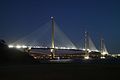 Queensferry Crossing road bridge
 -

-

-
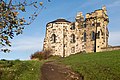 City Observatory, the Gothic Tower
 -

-
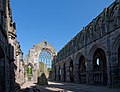 The ruins of Holyrood Abbey
 -
 The Governor's House
 -
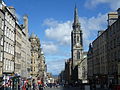 The High Street, part of the Royal Mile
 -

-
 Scottish baronial-style turrets on Victorian tenements in St. Mary's Street
 -
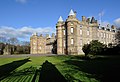 Holyrood Palace, the official residence of the British monarch in Scotland
 -
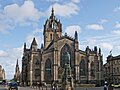 St Giles' Cathedral, the principal place of worship of the Church of Scotland in Edinburgh
 -
 Charlotte Square, a garden square in the New Town
 -
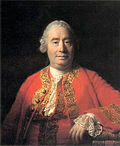 David Hume, Scottish philosopher, historian, economist, and essayist born in Edinburgh in 1711
 -
 Jenners Department Store, the oldest department store in Scotland
 -
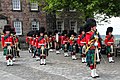 The Band of the Royal Regiment of Scotland in Edinburgh Castle
 -
 The Princes Street Gardens, the best known park in Edinburgh
 -
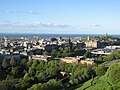 View over Edinburgh
 -
 The Castle Rock
 -
 Two Edinburgh Trams seen at the West End - Princes Street stop
 -
-
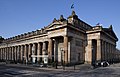
 The National Monument of Scotland (right) and Nelson Monument (left)
 -

-
 The BT building in Edinburgh Park
 -
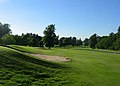 Ratho Park Golf Club

.jpg)


.jpg)

.jpg)

.jpg)


.jpg)


.jpg)


Selected transportation article

Edinburgh Waverley (also known simply as Edinburgh; Scottish Gaelic: Waverley Dhùn Èideann) is the principal railway station serving Edinburgh, Scotland. It is the second busiest station in Scotland, after Glasgow Central. The station serves as the northern terminus of the East Coast Main Line, 393 miles 13 chains (393.16 miles; 632.7 kilometres) from London King's Cross, although some trains operated by London North Eastern Railway continue to other Scottish destinations beyond Edinburgh. (Full article...)
Selected area article
.jpg)
The New Town is a central area of Edinburgh, the capital of Scotland. It was built in stages between 1767 and around 1850, and retains much of its original neo-classical and Georgian architecture. Its best-known street is Princes Street, facing Edinburgh Castle and the Old Town across the geological depression of the former Nor Loch. The area's New Town Gardens received a heritage designation in 2001. The combined New Town, Old Town, and West End were designated a UNESCO World Heritage Site in 1995. (Full article...)
Selected environment article

Cramond Island (Scottish Gaelic: Eilean Chair Amain) is one of several islands in the Firth of Forth in eastern Scotland, near Edinburgh. It lies off the foreshore at Cramond. It is 1⁄3 mile (0.54 km) long and covers 19.03 acres (7.70 ha). The island is part of the Dalmeny Estate, owned by the Rosebery Estates Partnership. (Full article...)
Did you know?
No recent additions
Selected arts article
.jpg)
Edinburgh's Hogmanay is the celebration and observance of Hogmanay—the Scottish celebration of the New Year—held in the capital city of Scotland, Edinburgh. The fireworks display at Edinburgh Castle are broadcast on television in Scotland, such as BBC Scotland's Hogmanay, as well as Hogmanay celebration broadcasts by STV. (Full article...)
Selected education article

Heriot-Watt University (Scottish Gaelic: Oilthigh Heriot-Watt) is a public research university based in Edinburgh, Scotland. It was established in 1821 as the School of Arts of Edinburgh, the world's first mechanics' institute, and was subsequently granted university status by royal charter in 1966. It is the eighth-oldest higher education institution in the United Kingdom. The name Heriot-Watt was taken from Scottish inventor James Watt and Scottish philanthropist and goldsmith George Heriot.
The annual income of the institution for 2024–25 was £293.9 million of which £52.3 million was from research grants and contracts, with an expenditure of £301.1 million. Known for its focus on science as well as engineering, it is one of the 23 colleges that were granted university status in the 1960s, and it is sometimes considered a plate glass university, like Lancaster and York. (Full article...)
Selected sports article
.jpg)
Meadowbank Stadium (officially the Meadowbank Sports Centre) is a multi-purpose sports facility located in the Meadowbank area of Edinburgh, Scotland. Built on the site of the earlier New Meadowbank and Old Meadowbank sports venues, it was originally built to host the 1970 Commonwealth Games. It also hosted the Games in 1986, becoming the first venue to host the Games twice. It is the current home of Scottish League Two side Edinburgh City.
The stadium has also regularly hosted football. It was the home ground of Scottish Football League team Meadowbank Thistle between 1974 and 1995, becoming the first all-seated football ground in the UK in the process, and subsequently hosted senior non-league football as the home ground of Edinburgh City. League football returned to Meadowbank in 2016 following City's promotion to the Scottish Professional Football League. The Meadowbank complex also hosts Leith Athletic, who first played on the Meadowbank 3G artificial pitch adjacent to the main stadium between 2013 and 2017. (Full article...)
Selected religion article
St Giles' Cathedral (Scottish Gaelic: Cathair-eaglais Naomh Giles), also known as the High Kirk of Edinburgh, is one of three cathedrals in Edinburgh, Scotland. The existing building was begun in the 14th century and extended until the early 16th century; significant alterations were undertaken in the 19th and 20th centuries, including the addition of the Thistle Chapel. St Giles' is closely associated with many events and figures in Scottish history, including John Knox, who served as the church's minister after the Scottish Reformation. The cathedral is administered by the Church of Scotland.
It was probably founded in the 12th century and dedicated to Saint Giles. The church was elevated to collegiate status by Pope Paul II in 1467. In 1559, the church became Protestant with John Knox, the foremost figure of the Scottish Reformation, as its minister. After the Reformation, St Giles' was internally partitioned to serve multiple congregations as well as secular purposes, such as a prison and as a meeting place for the Parliament of Scotland. In 1633, Charles I made St Giles' the cathedral of the newly created Diocese of Edinburgh. Charles' attempt to impose doctrinal changes on the presbyterian Scottish Kirk, including a Prayer Book causing a riot in St Giles' on 23 July 1637, which precipitated the formation of the Covenanters and the beginnings of the Wars of the Three Kingdoms. St Giles' role in the Scottish Reformation and the Covenanters' Rebellion has led to its being called "the Mother Church of World Presbyterianism". (Full article...)
Related portals


Categories

Topics


In the news
No recent news
Associated Wikimedia
The following Wikimedia Foundation sister projects provide more on this subject:
-
 Commons
Free media repository -
 Wikibooks
Free textbooks and manuals -
 Wikidata
Free knowledge base -
 Wikiquote
Collection of quotations -
 Wikisource
Free-content library -
 Wikiversity
Free learning tools -
 Wikivoyage
Free travel guide -
 Wiktionary
Dictionary and thesaurus


