Wiki Article
Portal:Scotland
Nguồn dữ liệu từ Wikipedia, hiển thị bởi DefZone.Net

_P-SCO_Banner.jpg)


_P-SCO_Panorama.jpg)
| Main Page | Selected articles 1 | Selected articles 2 | Selected biographies | Selected quotes | Selected pictures | Featured Content | Categories & Topics |
Introduction
 |

|
|

| ||
Scotland is a country that is part of the United Kingdom. It contains nearly one-third of the United Kingdom's land area, consisting of the northern part of the island of Great Britain and more than 790 adjacent islands, principally in the archipelagos of the Hebrides and the Northern Isles. In 2022, the country's population was about 5.4 million. Its capital city is Edinburgh, whilst Glasgow is the largest city and the most populous of the cities of Scotland. To the south-east, Scotland has its only land border with England; otherwise it is surrounded by the Atlantic Ocean to the north and west, the North Sea to the north-east and east, and the Irish Sea to the south. The legislature, the Scottish Parliament, elects 129 members to represent 73 constituencies. The Scottish Government is the executive arm of the devolved government, headed by the first minister, who chairs the cabinet and is responsible for government policy and international engagement.
The Kingdom of Scotland emerged as a sovereign state in the 9th century. Independence from England was maintained partly through an alliance with France. In 1603, James VI succeeded to the thrones of England and Ireland, forming a personal union of the three kingdoms. On 1 May 1707, Scotland and England combined to create the new Kingdom of Great Britain, with the Parliament of Scotland subsumed into the Parliament of Great Britain. In 1999, a Scottish Parliament was re-established, and has devolved authority over many areas of domestic policy. The country has its own distinct legal system, education system and religious history, which have all contributed to the continuation of Scottish culture and national identity. Scottish English and Scots are the most widely spoken languages in the country, existing on a dialect continuum with each other. Scottish Gaelic speakers can be found all over Scotland, but the language is largely spoken natively by communities within the Hebrides; Gaelic speakers now constitute less than 2% of the total population, although state-sponsored revitalisation attempts have led to a growing community of second language speakers.
The mainland of Scotland is broadly divided into three regions: the Highlands, a mountainous region in the north and north-west; the Lowlands, a flatter plain across the centre of the country; and the Southern Uplands, a hilly region along the southern border. The Highlands are the most mountainous region of the British Isles and contain its highest peak, Ben Nevis, at 4,413 feet (1,345 m). The region also contains many lakes, called lochs; the term is also applied to the many saltwater inlets along the country's deeply indented western coastline. The geography of the many islands is varied. Some, such as Mull and Skye, are noted for their mountainous terrain, while Tiree and Coll are flatter.
Selected article

St Andrews (Latin: S. Andrea(s); Scots: Saunt Aundraes; Scottish Gaelic: Cill Rìmhinn, pronounced [kʰʲɪʎˈrˠiː.ɪɲ]) is a town on the east coast of Fife in Scotland, 10 miles (16 kilometres) southeast of Dundee and 30 miles (50 kilometres) northeast of Edinburgh. St Andrews had a recorded population of 16,800 as of 2011[update], making it Fife's fourth-largest settlement and the 45th most populous settlement in Scotland.
The town is named after Saint Andrew the Apostle. The settlement grew to the west of St Andrews Cathedral, with the southern side of the Scores to the north and the Kinness Burn to the south. The burgh soon became the ecclesiastical capital of Scotland, a position which was held until the Scottish Reformation. The famous cathedral, the largest in Scotland, now lies in ruins. St Andrews is also known globally as the "home of golf". This is in part because of The Royal and Ancient Golf Club of St Andrews, founded in 1754, which until 2004 exercised legislative authority over the game worldwide (except in the United States and Mexico). The Old Course of St Andrews Links (acquired by the town in 1894) is the most frequent venue for The Open Championship.
It is home to the University of St Andrews, the third oldest university in the English-speaking world and the oldest in Scotland. It was ranked as the best university in the UK by the 2022 Good University Guide, which is published by The Times and The Sunday Times. According to other rankings, it is ranked as one of the best universities in the United Kingdom. The Martyrs Memorial, erected to the honour of Patrick Hamilton, George Wishart, and other martyrs of the Reformation epoch, stands at the west end of the Scores on a cliff overlooking the sea. The civil parish has a population of 18,421 (in 2011). The town also contains numerous museums, a botanic garden and an aquarium. (... Read the full article)
Selected quotes
-

" ... Celtic jerseys are not for second best, They don't shrink to fit inferior players ... "
— Jock Stein
" ... In every place, where there is any thing worthy of observation, there should be a short printed directory for strangers ... "
— James Boswell -
" ... I've got a great ambition to die of exhaustion rather than boredom ... "
— Thomas Carlyle
" ... Kilt, n. - a costume sometimes worn by Scotsmen in America and Americans in Scotland ... "
— Ambrose Bierce -
" ... Some folks are wise and some are otherwise ... "
— Tobias Smollett
" ... It is the mark of a good action that it appears inevitable in restrospect ... "
— Robert Louis Stevenson -
" ... A wise man, therefore, proportions his belief to the evidence ... "
— David Hume
" ... The surest way to get a thing in this life is to be prepared for doing without it, to the exclusion even of hope ... "
— Jane Welsh Carlyle -
" ... Politically correct is the language of cowardice ... "
— Billy Connolly
" ... It is never difficult to distinguish between a Scotsman with a grievance and a ray of sunshine ... "
— P. G. Wodehouse -
" ... Custom, then, is the great guide of human life ... "
— David Hume
" ... Perpetual devotion to what a man calls his business, is only to be sustained by perpetual neglect of many other things ... "
— Robert Louis Stevenson -
" ... Nae man can tether time nor tide ... "
— Robert Burns
" ... In all ages of the world, priests have been the enemies of liberty ... "
— David Hume -
" ... No man can become rich without himself enriching others ... "
— Andrew Carnegie
" ... The old cathedrals are good, but the great blue dome that hangs over everything is better ... "
— Thomas Carlyle -
" ... If something's neither here nor there, where the hell is it? ... "
— Chic Murray
" ... The artist cannot attain to mastery in his art unless he is endowed in the highest degree with the faculty of invention ... "
— Charles Rennie Mackintosh -
" ... The Scots are steadfast - not their clime ... "
— Thomas Crawford
" ... We do have the greatest fans in the world but I’ve never seen a fan score a goal ... "
— Jock Stein -
" ... Old and young, we are all on our last cruise ... "
— Robert Louis Stevenson
" ... None of Nature's landscapes are ugly so long as they are wild ... "
— John Muir -
" ... To live for a time close to great minds is the best kind of education ... "
— John Buchan
" ... Edinburgh is a cross between Copenhagen and Barcelona, except in Copenhagen they speak more understandable English ... "
— John Malkovich -
" ... Good lies need a leavening of truth to make them palatable ... "
— William McIlvanney
" ... Golf is a thoroughly national game; it is as Scotch as haggis, cockie-leekie, high cheek-bones or rowanberry jam ... "
— Andrew Lang -
" ... Come along inside. We'll see if tea and buns can make the world a better place ... "
— Kenneth Grahame
" ... All speech, written or spoken, is a dead language, until it finds a willing and prepared hearer ... "
— Robert Louis Stevenson -
" ... Of all vices, drinking is the most incompatible with greatness ... "
— Sir Walter Scott
" ... The hardest thing in life is to know which bridge to cross and which to burn ... "
— David Russell -
" ... Men are immortal till their work is done ... "
— David Livingstone
" ... America would have been a poor show had it not been for the Scots ... "
— Andrew Carnegie -
" ... We look to Scotland for all our ideas of civilisation ... "
— Voltaire
" ... Many a clever boy is flogged into a dunce and many an original composition corrected into mediocrity ... "
— Sir Walter Scott -
" ... He is an egregious dissembler and a great liar. Away with him, he is a greeting divil ... "
— Robert Blair (On Oliver Cromwell, to a fellow Covenanter)
" ... What is prudence in the conduct of every private family can scarce be folly in that of a great kingdom ... "
— Adam Smith -
" ... Some of my plays peter out and some pan out ... "
— J. M. Barrie, author of Peter Pan
" ... There are two rules for drinking whisky. First, never take whisky without water, and second, never take water without whisky ... "
— Chic Murray -
" ... Talk that does not end in any kind of action is better suppressed altogether ... "
— Thomas Carlyle
" ... Surplus wealth is a sacred trust which its possessor is bound to administer in his lifetime for the good of the community ... "
— Andrew Carnegie -
" ... When Scotland forgets Burns, then history will forget Scotland ... "
— John Stuart Blackie
" ... Women do not find it difficult nowadays to behave like men, but they often find it extremely difficult to behave like gentlemen ... "
— Compton Mackenzie -
" ... Diffused knowledge immortalizes itself ... "
— James Mackintosh
" ... The cloven-foot of self-interest was now and then to be seen aneath the robe of public principle ... "
— John Galt -
" ... Avarice, the spur of industry ... "
— David Hume
" ... No enemy is half so fatal as a friend estranged ... "
— John Davidson -
" ... Peace is that state in which fear of any kind is unknown ... "
— John Buchan
" ... There are two great days in a person's life - the day we are born and the day we discover why ... "
— William Barclay -
" ... He who has provoked the lash of wit, cannot complain that he smarts from it ... "
— J. M. Barrie speaking to George Bernard Shaw
" ... You think a wall as solid as the earth separates civilisation from barbarism. I tell you the division is a sheet of glass ... "
— John Buchan

In the news

No recent topical news
Selected biography
.jpg)
Sir Andrew Barron Murray (born 15 May 1987) is a British former professional tennis player and coach. He was ranked as the world No. 1 in men's singles by the Association of Tennis Professionals (ATP) for 41 weeks, including as the year-end No. 1 in 2016. Murray won 46 ATP Tour singles titles, including three majors at the 2012 US Open, 2013 Wimbledon Championships, and 2016 Wimbledon Championships. He also won two gold medals at the Summer Olympics, the 2016 ATP World Tour Finals, 14 Masters events, and contested a total of eleven major finals.
Murray began his professional career around the time Rafael Nadal established himself as one of two dominant players in men's tennis, Roger Federer being the other player. Murray had immediate success on the ATP Tour, making his top 10 debut in 2007 at age 19. By 2010, Murray and Novak Djokovic had joined Federer and Nadal in the Big Four, the group of players who dominated men's tennis for most of the 2010s. Murray initially struggled against the rest of the Big Four, losing his first four major finals, but won the gold medal final against Federer at the 2012 London Olympics gold medal. He then defeated Djokovic in the final of the 2012 US Open, becoming the first British major singles champion since Virginia Wade in 1977. He then beat Djokovic to win Wimbledon in 2013, the first home champion at the men's event since Fred Perry in 1936. After an injury-marred 2014, he bounced back in 2015, helping Great Britain to its first Davis Cup title in the Open Era, winning a record 11 rubbers in the event.
Murray had his career-best season in 2016, when he made the finals of the first three majors of the year and winning his second Wimbledon crown. He defended his Olympic gold medal at the 2016 Rio Olympics to become the only player, male or female, to win two Olympic gold medals in singles. Murray also became world No. 1 for the first time on 7 November 2016, and clinched the ATP year-end No. 1 ranking and ITF World Champion crown by winning the ATP Finals title over Djokovic. This solidified his place in the 'Big Four'. After 2016 he struggled with a hip injury that required major hip-resurfacing surgery. Upon his return, Murray won a final tour title at the 2019 European Open and rose back to the top 50 but failed to reach his previous level, never again getting beyond the third round of a major. He retired from the sport after a run to the quarter-finals of the men's doubles at the 2024 Paris Olympics.
Murray possessed one of the most consistent two-handed backhands on the ATP Tour and helped re-establish Great Britain as a leading force in men's tennis. Murray has been outspoken on issues of equality, and became only the second top-10 player in the history of the ATP Tour to have a female coach when he hired Amélie Mauresmo in 2014. Shortly following his playing career, Murray took up a coaching partnership with his former rival Djokovic for the 2025 Australian Open. (... Read the full article)
Selected picture
-

Jarlshof, Grutness, Shetland Islands
Jarlshof is the best known prehistoric archaeological site in Shetland. It lies near the southern tip of the Shetland Mainland and has been described as "one of the most remarkable archaeological sites ever excavated in the British Isles".
Photo credit: Nigel Duncan -

Scottish National Gallery
The Scottish National Gallery, in Edinburgh, is the national art gallery of Scotland. An elaborate neoclassical edifice, it stands on The Mound, between the two sections of Edinburgh's Princes Street Gardens. The building, which was designed by William Henry Playfair, first opened to the public in 1859.
Photo credit: Klaus with K -

Tobermory waterfront, isle of Mull
Tobermoray (Scottish Gaelic: Tobar Mhoire) is the capital of, and the only burgh on, the Isle of Mull in the Inner Hebrides. It is located in the northeastern part of the island, near the northern entrance of the Sound of Mull. The town was founded as a fishing port in 1788, its layout based on the designs of Dumfriesshire engineer Thomas Telford.
Photo credit: Lukas von Daeniken -

View over Edinburgh, with the Dugald Stewart Monument in the foreground
Calton Hill is a hill in central Edinburgh, just to the east of the New Town. The hill is home to several iconic monuments and buildings: the National Monument, Nelson's Monument, the Dugald Stewart Monument, the Royal High School, the Robert Burns Monument, the Political Martyrs' Monument and the City Observatory.
Photo credit: Andrewyuill -

The parliament building viewed from Salisbury Crags
The Scottish Parliament Building (Scottish Gaelic: Pàrlamaid na h-Alba, Scots: Scots Pairlament Biggin) is the home of the Scottish Parliament at Holyrood, within the UNESCO World Heritage Site in central Edinburgh. It was designed by Enric Miralles, the Catalan architect,.and has won a number of awards, including an award at the VIII Biennial of Spanish Architecture, the RIAS Andrew Doolan Award for Architecture, and the 2005 Stirling Prize, the UK's most prestigious architecture award.
Photo credit: Photo Credit: Wangi -

The William Younger Centre housing Our Dynamic Earth science centre
Our Dynamic Earth is a Scottish science centre and prominent conference venue and visitor attraction located in Holyrood, Edinburgh, beside the Scottish Parliament Building.
Photo credit: Globaltraveller -

Balmoral Castle
Balmoral Castle. Aberdeenshire a residence of the British royal family in the Scottish baronial style.
Photo credit: Ejdzej -

Mousa Broch, Shetland Islands
A broch is an Iron Age drystone hollow-walled structure of a type found only in Scotland. Brochs belong to the classification "complex atlantic roundhouse" devised by Scottish archaeologists in the 1980s. Their origin is a matter of some controversy.
Photo credit: Otter -

View of Oban and harbour
Oban (Scottish Gaelic: An t-Òban) (meaning "The Little Bay") is a resort town within the council area of Argyll and Bute. Oban Bay is a near perfect horseshoe bay, protected by the island of Kerrera, and beyond Kerrera is Mull. To the north is the long low island of Lismore, and the mountains of Morvern and Ardgour.
Photo credit: Josi -

The Room de Luxe at the Willow Tearooms
The Willow Tearooms are tearooms at 217 Sauchiehall Street, Glasgow, designed by internationally renowned architect Charles Rennie Mackintosh, which opened for business in October 1903.
Photo credit: Dave souza -
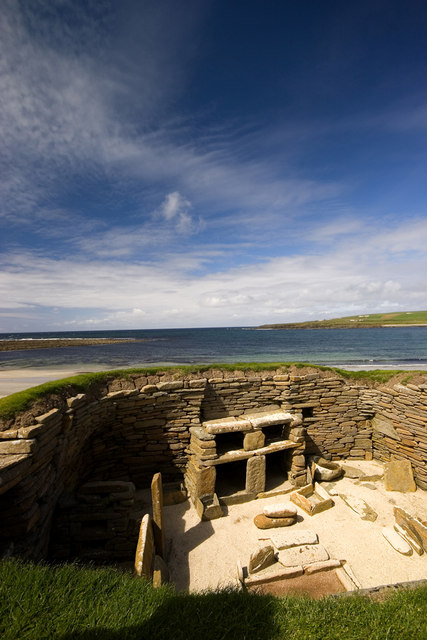
Skara Brae
Skara Brae is a stone-built Neolithic settlement, located on the Bay of Skaill on the west coast of Mainland, the largest island in the Orkney archipelago. It consists of eight clustered houses, and was occupied from roughly 3180 BCE–2500 BCE. Europe's most complete Neolithic village, Skara Brae gained UNESCO World Heritage Site status as one of four sites making up "The Heart of Neolithic Orkney".
Photo credit: craig w macgregor -

Arbroath Harbour
Arbroath or Aberbrothock (Scottish Gaelic: Obair Bhrothaig) is a former royal burgh on the North Sea coast, around 16 miles (25.7 km) ENE of Dundee and 45 miles (72.4 km) SSW of Aberdeen. It is the largest town in the council area of Angus. and has a population of 22,785.
Photo credit: Karen Vernon -

Coire nan Lochan on the southern side of Glen Coe
Glen Coe ((Scottish Gaelic: Gleann Comhann) is a glen in the Highlands. It lies in the southern part of the Lochaber committee area of Highland Council, and was formerly part of the county of Argyll.
Photo credit: Gil.cavalcanti -

Crail Harbour
Crail is a former royal burgh in the East Neuk of Fife. Built around a harbour, it has a particular wealth of vernacular buildings from the 17th to early 19th centuries, many restored by the National Trust for Scotland, and is a favourite subject for artists.
Photo credit: S.moeller -

36-inch telescope at the Royal Observatory, Edinburgh
36-inch telescope at the Royal Observatory on Blackford Hill, Edinburgh, the location of the UK Astronomy Technology Centre (UK ATC).
Photo credit: Science and Technology Facilities Council -

Comon seal basking on rocks
A common seal (Phoca vitulina) seen basking on rocks off Lismore, Argyll.
Photo credit: Sharp Photography -

Statue of Robert the Bruce, Bannockburn
Robert the Bruce statue at the Bannockburn Visitor Centre, Bannockburn, Stirling, is a 1964 work by Pilkington Jackson. The bronze sculpture depicts Robert the Bruce wielding an axe and on a war horse.
Photo credit: Martin Kraft -

Wemyss Bay railway station.
Wemyss Bay railway station is a railway station on the Inverclyde Line. Located in the village of Wemyss Bay, Inverclyde. The station incorporates the terminal for the Caledonian MacBrayne ferry connecting the mainland to Rothesay on the Isle of Bute.
Photo credit: wilm -

Glasgow University main building with Dumgoyne and the Campsie Fells in the background
Autumnal view of Glasgow University main building with Dumgoyne and the Campsie Fells in the background
Photo credit: Ian Dick -

Meall a' Bhùiridh and Lochan na h-Achlaise as seen from the A82 road driving towards Glen Coe
Meall a' Bhùiridh and Lochan na h-Achlaise on Rannoch Moor viewed from the A82 en route to Glen Coe in the HIghlands..
Photo credit: Fuzzy14 -

The gates of the Bruichladdich Distillery
The Bruichladdich distillery is a distillery on the Rhinns of the isle of Islay in Scotland. The distillery produces mainly single malt Scotch whisky, but has also offered artisanal gin.
Photo credit: Bdcl1881 -

Ben Vorlich and Loch Tay seen from Ben Lawers
Sunrise over Ben Vorlich , a mountain in the Southern Highlands and Loch Tay, the largest body of fresh water in Perth and Kinross.
Photo credit: Michal Klajban -

Overview of Holyrood Palace
Holyrood Palace is the official residence of the British monarch in Scotland. Located at the bottom of the Royal Mile in Edinburgh, at the opposite end to Edinburgh Castle, Holyrood has served as the principal royal residence in Scotland since the 16th century, and is a setting for state occasions and official entertaining.
Photo credit: Christoph Strässler -
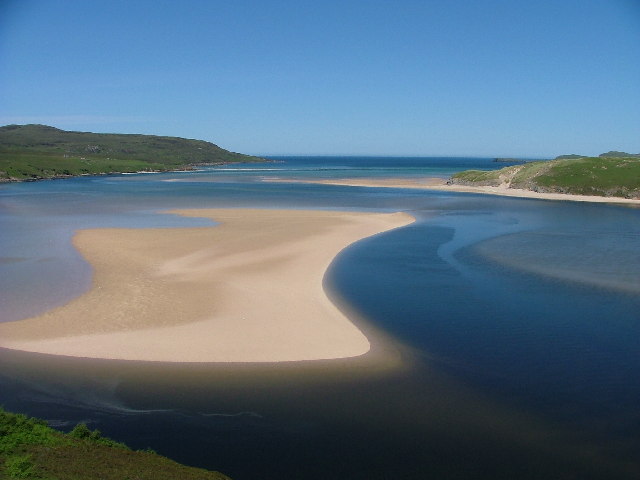
Kyle of Durness
Durness (Scottish Gaelic: Diùirnis) is a huge but remote parish in the northwestern Highlands, encompassing all the land between the Moine to the East (separating it from Tongue parish) and the Gualin to the West (separating it from Eddrachilis).
Photo credit: Neil Booth
Feb2007.jpg)

.jpg)


.jpg)


.jpg)

.jpg)
_2.jpg)


_(cropped).jpg)


.jpg)

Did You Know...

- ... that Thomas Kerr protested the Iraq War with his SNP-supporting aunt, later campaigned for Labour, joined the Conservatives, and defected to Reform UK?
- ... that a lane behind a tenement in Edinburgh is decorated as a Wild West town?
- ... that Prince Philip was the first member of the British royal family to fly in a helicopter?
- ... that the Scottish judge Lord Duthie served as an officer in the Royal Naval Reserve?
- ... that the unlicensed Willy's Chocolate Experience in Scotland led to a crossover event between the American television series Abbott Elementary and It's Always Sunny in Philadelphia?
- ... that Carrbridge Packhorse Bridge is the oldest-known stone bridge in the Scottish Highlands?
- ... that before Michael Shanks became Member of Parliament for Rutherglen and Hamilton West, he ran along all of Glasgow's 6,143 streets?
- ... that East Suffolk Park, a former student hostel in Edinburgh, was once an internment camp for enemy aliens?
Get involved


For editor resources and to collaborate with other editors on improving Wikipedia's Scotland-related articles, see WikiProject Scotland.
To get involved in helping to improve Wikipedia's Scotland related content, please consider doing some of the following tasks or joining one or more of the associated Wikiprojects:
- Visit the Scottish Wikipedians' notice board and help to write new Scotland-related articles, and expand and improve existing ones.
- Visit Wikipedia:WikiProject Scotland/Assessment, and help out by assessing unrated Scottish articles.
- Add the Project Banner to Scottish articles around Wikipedia.
- Participate in WikiProject Scotland's Peer Review, including responding to PR requests and nominating Scottish articles.
- Help nominate and select new content for the Scotland portal.
Do you have a question about The Scotland Portal that you can't find the answer to?
Post a question on the Talk Page or consider asking it at the Wikipedia reference desk.
Related portals



Other language versions
Associated Wikimedia
The following Wikimedia Foundation sister projects provide more on this subject:
-
 Commons
Free media repository -
 Wikibooks
Free textbooks and manuals -
 Wikidata
Free knowledge base -
 Wikinews
Free-content news -
 Wikiquote
Collection of quotations -
 Wikisource
Free-content library -
 Wikispecies
Directory of species -
 Wikiversity
Free learning tools -
 Wikivoyage
Free travel guide -
 Wiktionary
Dictionary and thesaurus


