Wiki Article
Portal:Cities
Nguồn dữ liệu từ Wikipedia, hiển thị bởi DefZone.Net

The Cities Portal


A city is a human settlement of a substantial size. The term "city" has different meanings around the world and in some places the settlement can be very small. Even where the term is limited to larger settlements, there is no universally agreed definition of the lower numerical boundary for their size. In a more specific sense, a city can be defined as a permanent and densely populated place with administratively defined boundaries whose members work primarily on non-agricultural tasks. Cities generally have extensive systems for housing, transportation, sanitation, utilities, land use, production of goods, and communication. Their density facilitates interaction between people, government organizations, and businesses, sometimes benefiting different parties in the process, such as improving the efficiency of goods and service distribution.
Historically, city dwellers have been a small proportion of humanity overall, but following two centuries of unprecedented and rapid urbanization, more than half of the world population now lives in cities, which has had profound consequences for global sustainability. Present-day cities usually form the core of larger metropolitan areas and urban areas—creating numerous commuters traveling toward city centres for employment, entertainment, and education. However, in a world of intensifying globalization, all cities are to varying degrees also connected globally beyond these regions. This increased influence means that cities also have significant influences on global issues, such as sustainable development, climate change, and global health. Because of these major influences on global issues, the international community has prioritized investment in sustainable cities through Sustainable Development Goal 11. Due to the efficiency of transportation and the smaller land consumption, dense cities hold the potential to have a smaller ecological footprint per inhabitant than more sparsely populated areas. Therefore, compact cities are often referred to as a crucial element in fighting climate change. However, this concentration can also have some significant harmful effects, such as forming urban heat islands, concentrating pollution, and stressing water supplies and other resources. (Full article...)
Selected city -

Pristina (or Prishtina; UK: /ˈpriːʃtɪnə, prɪʃˈtiːnə/ PREE-shtin-ə, prish-TEE-nə, US: /ˈprɪʃtɪnə/ PRISHT-in-ə) is the capital and largest city of Kosovo. It is the administrative center of the eponymous municipality and district.
In antiquity, the area of Pristina was part of the Dardanian Kingdom. The heritage of the classical era is represented by the settlement of Ulpiana. After the Roman Empire was divided into a western and an eastern half, the area remained within the Byzantine Empire between the 5th and 9th centuries. In the middle of the 9th century, it was ceded to the First Bulgarian Empire, before falling again under Byzantine occupation in the early 11th century and then in the late 11th century to the Second Bulgarian Empire. The growing Kingdom of Serbia annexed the area in the 13th century and it remained under the Serbian Empire in the 14th century up to the start of the Ottoman era (1389–1455). City was capital of Serbian lord family of Branković. The next centuries would be characterized by Ottoman rule. During this period, Pristina developed from a village to a major urban center of the region. Following the end of the First Balkan War in 1914, it became a part of the newly formed Kingdom of Serbia. In 1948, it was chosen as the capital of the province SAP Kosovo under the statehood of Yugoslavia. Furthermore, Pristina would continue to serve as the capital of Kosovo after its 2008 independence from Serbia. (Full article...)
Did you know -
- ... that the U.S. Supreme Court ruled that plans for a New York City office tower could be rejected?
- ... that 32 former members of the city council of Bogor, Indonesia, were convicted of corruption in 2010, including 3 who were still serving?
- ... that New York City's Bartow–Pell Mansion became a museum after its operator was restricted from importing and exporting plants?
- ... that Alaíde Foppa used the airwaves of Mexico City to launch a feminist "forum for women"?
- ... that the city council of Bandung in the Dutch East Indies initially met at the site of a former coffee-packing factory?
- ... that the East River Generating Station in New York City was opened by the Queen of Romania?
Related portals


Related WikiProjects

 Recognized content -


Odense (/ˈoʊdənsə/ OH-dən-sə, US also /ˈoʊθənsə/ OH-thən-sə; Danish: [ˈoðˀn̩sə] ⓘ) is the third largest city in Denmark (after Copenhagen and Aarhus) and the largest city on the island of Funen. As of 1 January 2026, the city proper had a population of 187,558 while Odense Municipality had a population of 213,168, making it the fourth largest municipality in Denmark (behind Copenhagen, Aarhus and Aalborg municipalities). Eurostat and OECD have used a definition for the Metropolitan area of Odense (referred to as a Functional urban area), which includes all municipalities in the Province (Danish: landsdel) of Funen (Danish: Fyn), with a total population of 504,066 as of 1 July 2022.
By road, Odense is located 45 kilometres (28 mi) north of Svendborg, 144 kilometres (89 mi) to the south of Aarhus and 167 kilometres (104 mi) to the southwest of the capital Copenhagen. The city was the seat of Odense County until 1970, and Funen County from 1970 until 1 January 2007, when Funen County became part of the Region of Southern Denmark. Odense has close associations with Hans Christian Andersen or HCA who is remembered above all for his fairy tales. He was born in the city in 1805 and spent his childhood years there. (Full article...)
Selected article -

Co-op City (short for Cooperative City) is a cooperative housing development located in the northeast section of the borough of the Bronx in New York City, New York, U.S. It is bounded by Interstate 95 to the southwest, west, and north and the Hutchinson River Parkway to the east and southeast, and is partially in the Baychester and Eastchester neighborhoods. With 43,752 residents as of the 2010 United States census, it is the largest housing cooperative in the world. It is in New York City Council District 12.
The Co-op City site was marshland before being occupied by an amusement park called Freedomland U.S.A. from 1960 to 1964. Construction began in 1966 and the first residents moved in two years later, though the project was not completed until 1973. The construction of the community was sponsored by the United Housing Foundation and financed with a mortgage loan from New York State Housing Finance Agency. (Full article...)
General images -
-
 A poster from the EPA entitled "Soak Up the Rain with Green Infrastructure." The poster depicts various green infrastructure that can be effective in preventing floods. (from Urban geography)
 -
 A map showing the world energy consumption per capita based on 2013 data from the World Bank. (from Urban geography)
 -
 Daily life of people from the Song period at the capital, Bianjing, today's Kaifeng (from History of cities)
 -
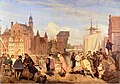 Gdańsk in the 17th century (from History of cities)
 -
 This woodcut shows Nuremberg as a prototype of a flourishing and independent city in the 15th century. (from History of cities)
 -
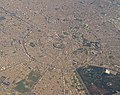 The city of Arbil in the Kurdistan Region of Iraq has a radial urban structure centred on an ancient fortress (from Urban structure)
 -

-
 New York City, one of the largest urban areas in the world (from Urban geography)
 -
 Aerial photograph shows the remains of the Sumerian city Ur, near Nasiriyah, Iraq. (from History of cities)
 -
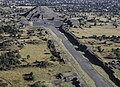 The Avenue of the Dead in Teotihuacan originates with the Pyramid of the Moon, forming the basis of the city grid. (from History of cities)
 -
 View of the Agora of Athens with the temple of Hephaestus to the left and the Stoa of Attalos to the right (from History of cities)
 -
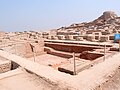 Mohenjo-daro, a World Heritage Site that was part of the Indus Valley Civilization (from History of cities)
 -
 Palmanova, Italy, constructed in 1593 according to the defensive ideal of the star fort, today retains its distinctive geometry. (from History of cities)
 -
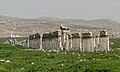
-
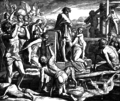 Cain founding the city of Enoch (from History of cities)
 -
 Constantinople, the largest and wealthiest city in Europe from the 9th through the 12th century (from History of cities)
 -
 Extent and major sites of the Indus Valley Civilization of ancient India (from History of cities)
 -
 The Round city of Baghdad, the capital of Iraq (from History of cities)
 -
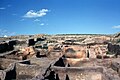 Excavated foundations of Çatalhöyük, Turkey. An Anatolian town dated to 7000 BCE. (from History of cities)


.jpg)


_LACMA_M.2008.40.98.8.jpg)
_from_the_east_corner_of_the_86th_Floor_Observatory_of_the_Empire_State_Building_in_Manhattan,_New_York_City,_New_York.jpg)


Topics


List articles
Subcategories

Associated Wikimedia
The following Wikimedia Foundation sister projects provide more on this subject:
-
 Commons
Free media repository -
 Wikidata
Free knowledge base -
 Wikiquote
Collection of quotations -
 Wikisource
Free-content library -
 Wikiversity
Free learning tools -
 Wiktionary
Dictionary and thesaurus


