Wiki Article
Portal:Liberalism
Nguồn dữ liệu từ Wikipedia, hiển thị bởi DefZone.Net

The Liberalism portal
Liberalism is a political and moral philosophy based on the rights of the individual, liberty, consent of the governed, political equality, right to private property, and equality before the law. Different liberals espouse various and sometimes conflicting views depending on their understanding of these principles but generally support liberal democracy, private property, market economies, individual rights (including civil rights and human rights), secularism, rule of law, economic and political freedom, freedom of speech, freedom of the press, freedom of assembly, and freedom of religion. Liberalism is frequently cited as the dominant ideology of modern history.
Liberalism became a distinct movement in the Age of Enlightenment, gaining popularity among Western philosophers and economists. Liberalism sought to replace the norms of hereditary privilege, state religion, absolute monarchy, the divine right of kings, and traditional conservatism with representative democracy, rule of law, and equality under the law. Liberals also ended mercantilist policies, royal monopolies, and other trade barriers, instead promoting free trade and marketization. The philosopher John Locke is often credited with founding liberalism as a distinct tradition based on the social contract, arguing that each man has a natural right to life, liberty and property, and governments must not violate these rights. While the British liberal tradition emphasized expanding democracy, French liberalism emphasized rejecting authoritarianism. (Full article...)
Selected article -
The Liberal Democrats, colloquially known as the Lib Dems, is a political party in the United Kingdom. Ideologically adhering to liberalism, it was founded in 1988. The party is based at Liberal Democrat Headquarters, which since September 2025 has been located at Buckingham Gate, in the Westminster area of Central London. The party's leader is Ed Davey. It is the third-largest party in the United Kingdom, with 72 members of Parliament (MPs) in the House of Commons. It has 74 members of the House of Lords, 10 in the Scottish Parliament, 1 in the Welsh Senedd, and around 3,200 local council seats. The party holds a twice yearly Liberal Democrat Conference, at which policy is formulated. In contrast to its main opponents, the Lib Dems grant all members attending Conference the right to vote on policy, under a one member, one vote system. As well as voting in the Conference Hall, the party allows its members to vote online for its policies and leadership elections. Members are also free to join organisations representing strands of party thinking, such as Liberal Reform and Social Liberal Forum, and for those under 30 years, Young Liberals.
In 1981, an electoral alliance was established between the Liberal Party, a group which descended from the 18th-century Whigs, and the Social Democratic Party (SDP), a splinter group from the Labour Party. In 1988, the parties merged as the Social and Liberal Democrats, adopting their present name a year later. Under the leaderships of Paddy Ashdown and Charles Kennedy, the party grew in the 1990s and 2000s, focusing its campaigns on specific seats and retained the third-largest party status in the House of Commons, although with significantly more seats than the predecessor Liberal Party. In the 1997 election, the Liberal Democrats doubled their seat count to 46. In 2010, under Nick Clegg's leadership, the Lib Dems were junior partners in the Conservative-led coalition government, in which Clegg served as deputy prime minister. Though it allowed the party to implement some of its policies, the coalition damaged its electoral standing; it lost 48 of its 56 MPs at the 2015 general election, which relegated it to fourth-largest party in the House of Commons. Under the leaderships of Tim Farron, Vince Cable and Jo Swinson, the party refocused as a pro-Europeanist party opposing Brexit. In the 2019 general election, the party garnered 11.5% of the vote on an anti-Brexit platform, but this did not translate into seat gains. However, the party's success was renewed under the leadership of Ed Davey, winning hundreds of councillors and 72 MPs in the 2024 general election, its highest result since 1923, and resuming its status as the third largest party in the House of Commons. (Full article...)
Selected biography -

David Lloyd George, 1st Earl Lloyd-George of Dwyfor (17 January 1863 – 26 March 1945), was Prime Minister of the United Kingdom from 1916 to 1922. A Liberal Party politician from Wales, he was known for leading the United Kingdom during the First World War, for social-reform policies, for his role in the Paris Peace Conference, and for negotiating the establishment of the Irish Free State.
Born in Chorlton-on-Medlock, Manchester, and raised in Llanystumdwy, Lloyd George gained a reputation as an orator and proponent of a Welsh blend of radical Liberal ideas that included support for Welsh devolution, the disestablishment of the Church of England in Wales, equality for labourers and tenant farmers, and reform of land ownership. He won an 1890 by-election to become the Member of Parliament for Caernarvon Boroughs, and was continuously re-elected to the seat for 55 years. He served in Henry Campbell-Bannerman's cabinet from 1905. After H. H. Asquith succeeded to the premiership in 1908, Lloyd George replaced him as Chancellor of the Exchequer. To fund extensive welfare reforms, he proposed taxes on land ownership and high incomes in the 1909 People's Budget, which the Conservative-dominated House of Lords rejected. The resulting constitutional crisis was only resolved after elections in 1910 and passage of the Parliament Act 1911. His budget was enacted in 1910, with the National Insurance Act 1911 and other measures helping to establish the modern welfare state. He was embroiled in the 1913 Marconi scandal but remained in office and secured the disestablishment of the Church of England in Wales. (Full article...)
List of selected biographies
|
|---|
Selected quote

General images
-

-
 The US federal minimum wage if it had kept pace with productivity compared to the actual wage (from Neoliberalism)
 -
 Unemployment in Chile and South America (1980–1990) (from Neoliberalism)
 -
 Member nations of the International Monetary Fund (from Neoliberalism)
 -
 Builders in West Berlin, 1952 (from Neoliberalism)
 -
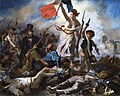 The iconic painting Liberty Leading the People by Eugène Delacroix, a tableau of the July Revolution in 1830 (from Liberalism)
 -
 Execution of José María de Torrijos y Uriarte and his men in 1831 as Spanish King Ferdinand VII took repressive measures against the liberal forces in his country (from Liberalism)
 -

-
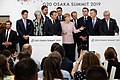 The European Union–Mercosur free trade agreement, which would form one of the world's largest free trade areas, has been denounced by environmental activists and indigenous rights campaigners. (from Neoliberalism)
 -
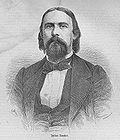 Julius Faucher (from Liberalism)
 -
 Per capita income during the Great Depression (from Neoliberalism)
 -
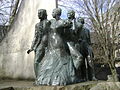 Monument to the liberals of the 19th century in Agra del Orzán neighborhood, La Coruña, Galicia (Spain) (from Liberalism)
 -
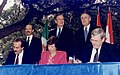 U.S. President Bush, Canadian PM Mulroney, and Mexican President Salinas participate in the ceremonies to sign the North American Free Trade Agreement (NAFTA). (from Neoliberalism)
 -
 Sismondi, who wrote the first critique of the free market from a liberal perspective in 1819 (from Liberalism)
 -

-
 Raif Badawi, a Saudi Arabian writer and the creator of the website Free Saudi Liberals, who was sentenced to ten years in prison and 1,000 lashes for "insulting Islam" in 2014 (from Liberalism)
 -
 As a liberal nationalist, K. J. Ståhlberg (1865–1952), the President of Finland, anchored the state in liberal democracy, guarded the fragile germ of the rule of law, and embarked on internal reforms. (from Liberalism)
 -
 John Maynard Keynes, one of the most influential economists of modern times and whose ideas, which are still widely felt, formalized modern liberal economic policy (from Liberalism)
 -
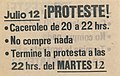 Pamphlet calling for a protest of economic policy in 1983 following the economic crisis (from Neoliberalism)
 -
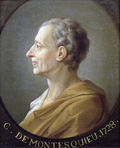
-
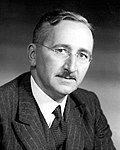 Friedrich Hayek (from Neoliberalism)
 -
 Benjamin Constant, a Franco-Swiss political activist and theorist (from Liberalism)
 -
 Ronald Reagan (left) and Margaret Thatcher (right) were responsible for the popularisation of Neoliberalism. (from Neoliberalism)
 -
 Chilean (orange) and average Latin American (blue) rates of growth of GDP (1971–2007) (from Neoliberalism)
 -
 T. H. Green, an influential liberal philosopher who established in Prolegomena to Ethics (1884) the first major foundations for what later became known as positive liberty and in a few years, his ideas became the official policy of the Liberal Party in Britain, precipitating the rise of social liberalism and the modern welfare state (from Liberalism)
 -
 John Locke was the first to develop a liberal philosophy, including the right to private property and the consent of the governed. (from Liberalism)
 -
 The 2017–2018 Russian protests were organized by Russia's liberal opposition. (from Liberalism)
 -
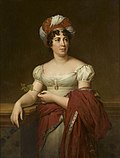 Madame de Staël (from Liberalism)
 -
 Ludwig Erhard (from Neoliberalism)
 -
 Gustave de Molinari (from Liberalism)
 -
 United States incarceration rate per 100,000 population, 1925–2014 (from Neoliberalism)
 -
 GDP per capita in Chile and Latin America 1950–2010 (time under Pinochet highlighted) (from Neoliberalism)
 -
 Wealth inequality in the United States increased from 1989 to 2013. (from Neoliberalism)
 -
 Franklin D. Roosevelt (from Liberalism)
 -
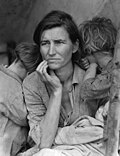 The Great Depression, with its periods of worldwide economic hardship, formed the backdrop against which the Keynesian Revolution took place (the image is Dorothea Lange's Migrant Mother depiction of destitute pea-pickers in California, taken in March 1936). (from Liberalism)
.jpg)


.jpg)

.jpg)
_b_269.jpg)


.png)

.jpg)


,_%C3%A9crivain_et_homme_politique_-_P1679_-_Mus%C3%A9e_Carnavalet_(cropped).jpg)
.jpg)


.jpg)


_(1).jpg)

Subcategories

Related portals


WikiProjects

Topics

Recognized content


Associated Wikimedia
The following Wikimedia Foundation sister projects provide more on this subject:
-
 Commons
Free media repository -
 Wikidata
Free knowledge base -
 Wikiquote
Collection of quotations -
 Wikisource
Free-content library -
 Wikiversity
Free learning tools -
 Wiktionary
Dictionary and thesaurus


