Wiki Article
NGC 1073
Nguồn dữ liệu từ Wikipedia, hiển thị bởi DefZone.Net
| NGC 1073 | |
|---|---|
 NGC 1073 imaged by the Liverpool Telescope | |
| Observation data (J2000 epoch) | |
| Constellation | Cetus |
| Right ascension | 02h 43m 40.5199s[1] |
| Declination | +01° 22′ 34.104″[1] |
| Redshift | 0.004013±0.00000667[1] |
| Heliocentric radial velocity | 1203 ± 2 km/s[1] |
| Distance | 47.1 ± 3.4 Mly (14.45 ± 1.04 Mpc)[1] |
| Apparent magnitude (V) | 11.5[1] |
| Characteristics | |
| Type | SB(rs)c[1] |
| Apparent size (V) | 4.9′ × 4.5′[1] |
| Other designations | |
| IRAS 02411+0109, 2MASX J02434059+0122331, UGC 2210, MCG +00-08-001, PGC 10329, CGCG 389-002[1] | |
NGC 1073 is a barred spiral galaxy in the constellation Cetus. The galaxy is estimated to be about 55 million light years from Earth, possess a disk spanning an estimated 80,000 light years in diameter, and likely contains a type of active core, called an HII nucleus.[2][3] It was discovered by German-British astronomer William Herschel on 9 October 1785.[4]
NGC 1073 is similar to the Milky Way only in their shared possession of a galactic bar. NGC 1073, however, does not possess the well-defined symmetrical arm structure the Milky Way exhibits, and retains a central bar larger than our home galaxy's.[5] NGC 1073 can be viewed with a mid-sized telescope in rural, dark skies.
Supernova
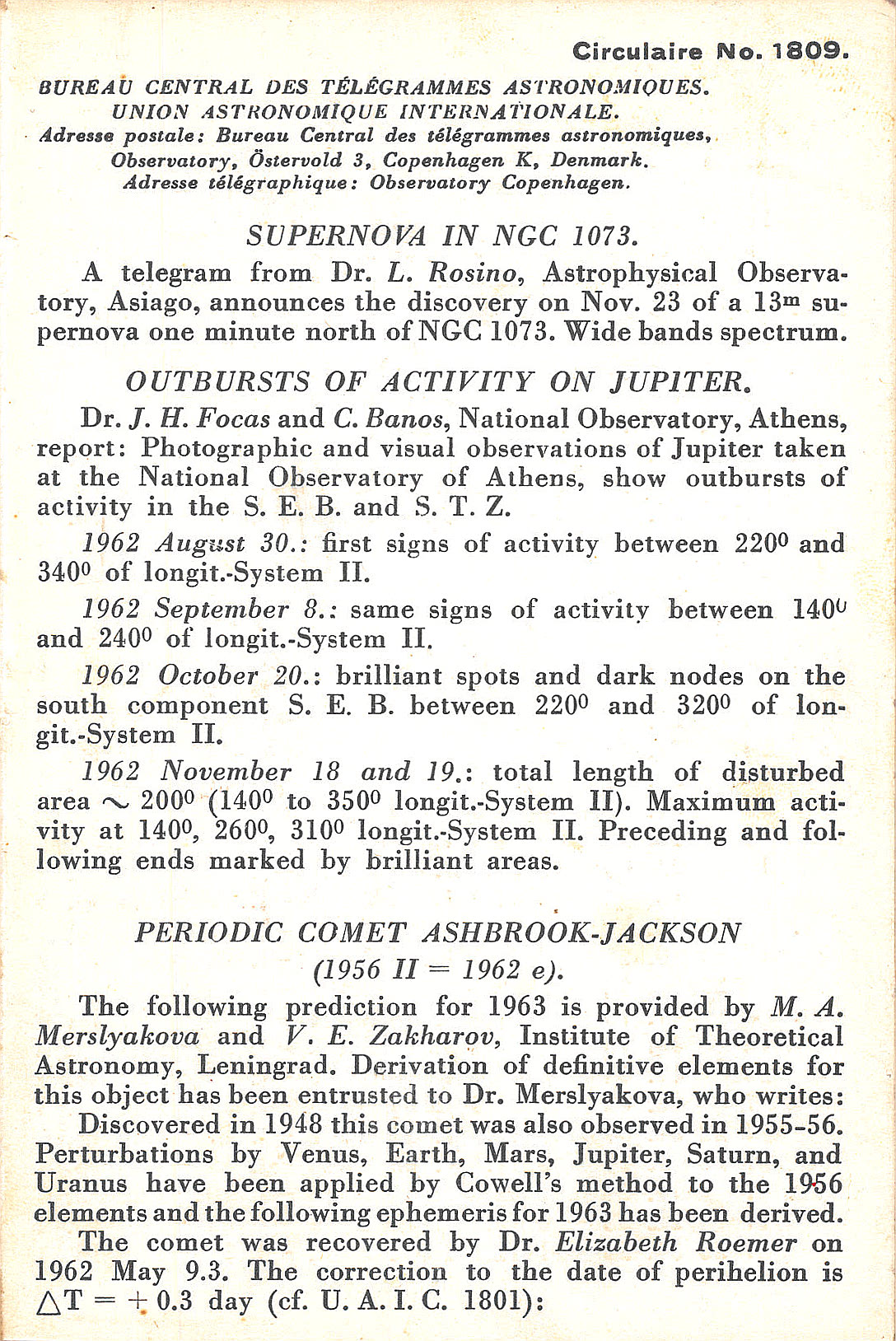
[edit]One supernova has been observed in NGC 1073: SN 1962L (Type Ic, mag. 13.9) was discovered by Leonida Rosino on 23 November 1962,[6] and independently by Enrique Chavira and Guillermo Haro.[7]
References
[edit]- ^ a b c d e f g h i "Results for object NGC 1073". NASA/IPAC Extragalactic Database. NASA and Caltech. Retrieved February 25, 2007.
- ^ Ho, Luis C.; Filippenko, Alexei V.; Sargent, Wallace L. W. (October 1997), "A Search for "Dwarf" Seyfert Nuclei. III. Spectroscopic Parameters and Properties of the Host Galaxies", Astrophysical Journal Supplement, vol. 112, no. 2, pp. 315–390, arXiv:astro-ph/9704107, Bibcode:1997ApJS..112..315H, doi:10.1086/313041, S2CID 17086638
- ^ Staff (3 February 2012). "Hubble Telescope Spies Milky Way Galaxy's Twin". Space.com. Retrieved 3 February 2012.
- ^ Seligman, Courtney. "New General Catalogue Objects: NGC 1073". Celestial Atlas. Retrieved 26 May 2026.
- ^ National Radio Astronomy Observatory Milky Way
- ^ Rosino, L. (3 December 1962). Thernöe, K. A. (ed.). "SUPERNOVA IN NGC 1073". Central Bureau for Astronomical Telegrams. 1809. Smithsonian Astrophysical Observatory, IAU: 1. Retrieved 1 December 2024.
- ^ "SN 1962L". Transient Name Server. IAU. Retrieved 1 December 2024.
External links
[edit]
- NGC 1073 on WikiSky: DSS2, SDSS, GALEX, IRAS, Hydrogen α, X-Ray, Astrophoto, Sky Map, Articles and images
- Video (01:18)


 | This barred spiral galaxy article is a stub. You can help Wikipedia by adding missing information. |