Wiki Article
NGC 4564
Nguồn dữ liệu từ Wikipedia, hiển thị bởi DefZone.Net
| NGC 4564 | |
|---|---|
 NGC 4564 imaged by Sloan Digital Sky Survey | |
| Observation data (J2000 epoch) | |
| Constellation | Virgo |
| Right ascension | 12h 36m 26.9913s[1] |
| Declination | +11° 26′ 21.266″[1] |
| Redshift | 0.003809[1] |
| Heliocentric radial velocity | 1142 km/s[1] |
| Distance | 57.2 Mly (17.55 Mpc)[1] |
| Group or cluster | Virgo Cluster |
| Apparent magnitude (V) | 12.05[1] |
| Characteristics | |
| Type | E6[1] |
| Size | ~63,200 ly (19.38 kpc) (estimated)[1] |
| Apparent size (V) | 3.5′ × 1.5′[1] |
| Other designations | |
| VCC 1664, UGC 7773, MCG +02-32-150, PGC 42051, CGCG 070-186[1] | |
NGC 4564 is an elliptical galaxy located about 57 million light-years away[2] in the constellation Virgo.[3] NGC 4564 was discovered by astronomer William Herschel on March 15, 1784.[4][5] The galaxy is also a member of the Virgo Cluster.[6][7]
NGC 4564 has an estimated population of 213 ± 31 globular clusters.[8] It is the host of a supermassive black hole with an estimated mass of about 56 million suns (0.56+0.03
−0.08×10⁸ M☉).[9]
Supernova
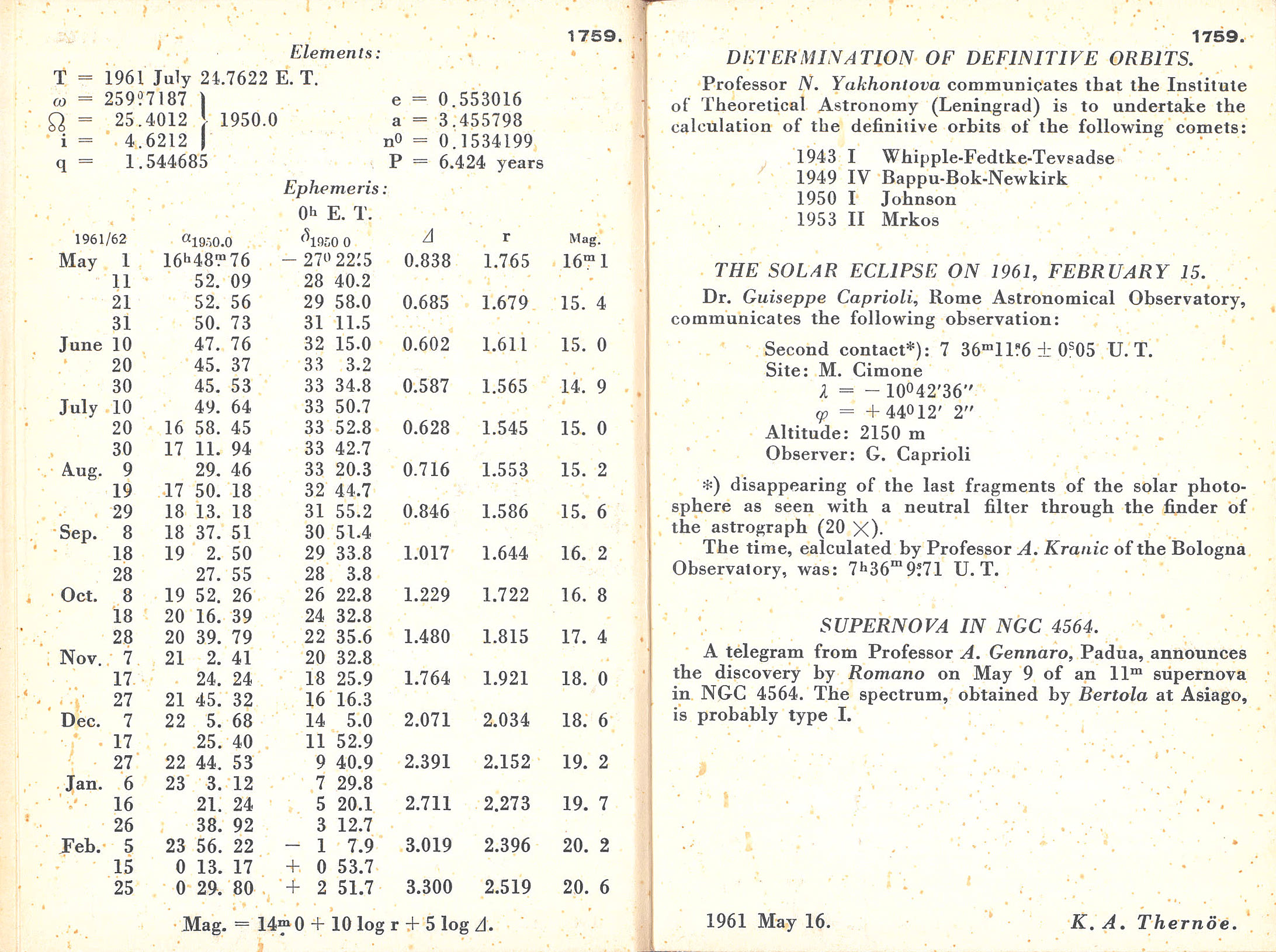
[edit]One supernova has been observed in NGC 4564: SN 1961H (type unknown, mag. 11.2) was discovered by Italian amateur astronomer Giuliano Romano on 2 May 1961.[10][11] A spectrum taken indicated that it was probably of Type I.[10]
See also
[edit]References
[edit]- ^ a b c d e f g h i j "Results for object NGC 4564". NASA/IPAC Extragalactic Database. NASA and Caltech. Retrieved 2018-02-04.
- ^ "Your NED Search Results". ned.ipac.caltech.edu. Retrieved 2018-02-04.
- ^ "Revised NGC Data for NGC 4564". spider.seds.org. Retrieved 2018-02-04.
- ^ Herschel, W. (1786). "Catalogue of One Thousand New Nebulae and Clusters of Stars". Philosophical Transactions of the Royal Society of London. 76: 457–499. Bibcode:1786RSPT...76..457H. doi:10.1098/rstl.1786.0027.
- ^ "New General Catalog Objects: NGC 4550 - 4599". cseligman.com. Retrieved 2018-02-04.
- ^ "The Virgo Cluster". www.atlasoftheuniverse.com. Retrieved 2018-02-04.
- ^ "Detailed Object Classifications". ned.ipac.caltech.edu. Retrieved 2018-02-04.
- ^ Rhode, Katherine L. (2012). "Exploring the Correlations between Globular Cluster Populations and Supermassive Black Holes in Giant Galaxies". The Astronomical Journal. 144 (5): 154. arXiv:1210.4570. Bibcode:2012AJ....144..154R. doi:10.1088/0004-6256/144/5/154. hdl:2022/19083. ISSN 1538-3881. S2CID 118565802.
- ^ Soria, R.; Graham, Alister W.; Fabbiano, G.; Baldi, A.; Elvis, M.; Jerjen, H.; Pellegrini, S.; Siemiginowska, A. (2006). "Accretion and Nuclear Activity of Quiescent Supermassive Black Holes. II. Optical Study and Interpretation". The Astrophysical Journal. 640 (1): 143–155. arXiv:astro-ph/0511341. Bibcode:2006ApJ...640..143S. doi:10.1086/499935. ISSN 0004-637X. S2CID 14584649.
- ^ a b Gennaro, A.; Romano; Bertola (16 May 1961). Thernöe, K. A. (ed.). "Circular No. 1759". Central Bureau for Astronomical Telegrams. 1759. Observatory Copenhagen, IAU: 3. Retrieved 30 November 2024.
- ^ "Other Supernovae images". www.rochesterastronomy.org. Retrieved 2018-02-04.
External links
[edit]
Wikimedia Commons has media related to NGC 4564.
- NGC 4564 on WikiSky: DSS2, SDSS, GALEX, IRAS, Hydrogen α, X-Ray, Astrophoto, Sky Map, Articles and images