This is a Featured article, which represents some of the best content on English Wikipedia..
Image 1
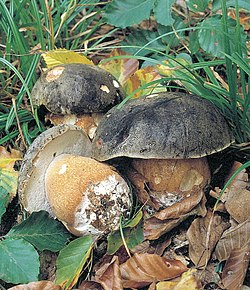
Boletus aereus, commonly known as the queen bolete, dark cep, or bronze bolete, is a species of fungus in the family Boletaceae. Described in 1789 by French mycologist Pierre Bulliard, it is closely related to several other European boletes, including B. reticulatus, B. pinophilus, and the popular B. edulis. Some populations in North Africa have in the past been classified as a separate species, B. mamorensis, which has been shown to be phylogenically conspecific to B. aereus and is now regarded as a synonym. (Full article...)
Image 2
Italy during the contemporary conflicts, that included the War of the League of Cambrai
Muhammad II (Arabic: محمد الثاني) (also known by the epithet al-Faqih, "the canon-lawyer", c. 1235 – 8 April 1302; reigned from 1273 until his death) was the second Nasrid ruler of the Emirate of Granada in Al-Andalus on the Iberian Peninsula, succeeding his father, Muhammad I. Already experienced in matters of state when he ascended the throne, he continued his father's policy of maintaining independence in the face of Granada's larger neighbours, the Christian kingdom of Castile and the Muslim Marinid state of Morocco, as well as an internal rebellion by his family's former allies, the Banu Ashqilula. (Full article...)
Image 4
Nasr (1 November 1287 – 16 November 1322), full name Abu al-Juyush Nasr ibn Muhammad (Arabic: أبو الجيوش نصر بن محمد), was the fourth Nasrid ruler of the Emirate of Granada from 14 March 1309 until his abdication on 8 February 1314. He was the son of Muhammad II al-Faqih and Shams al-Duha. He ascended the throne after his brother Muhammad III was dethroned in a palace revolution. At the time of his accession, Granada faced a three-front war against Castile, Aragon and the Marinid Sultanate, triggered by his predecessor's foreign policy. He made peace with the Marinids in September 1309, ceding to them the African port of Ceuta, which had already been captured, as well as Algeciras and Ronda in Europe. Granada lost Gibraltar to a Castilian siege in September, but successfully defended Algeciras until it was given to the Marinids, who continued its defense until the siege was abandoned in January 1310. James II of Aragon sued for peace after Granadan defenders defeated the Aragonese siege of Almería in December 1309, withdrawing his forces and leaving the Emirate's territories by January. In the ensuing treaty, Nasr agreed to pay tributes and indemnities to Ferdinand IV of Castile and yield some border towns in exchange for seven years of peace. (Full article...)
Europejara is a genus of tapejarid pterosaur that lived during the Barremian age of the Early Cretaceous epoch in what is now Spain. The only known specimen was found at the Las Hoyas site of Cuenca, a location noted for its exceptional Konservat-Lagerstätte preservation. In 2012, the new genus and speciesEuropejara olcadesorum was named based on it. The generic name refers to Europe, where it was found, and to the related genus Tapejara from what is now Brazil, while the specific name refers to the Olcades, an ancient people that lived in the region. The holotype specimen consists of an incomplete, crushed skull; the bones of the postorbital region are displaced while the mandible is almost complete. (Full article...)
Image 6
The western Mediterranean in 218BC
The Second Punic War (218 to 201 BC) was the second of three wars fought between Carthage and Rome, the two main powers of the western Mediterranean in the 3rd century BC. For 17 years the two states struggled for supremacy, primarily in Italy and Iberia, but also on the islands of Sicily and Sardinia and, towards the end of the war, in North Africa. After immense materiel and human losses on both sides, the Carthaginians were once again defeated. Macedonia, Syracuse and several Numidian kingdoms were drawn into the fighting, and Iberian and Gallic forces fought on both sides. There were three main military theatres during the war: Italy, where Hannibal defeated the Roman legions repeatedly, with occasional subsidiary campaigns in Sicily, Sardinia and Greece; Iberia, where Hasdrubal, a younger brother of Hannibal, defended the Carthaginian colonial cities with mixed success before moving into Italy; and Africa, where Rome finally won the war. (Full article...)
Image 7
Map of the Greek and Latin states in southern Greece c. 1278
Abu'l-Walid Ismail I ibn Faraj (3March 1279 – 8July 1325) was the fifth Nasrid ruler of the Emirate of Granada on the Iberian Peninsula from 1314 to 1325. A grandson of MuhammadII on the side of his mother Fatima, he was the first of the lineage of sultans now known as the al-dawla al-isma'iliyya al-nasriyya (lit.'the Nasrid dynasty of Ismail'). Historians characterise him as an effective ruler who improved the emirate's position with military victories during his reign. (Full article...)
Image 10
El Alma al Aire (transl.The Bared Soul) is the sixth studio album by Spanish singer-songwriter Alejandro Sanz. It was released on 25 September 2000 by Warner Music Spain, following the success of Más (1997) and his hiatus from the music scene in 1999. El Alma al Aire is a pop album, which in comparison to its predecessor, leans more towards ballads. The album was produced by Sanz's frequent collaborator Emanuele Ruffinengo, while other musicians, including Vicente Amigo, returned to collaborate with him following Más. (Full article...)
Image 11
The Third of May 1808 in Madrid (commonly known as The Third of May 1808) and also known, in Spanish, as El tres de mayo de 1808 en Madrid or Los fusilamientos de la montaña del Príncipe Pío, or Los fusilamientos del tres de mayo, is a painting completed in 1814 by the Spanish painter Francisco Goya. In the work, Goya sought to commemorate Spanish resistance to Napoleon's armies during the occupation of Madrid in 1808 at the start of the Peninsular War. Along with its companion piece of the same size, The Second of May 1808 (or The Charge of the Mamelukes), it was commissioned by the provisional government of Spain at Goya's own suggestion shortly after the ousting of the French occupation and the restoration of King Ferdinand VII. (Full article...)
Image 12
Shekel minted by the Libyans during the war, depicting Herakles and a lion, with the legend ΛIBYΩN ("the Libyans"). Above the lion, the Phoenician letter M could stand for Mathos, a leader of the rebellion.
The Mercenary War, also known as the Truceless War, was a mutiny by troops that were employed by Carthage at the end of the First Punic War (264–241 BC), supported by uprisings of African settlements revolting against Carthaginian control. It lasted from 241 to late 238 or early 237 BC and ended with Carthage suppressing both the mutiny and the revolt. (Full article...)
Image 13
Lombardy in 1522. The location of the battle is marked.
The Lince (Spanish pronunciation:[ˈlinθe], meaning "Lynx") was a Spanish development programme for a proposed main battle tank that unfolded during the late 1980s and early 1990s. The intention was to replace the M47 and M48 Patton tanks that the Spanish Army had received under the U.S. Mutual Defense Assistance Act between 1954 and 1975, and to complement the AMX-30E tanks manufactured for the army during the 1970s. Companies from several nations, such as German Krauss-Maffei, Spanish Santa Bárbara, and French GIAT, made bids for the development contract. The main priorities were mobility and firepower, with secondary priority placed on protection; the Lince tank was to have been lighter and faster than its competitors. To achieve a sufficient level of firepower and protection, the Lince was to use Rheinmetall's120 mm L/44 tank-gun and German composite armour from the Leopard 2A4. (Full article...)
Witches' Sabbath or The Great He-Goat (Spanish: Aquelarre or El gran cabrón) are names given to an oilmural by the Spanish artist Francisco de Goya, completed sometime between 1820 and 1823. It depicts a Witches' Sabbath and evokes themes of violence, intimidation, ageing and death; Satan hulks in the form of a goat in moonlit silhouette over a coven of terrified old witches. Goya was then around 75 years old, living alone and suffering from acute mental and physical distress. (Full article...)
Image 17
The Western Mediterranean just before the start of the war in 264 BC: Rome is shown in red, Carthage in grey, and Syracuse in green
The First Punic War (264–241 BC) was the first of three wars fought between Rome and Carthage, the two main powers of the western Mediterranean in the early 3rd century BC. For 23 years, in the longest continuous conflict and greatest naval war of antiquity, the two powers struggled for supremacy. The war was fought primarily on the Mediterranean island of Sicily and its surrounding waters, and also in North Africa. After immense losses on both sides, the Carthaginians were defeated and Rome gained territory from Carthage. (Full article...)
Image 18
Hieronymus Bosch, The Garden of Earthly Delights, oil on oak panels, 205.5 cm × 384.9 cm (81 in × 152 in), Museo del Prado, Madrid
The Garden of Earthly Delights (Dutch: De tuin der lusten, lit.'The garden of lusts') is the modern title given to a five-panel triptych (three oil-painted panels when open, two oak panels when closed) by the Early Netherlandish master Hieronymus Bosch, between 1490 and 1510, when Bosch was between 40 and 60 years old. Because of Bosch's religious beliefs, interpretations of the work typically assume it is a warning against the perils of temptation. The outer panels place the work on the Third Day of Creation. The intricacy of its symbolism, particularly that of the central panel, has led to a wide range of scholarly interpretations over the centuries. (Full article...)
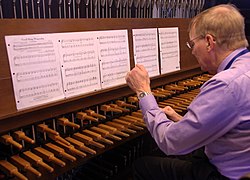
A carillonist plays the 56-bell carillon of the Plummer Building, Rochester, Minnesota, US A carillon is a pitched percussion instrument that is played with a keyboard and consists of at least 23 bells. The bells are cast in bronze, hung in fixed suspension, and tuned in chromatic order so that they can be sounded harmoniously together. They are struck with clappers connected to a keyboard of wooden batons played with the hands and pedals played with the feet. Often housed in bell towers, carillons are usually owned by churches, universities, or municipalities. They can include an automatic system through which the time is announced and simple tunes are played throughout the day. (Full article...)
Image 21
Muhammad III (Arabic: محمد الثالث; 15 August 1257 – 21 January 1314) was the ruler of the Emirate of Granada in Al-Andalus on the Iberian Peninsula from 8 April 1302 until 14 March 1309, and a member of the Nasrid dynasty. He ascended the Granadan throne after the death of his father Muhammad II, which according to rumours, was caused by Muhammad III poisoning him. He had the reputation of being both cultured and cruel. Later in his life, he became visually impaired—which caused him to be absent from many government activities and to rely on high officials, especially the powerful VizierIbn al-Hakim al-Rundi. (Full article...)
The Leopardo 2E or Leopard 2A6E (E stands for España (Spanish for 'Spain')) is a variant of the German Leopard 2 main battle tank (specifically the Leopard 2A6 variant), tailored to the requirements of the Spanish army, which acquired it as part of an armament modernization program named Programa Coraza, or Program Cuirass. The acquisition program for the Leopard 2E began in 1994, five years after the cancellation of the Lince tank program that culminated in an agreement to transfer 108 Leopard 2A4s to the Spanish army in 1998 and started the local production of the Leopard 2E in December 2002. Despite postponement of production owing to the 2003 merger between Santa Bárbara Sistemas and General Dynamics, and continued manufacturing issues between 2006 and 2007, 219 Leopard 2Es have been delivered to the Spanish army. (Full article...)
The European rabbit (Oryctolagus cuniculus) or coney is a species of rabbit native to the Iberian Peninsula and southwestern France. It has been introduced to hundreds of locations around the world. Wild and domesticated European rabbits around the world can vary widely in size, shape, and colour. The average adult European rabbit is smaller than the European hare, though size and weight vary with habitat and diet. (Full article...)
Image 24
Spanish entry routes to Petén during the 17th century, overlaid with the route that Hernán Cortés took in 1525
The Spanish conquest of Petén was the last stage of the conquest of Guatemala, a prolonged conflict during the Spanish colonisation of the Americas. A wide lowland plain covered with dense rainforest, Petén contains a central drainage basin with a series of lakes and areas of savannah. It is crossed by several ranges of low karstic hills and rises to the south as it nears the Guatemalan Highlands. The conquest of Petén, a region now incorporated into the modern republic of Guatemala, climaxed in 1697 with the capture of Nojpetén, the island capital of the Itza kingdom, by Martín de Ursúa y Arizmendi. With the defeat of the Itza, the last independent and unconquered native kingdom in the Americas fell to European colonisers. (Full article...)
Sebastián Francisco de Miranda y Rodríguez (March 28, 1750 – July 14, 1816), commonly known as Francisco de Miranda, was a Venezuelanrevolutionary. Although his own plans for the independence of the Spanish American colonies failed, he is regarded as a forerunner of Simón Bolívar, who during the South American wars of independence successfully liberated a vast portion of South America. Miranda led a romantic and adventurous life. An idealist, he developed a visionary plan to liberate and unify all of Spanish America. His military initiatives failed in 1812, and he was handed over to his enemies, dying four years later in a Spanish prison dungeon. Within fourteen years of his death, most of Spanish America was independent.
A Río Nervión patrol boat of the Civil Guard, pictured moving along the waters of Bilbao. The Spanish civil guard was created in numerous different stages between 1835 and 1844, and was established as an operational force in 1855.
Ana Santos Aramburo (born 1957) has been the director of the National Library of Spain since February 2013. Having received a degree in geography and history from the University of Zaragoza in Spain, she has spent much of her career working at the Complutense University of Madrid, first at the library of the Faculty of Economics and Business Sciences, and later serving as deputy director of the university library. Later she served as Director of the Historical Library Marquis of Valdecilla, General Director of Libraries and Archives of the City of Madrid, and Director of Cultural Action at the National Library. This photograph of Santos shows her at the headquarters of the National Library of Spain in Madrid.
The Alhambra (Arabic: الحمراء = Al-Ħamrā; literally "the red") is a palace and fortress complex of the Moorish monarchs of Granada in southern Spain (known as Al-Andalus when the fortress was constructed), occupying a hilly terrace on the southeastern border of the city of Granada.
Gaspar de Guzmán, Count-Duke of Olivares (1587–1645) was a Spanish royal favourite of Philip IV and minister. As prime minister from 1621 to 1643, he over-exerted Spain in foreign affairs and unsuccessfully attempted domestic reform. His policies of committing Spain to recapture the Dutch Republic led to his major involvement in the Thirty Years War. This portrait was completed in 1634, with its composition referring to Olivares' military leadership in the service of King Philip.
Ferdinand I, Holy Roman Emperor, is represented in this anonymous portrait as a young archduke in his native Spain. He left Spain in his early twenties, to start his life as future King of the Romans and successor to his grandfather, Maximilian I. His older brother Charles eventually succeeded as Holy Roman Emperor, but Ferdinand was elected after Charles's abdication. Philip, Charles's son, inherited Spain and became King Philip II of Spain. Ferdinand ruled between 1558 and 1564, for nearly six years.
The Puente Nuevo, whose name means "new bridge" in Spanish, is the newer and larger of two bridges that span the 120m-deep chasm that divides the city of Ronda in southern Spain.
An overturned tourer caravan which was damaged by the effects of Tropical Storm Delta (2005). Considerable other damage was caused to other areas of the Canary Islands during the storm.
Moros is a municipality in the province of Zaragoza, Spain. Located in the Sistema Ibérico mountain range, the village lies on a hill, with the church and former town hall at the top, the residences in the middle, and the sheep pens at the bottom. The population of Moros has been steadily decreasing in recent decades, and was 478 in 2006.
The Monument to Alfonso XII is located in Buen Retiro Park (El Retiro) in Madrid, Spain. Measuring 30 m (98 ft) high, 86 m (282 ft) long, and 58 m (190 ft) wide, it has at its center an equestrian statue of King Alfonso XII, cast in bronze by the Spanish sculptor Mariano Benlliure in 1904. The monument is situated on the eastern edge of an artificial lake near the center of the park and was inaugurated on 6 June 1922.
The peaks of the Central Massif overlook the village of Sotres in Cabrales, located in the Picos de Europa, a mountain range in northern Spain forming part of the Cantabrian Mountains. The name (literally: "Peaks of Europe") is believed to derive from being the first European landforms visible to mariners arriving from the Americas.
The Madrid Metro is a rapid transit system serving the Spanish capital, Madrid. It was inaugurated in 1919 by King Alfonso, with a single line which ran for 3.48 km (2.16 mi) between Puerta del Sol and Cuatro Caminos, with eight stops. The present system has 301 stations on 13 lines plus one branch line, totalling 294 km (183 mi).
The Spanish painted frog (Discoglossus jeanneae) is a species of frog in the family Alytidae. Endemic to Spain, it mostly lives in open areas, pine groves and shrublands. It feeds mostly on insects and worms.
The Cathedral of Seville, formally Catedral de Santa María de la Sede (Cathedral of Saint Mary of the See) was begun in 1402, with construction continuing into the 16th century. It is the largest of all Roman Catholic cathedrals (Saint Peter's Basilica not being a cathedral) and also the largest MedievalGothic religious building, in terms of both area and volume.
The Mediterranean campaign of 1798 was a series of major naval operations surrounding a French expeditionary force sent to Egypt under Napoleon Bonaparte during the French Revolutionary Wars. The French Republic sought to capture Egypt as the first stage in an effort to threaten British India and support Tipu Sultan, and thus force Great Britain to make peace. Departing Toulon in May 1798 with over 40,000 troops and hundreds of ships, Bonaparte's fleet sailed southeastwards across the Mediterranean Sea. They were followed by a small British squadron under Rear-Admiral Sir Horatio Nelson, later reinforced to 13 ships of the line, whose pursuit was hampered by a lack of scouting frigates and reliable information. Bonaparte's first target was the island of Malta, which was under the government of the Knights of St. John and theoretically granted its owner control of the Central Mediterranean. Bonaparte's forces landed on the island and rapidly overwhelmed the defenders, securing the port city of Valletta before continuing to Egypt. When Nelson learned of the French capture of the island, he guessed the French target to be Egypt and sailed for Alexandria, but passed the French during the night of 22 June without discovering them and arrived off Egypt first. (Full article...)
Image 3
Conquistador Pedro de Alvarado led the initial efforts to conquer Guatemala.The Spanish conquest of the Maya was a protracted conflict during the Spanish colonisation of the Americas, in which the Spanish conquistadores and their allies gradually incorporated the territory of the Late PostclassicMaya states and polities into the colonial Viceroyalty of New Spain. The Maya occupied the Maya Region, an area that is now part of the modern countries of Mexico, Guatemala, Belize, Honduras and El Salvador; the conquest began in the early 16th century and is generally considered to have ended in 1697. (Full article...)
The bombing on 31 May 1906 The Morral affair was the attempted regicide of Spanish King Alfonso XIII and his bride, Queen Victoria Eugenie, on their wedding day, 31 May 1906, and its subsequent effects. The attacker, Mateu Morral, acting on a desire to spur revolution, threw a bomb concealed in a floral bouquet from a Madrid hotel window as the King's procession passed, killing 24 bystanders and soldiers and wounding over 100 others, while leaving the royals unscathed. Morral sought refuge from republican journalist José Nakens but fled in the night to Torrejón de Ardoz, whose villagers reported the interloper. Two days after the attack, militiamen accosted Morral, who killed one before killing himself. Morral was likely involved in a similar attack on the king a year earlier. (Full article...)
Spain was represented at the Eurovision Song Contest 2013 with the song "Contigo hasta el final", written by Raquel del Rosario, David Feito, and Juan Luis Suárez, and performed by themselves under their stage name ESDM. The Spanish participating broadcaster, Radiotelevisión Española (RTVE), selected its entry through a national final, after having previously selected the band internally. RTVE announced ESDM as its representative on 17 December 2012, while the national final El Sueño de Morfeo: Destino Eurovisión was organised in order to select the song ESDM would perform. Three songs, one selected through an Internet public vote, competed in the televised show where an in-studio jury and a public televote selected "Contigo hasta el final" as the winning song. (Full article...)
Image 9
A collage of photos taken of Agotes in Bozate [es] at the beginning of the 20th Century
The Cagots (pronounced[ka.ɡo]) were a persecuted minority who lived in the west of France and northern Spain: the NavarresePyrenees, Basque provinces, Béarn, Aragón, Gascony and Brittany. Evidence of the group exists as far back as 1000 CE. The name they were known by varied across the regions where they lived. (Full article...)
Image 10
"Miente" (English: "Lie") is a song by Spanish singer Enrique Iglesias from his second studio album, Vivir (1997). The song was written and produced by Rafael Pérez-Botija. It was released as the third single from the album in 1997. An uptempopoppower ballad backed by a piano and percussion, the song deals with the singer being in denial about a relationship ending. (Full article...)
The Jiloca (Spanish pronunciation:[xiˈloka]) is a river in Aragón, Spain, a tributary of the river Jalón, and part of the watershed of the Ebro basin. The course of the river runs through the provinces of Teruel and Zaragoza. It has a length of 126 kilometres (78 mi) and an average flow rate of 2.1 cubic metres per second (74 cu ft/s), although this varies between the seasons. The river flows in a generally north easterly direction from its source near Monreal del Campo. (Full article...)
The Mudéjar revolt of 1264–1266 was a rebellion by the Muslim populations (Mudéjares) in the Lower Andalusia and Murcia regions of the Crown of Castile. The rebellion was in response to Castile's policy of relocating Muslim populations from these regions and was partially instigated by Muhammad I of Granada. The rebels were aided by the independent Emirate of Granada, while the Castilians were allied with Aragon. Early in the uprising, the rebels managed to capture Murcia and Jerez, as well as several smaller towns, but were eventually defeated by the royal forces. Subsequently, Castile expelled the Muslim populations of the reconquered territories and encouraged Christians from elsewhere to settle their lands. Granada became a vassal of Castile and paid an annual tribute. (Full article...)
Émilienne Léontine Morin (29 October 1901 – 14 February 1991) was a French anarchist activist, journalist and stenographer. Born into an anarcho-syndicalist family, she joined the French anarchist movement at an early age, going on to write for its newspapers and contribute to anarchist legal defence campaigns. In 1927, she met and fell in love with Buenaventura Durruti, a Spanish anarchist in whose legal defence she had participated. She followed him to Belgium, where she lived a semi-clandestine life until the proclamation of the Second Spanish Republic. She then moved to Barcelona and joined the National Confederation of Labour (CNT). Morin struggled in her new home due to a lack of understanding the Spanish language, the sexism expressed by many Spanish male anarchists, and Durruti's prolonged absence from her life. She raised their child, Colette, as a single parent, as Durruti spent most of the subsequent years in exile or prison. Following the outbreak of the Spanish Civil War, she joined her companion on the Aragon front, where she was an administrator for the Durruti Column. Morin left Spain with her daughter when Durruti was killed in action during the Siege of Madrid. She remained active among the Spanish exiles until her retirement and later became a key primary source about her companion's life. (Full article...)
Image 23
The current Basque coat of arms (Euskal autonomi erkidegoaren armarria) is the official coat of arms of the Basque Country, an autonomous community of Spain. It consists of a party per cross representing the three historical territories of Álava, Gipuzkoa and Biscay, as well as a fourth, void quarter. The arms are ringed by a regal wreath of oak leaves, symbolic of the Gernikako Arbola. The fourth quarter constituted since the late 19th century the linked chains of Navarre; however, following a legal suit by the Navarre Government claiming that the usage of the arms of a region on the flag of another was illegal, the Constitutional Court of Spain ordered the removal of the chains of Navarre in a judgement of 1986. (Full article...)
Image 24
Pic-Nic was a Spanish teenage folk-pop and sunshine pop band formed in Barcelona in the mid-to-late 1960s, composed of lead singer Jeanette, guitarists Toti Soler and Al Cárdenas, drummer Jordi Barangé and bassist Isidoro "Doro" de Mentaberry. Although keyboardist Jordi Sabatés is often mentioned as a member of the band, he does not appear on any of the group's releases, having joined after their only published recording sessions had taken place. Pic-Nic was the successor to the short-lived group Brenner's Folk, originally founded by German-Venezuelan brothers Haakon and Vytas Brenner together with Soler, Barangé and Jeanette, an English girl who had recently moved to Spain after being raised in the United States. After releasing a four-song extended play for the label Edigsa in 1966, the Brenner brothers left the band, being replaced by Cárdenas and de Mentaberry. (Full article...)
The Phoenician shipwrecks of Mazarrón are two wrecks dated to the 7th century BC, found off the coast of Mazarrón, in the Region of Murcia, Spain. The shipwreck site was identified in 1988 by archaeologists from the Spanish National Museum of Maritime Archaeology and the National Center for Underwater Archaeological Research. In July 1991, the remains of a first ship, dubbed Mazarrón I, were identified, and has undergone excavation, extraction, and restoration since 1993. It is currently on display at the Museum of Underwater Archaeology in Cartagena. The second shipwreck, dubbed Mazarrón II, was discovered in 1994, and was found in a better state of preservation. After years of study, its was extracted in November 2024. (Full article...)
Image 5El paseo de las Delicias, a 1784–1785 painting by Ramón Bayeu depicting a meeting of members of the aristocracy in the aforementioned location. (from History of Spain)
Image 6The Port of Seville in the late 16th century. Seville became one of the most populous and cosmopolitan European cities after the expeditions to the New World. (from History of Spain)
Image 14Royal Site of San Lorenzo de El Escorial. Built between 1563 and 1584 by order of King Philip II, it is the largest Renaissance building in the world. (from Spanish Golden Age)
Image 28The pro-independence forces delivered a crushing defeat to the royalists and secured the independence of Peru in the 1824 battle of Ayacucho. (from History of Spain)
Image 401894 satirical cartoon depicting the tacit accord for seamless government change (turnismo) between the leaders of two dynastic parties (Sagasta and Cánovas del Castillo), with the country being lied in an allegorical fashion. (from History of Spain)

.svg)
 Featured article –





.png)


.png)

.jpg)


.jpeg)


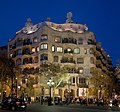 Photo credit: David IliffThe Casa Milà, a 1912 work by Catalán architect Antoni Gaudi, in the Eixample district of Barcelona, Spain. Gaudí's fascination with trencadís-influenced decoration and curves (predating biomorphism by almost 20 years) can be seen here.
 Photograph credit: Biblioteca Nacional de EspañaAna Santos Aramburo (born 1957) has been the director of the National Library of Spain since February 2013. Having received a degree in geography and history from the University of Zaragoza in Spain, she has spent much of her career working at the Complutense University of Madrid, first at the library of the Faculty of Economics and Business Sciences, and later serving as deputy director of the university library. Later she served as Director of the Historical Library Marquis of Valdecilla, General Director of Libraries and Archives of the City of Madrid, and Director of Cultural Action at the National Library. This photograph of Santos shows her at the headquarters of the National Library of Spain in Madrid.

 Gaspar de Guzmán, Count-Duke of Olivares (1587–1645) was a Spanish royal favourite of Philip IV and minister. As prime minister from 1621 to 1643, he over-exerted Spain in foreign affairs and unsuccessfully attempted domestic reform. His policies of committing Spain to recapture the Dutch Republic led to his major involvement in the Thirty Years War. This portrait was completed in 1634, with its composition referring to Olivares' military leadership in the service of King Philip.
 Artist: UnknownFerdinand I, Holy Roman Emperor, is represented in this anonymous portrait as a young archduke in his native Spain. He left Spain in his early twenties, to start his life as future King of the Romans and successor to his grandfather, Maximilian I. His older brother Charles eventually succeeded as Holy Roman Emperor, but Ferdinand was elected after Charles's abdication. Philip, Charles's son, inherited Spain and became King Philip II of Spain. Ferdinand ruled between 1558 and 1564, for nearly six years.
 Photo credit: David IliffThe Tagus River, seen here passing through the World Heritage listed city of Toledo, Spain. It is the longest river on the Iberian Peninsula at 1,038 kilometres (645 mi). It begins its journey in the Albarracín mountains in Spain, and follows a very constricted course for much of its length before reaching the Atlantic Ocean in Portugal.

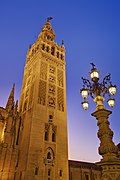 Photo: David IliffThe Giralda is a 104.5 m (343 ft) tall bell tower for the Seville Cathedral in Seville, Andalusia, Spain. It was originally constructed as a minaret in 1198, when Seville was ruled by the Almohad Caliphate. After the city was taken by the Christians in the Reconquista, the city's mosque was converted to a church. The upper third of the structure was completed during the Spanish Renaissance.
 Photograph: Diego DelsoMoros is a municipality in the province of Zaragoza, Spain. Located in the Sistema Ibérico mountain range, the village lies on a hill, with the church and former town hall at the top, the residences in the middle, and the sheep pens at the bottom. The population of Moros has been steadily decreasing in recent decades, and was 478 in 2006.
 Architecture credit: José Grases Riera; photographed by Carlos DelgadoThe Monument to Alfonso XII is located in Buen Retiro Park (El Retiro) in Madrid, Spain. Measuring 30 m (98 ft) high, 86 m (282 ft) long, and 58 m (190 ft) wide, it has at its center an equestrian statue of King Alfonso XII, cast in bronze by the Spanish sculptor Mariano Benlliure in 1904. The monument is situated on the eastern edge of an artificial lake near the center of the park and was inaugurated on 6 June 1922.
 The peaks of the Central Massif overlook the village of Sotres in Cabrales, located in the Picos de Europa, a mountain range in northern Spain forming part of the Cantabrian Mountains. The name (literally: "Peaks of Europe") is believed to derive from being the first European landforms visible to mariners arriving from the Americas.
 Photograph: Diego DelsoThe Assut de l'Or Bridge is a white single-pylon cable-stayed bridge in the City of Arts and Sciences, Valencia, Spain. Completed in 2008, it was designed by Valencian architect and civil engineer Santiago Calatrava as a variant of his cantilever spar cable-stayed bridge in Seville.
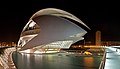 Photo credit: David IliffThe Queen Sofia Palace of the Arts (Valencian: Palau de les Arts Reina Sofía) is an opera house located in Valencia, Spain. The last to be completed of the City of Arts and Sciences complex, it was designed by architect Santiago Calatrava. The 14-story structure opened on 8 October 2005.
 Painting: Francisco GoyaThe Third of May 1808 is a painting completed in 1814 by the Spanish master Francisco Goya, now in the Museo del Prado, Madrid. Along with its companion piece of the same size, The Second of May 1808 (or The Charge of the Mamelukes), it was commissioned by the provisional government of Spain at Goya's suggestion. Goya sought to commemorate Spanish resistance to Napoleon's armies during the Peninsular War.
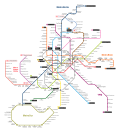 The Madrid Metro is a rapid transit system serving the Spanish capital, Madrid. It was inaugurated in 1919 by King Alfonso, with a single line which ran for 3.48 km (2.16 mi) between Puerta del Sol and Cuatro Caminos, with eight stops. The present system has 301 stations on 13 lines plus one branch line, totalling 294 km (183 mi).
 Image: Royal Household of Spain; Restoration: Lise BroerA Grant of Arms by Philip II of Spain to Alonso de Mesa and Hernando de Mesa, signed 25 November 1566. In Spanish heraldry, coats of arms were granted based almost entirely on military service, which made it possible for commoners to join the ranks of the Spanish nobility. Also unique to Spain was that titles could be inherited through females and via illegitimacy.
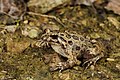 Photograph: Benny TrappThe Spanish painted frog (Discoglossus jeanneae) is a species of frog in the family Alytidae. Endemic to Spain, it mostly lives in open areas, pine groves and shrublands. It feeds mostly on insects and worms.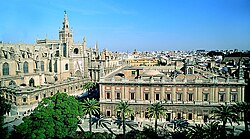


.jpg)
_02b.jpg)


.jpg)


_jeannaea.jpg)

 Good article –


.jpg)


.jpg)


.jpg)


.jpg)
 Cabeza de Luis Buñuel, sculptor's work by Iñaki, in the center Buñuel Calanda. (from Culture of Spain)
 Execution of Torrijos and his men in 1831. Ferdinand VII took repressive measures against the liberal forces in his country. (from History of Spain)
 Plaza Mayor built in 1619 during the reign of Philip III (from Spanish Golden Age)
 El paseo de las Delicias, a 1784–1785 painting by Ramón Bayeu depicting a meeting of members of the aristocracy in the aforementioned location. (from History of Spain)
 The Port of Seville in the late 16th century. Seville became one of the most populous and cosmopolitan European cities after the expeditions to the New World. (from History of Spain)
 Inner view of Granada Cathedral (from Spanish Golden Age)
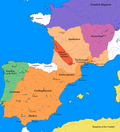 The greatest extent of the Visigothic Kingdom of Toulouse, c. 500, showing Territory lost after Vouillé in light orange (from History of Spain)
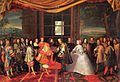 Louis XIV of France and Philip IV of Spain at the Meeting on the Isle of Pheasants in June 1660, part of the process to put an end to the Franco-Spanish War (1635–59). (from History of Spain)
 Jamón ibérico (from Culture of Spain)
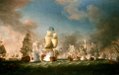 The Battle of Cape Passaro, 11 August 1718 (from History of Spain)
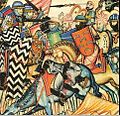 A battle of the Reconquista from the Cantigas de Santa Maria (from History of Spain)
 Royal Site of San Lorenzo de El Escorial. Built between 1563 and 1584 by order of King Philip II, it is the largest Renaissance building in the world. (from Spanish Golden Age)
 An 18th-century map of the Iberian Peninsula (from History of Spain)
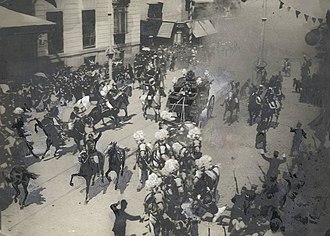
 Celebrations of the proclamation of the 2nd Republic in Barcelona. (from History of Spain)
 Visigothic church, San Pedro de la Nave. Zamora. Spain (from History of Spain)
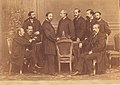 Members of the provisional government after the 1868 Glorious Revolution, by Jean Laurent. (from History of Spain)
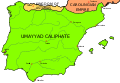 al-Andalus at its greatest extent, 720 (from History of Spain)
 The Virgin of the Rosary (1675–80) by Bartolomé Esteban Murillo (from Spanish Golden Age)
 Ethnology of the Iberian Peninsula c. 200 BC (from History of Spain)
 The Third of May 1808, Napoleon's troops shoot hostages. Goya (from History of Spain)
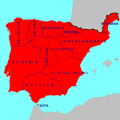 Visigothic Hispania and its regional divisions in 700, prior to the Muslim conquest (from History of Spain)
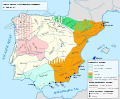 The Iberian Peninsula in the 3rd century BC (from History of Spain)
 The promulgation of the Constitution of 1812, oil painting by Salvador Viniegra. (from History of Spain)
 Contemporary printing of the sheet music for Tomás Luis de Victoria's Officium Defunctorum (from Spanish Golden Age)
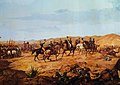 The pro-independence forces delivered a crushing defeat to the royalists and secured the independence of Peru in the 1824 battle of Ayacucho. (from History of Spain)
 Recognition of the Duke of Anjou as King of Spain, under the name of Philip V, November 16, 1700 (from History of Spain)
 Taking of Oran by Francisco Jiménez de Cisneros in 1509. (from History of Spain)
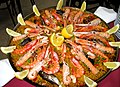 Paella mixta (from Culture of Spain)
 Felipe González signing the treaty of accession to the European Economic Community on 12 June 1985. (from History of Spain)
 The Defence of Cádiz Against the English oil on canvas by Francisco de Zurbarán (from Spanish Golden Age)
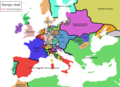 A map of Europe in 1648, after the Peace of Westphalia (from History of Spain)
 The title page of the Gramática de la lengua castellana (1492), the first grammar of a modern European language to be published. (from History of Spain)
 Panoramic view of the lower level patio of the Palace (from Spanish Golden Age)

 1894 satirical cartoon depicting the tacit accord for seamless government change (turnismo) between the leaders of two dynastic parties (Sagasta and Cánovas del Castillo), with the country being lied in an allegorical fashion. (from History of Spain)
 Visigothic King Roderic haranguing his troops before the Battle of Guadalete (from History of Spain)
 People's militias attacking on a Rebel position in Somosierra in the early stages of the war. (from History of Spain)
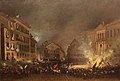 Episode of the 1854 Spanish Revolution in the Puerta del Sol, by Eugenio Lucas Velázquez. (from History of Spain)
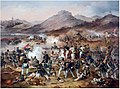 Battle of the First Carlist War, by Francisco de Paula Van Halen (from History of Spain)
 Proclamation of the Spanish Republic in Madrid (from History of Spain)
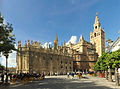 Cathedral of Saint Mary of the See in Sevilla. (from Culture of Spain)
 Map of territories that were once part of the Spanish Empire (from History of Spain)
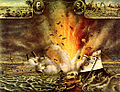 The explosion of the USS Maine launched the Spanish–American War in April 1898 (from History of Spain)

![Image 52Detail of the votive crown of Recceswinth from the Treasure of Guarrazar, (Toledo-Spain) hanging in Madrid. The hanging letters spell [R]ECCESVINTHVS REX OFFERET [King R. offers this]. (from History of Spain)](//upload.wikimedia.org/wikipedia/commons/thumb/f/f2/Corona_de_%2829049230050%29.jpg/60px-Corona_de_%2829049230050%29.jpg) Detail of the votive crown of Recceswinth from the Treasure of Guarrazar, (Toledo-Spain) hanging in Madrid. The hanging letters spell [R]ECCESVINTHVS REX OFFERET [King R. offers this]. (from History of Spain)
Detail of the votive crown of Recceswinth from the Treasure of Guarrazar, (Toledo-Spain) hanging in Madrid. The hanging letters spell [R]ECCESVINTHVS REX OFFERET [King R. offers this]. (from History of Spain) The Conquest of Tenochtitlán (from History of Spain)
 Charles I of Spain (better known in the English-speaking world as the Holy Roman Emperor Charles V) was the most powerful European monarch of his day. (from History of Spain)
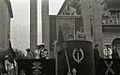 Franco visiting Tolosa in 1948 (from History of Spain)
 The Second of May 1808 was the beginning of the popular Spanish resistance against Napoleon. (from History of Spain)
 Wedding portrait of the Catholic Monarchs (from History of Spain)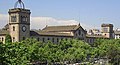
 Ruins of Guernica (from History of Spain)

 The realms of Philip II of Spain (from Spanish Golden Age)
 Roman Empire, 3rd century (from History of Spain)
 Two women and a man during the siege of the Alcázar (from History of Spain)
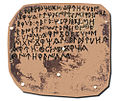 Illustration depicting the (now lost) Luzaga's Bronze, an example of the Celtiberian script. (from History of Spain)
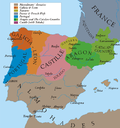 The Christian kingdoms of Hispania and the Islamic Almohad empire c. 1210
 Façade of the Cathedral of Valladolid (from Spanish Golden Age)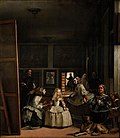
 Landing of Columbus by John Vanderlyn, 1847. Christopher Columbus leads expedition to the New World, 1492, sponsored by Spanish crown (from History of Spain)
 The successful 1925 Alhucemas landing turned the luck in the Rif War towards Spain's favour. (from History of Spain)

.jpg)


.jpg)


.jpg)


.jpg)


.jpg)


.jpeg)


.jpg)

.JPG)


.svg)


_El_ingenioso_hidalgo_Don_Quixote_de_la_Mancha.png)
![Image 52Detail of the votive crown of Recceswinth from the Treasure of Guarrazar, (Toledo-Spain) hanging in Madrid. The hanging letters spell [R]ECCESVINTHVS REX OFFERET [King R. offers this]. (from History of Spain)](/wiki/File:Corona_de_(29049230050).jpg)


_-_Fondo_Car-Kutxa_Fototeka.jpg)

.jpg)


_en_Prins_Juan_Carlos,_Bestanddeelnr_254-9762.jpg)


_(cropped).jpg)


.svg)

 Commons
 Wikidata
 Wikiquote
 Wikisource
 Wikiversity
 Wikivoyage
 Wiktionary


